30-day satisfaction guarantee or your money back
Call us : +33 257 880 074
 en
en 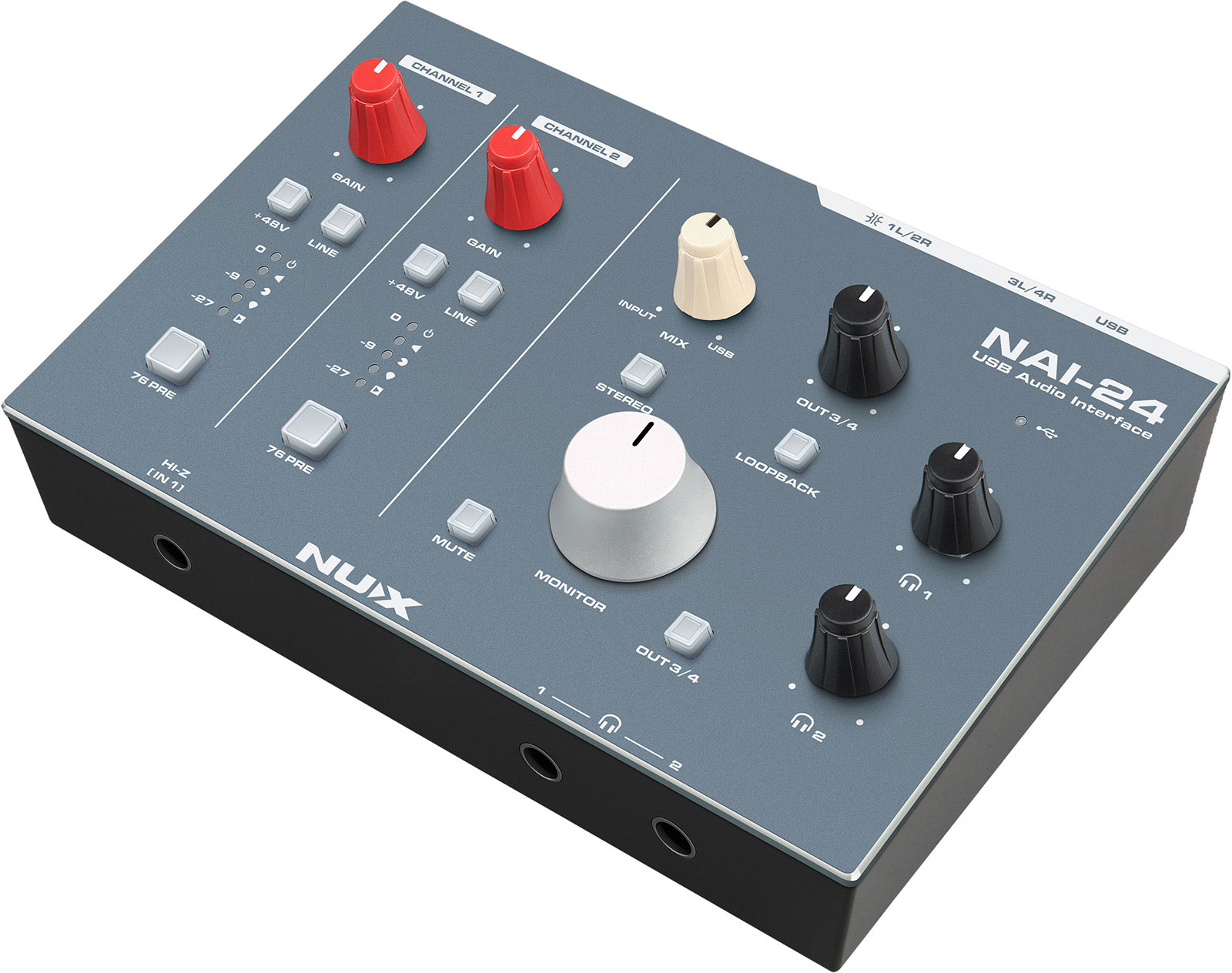
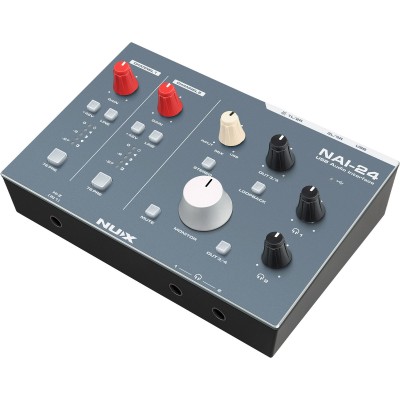
The NAI-24 embraces a sonic approach that pays tribute to classic studio gear, notably through a FET compression circuit inspired by the type 76 and a Class A transistor input topology. The idea is not to complicate your signal chain but to provide, right from recording, an exploitable color and quick control, with preset modes accessible via digital control. The result: a compact "desktop" interface aimed equally at demanding vocal recording, instrument tracking, or content creation.
With its 2 inputs and 4 outputs, the NAI-24 positions itself as an ideal solution for home studios, mobile setups, and streaming configurations. The mic inputs allow capturing vocals, acoustic guitar, or line sources, while the HI-Z input facilitates direct recording of guitar and bass. In production, the 4 outputs enable practical scenarios: managing multiple monitor mixes, sending to external systems, or dedicated routing for a musician in an isolation booth.
Content creators will appreciate the loopback feature for cleanly capturing audio from applications (browser, player, video conferencing software) into their DAW, as well as the monitoring settings (soft/hard) to adjust playing feel and responsiveness depending on the session. Finally, the presence of two independently controlled headphone outputs simplifies two-person sessions: artist and engineer, or vocal/instrument duo, without needing an additional headphone amplifier.
Each input channel relies on Class A transistors with wide dynamic range and offers a maximum gain of 71 dB. The Boost mode adds 8 dB to the overall preamp, useful for gaining level with less sensitive microphones or to keep a comfortable headroom without pushing your chain to the limit.
The NAI-24 integrates three compression behaviors quickly accessible to avoid endless tweaking when you need to record fast and well. The Vocal Compression mode favors moderate attack and release for a smoother, more controlled result. The Guitar Compression mode focuses on fast response and calibrated release for guitar and bass, balancing level and stabilizing dynamics. Finally, the Live Streaming Compression mode is the most reactive: it aims to preserve clarity and intelligibility when level variations are frequent during broadcasts.
For conversion, the interface relies on professional AKM AD/DA chips, known for their musicality and precision, preserving detail and depth both in recording and playback. On the output side, the main 1L/2R output benefits from studio-quality audio transformers: besides a warmer signature, they contribute to electrical isolation and reduce interference caused by ground loops. The manufacturer specifies that even with unbalanced connection on 1L/2R, the strength of the balanced output signal is maintained.
The NAI-24 offers routing designed for studio realities. In A/B mode, you can connect two pairs of active monitors on 1L/2R and 3L/4R and switch between them via the OUT 3/4 button: ideal for comparing a mix on two different monitors. In recording mode, the OUT 3/4 button adjusts with one click what is sent to channels 3/4, for example to quickly change a headphone mix or musician send during a take.
This logic also facilitates integrating external effects: in recording mode, you can connect effects modules to enrich existing recordings and start a new take without turning your session into a wiring nightmare.