30-day satisfaction guarantee or your money back
Call us : +33 257 880 074
 en
en 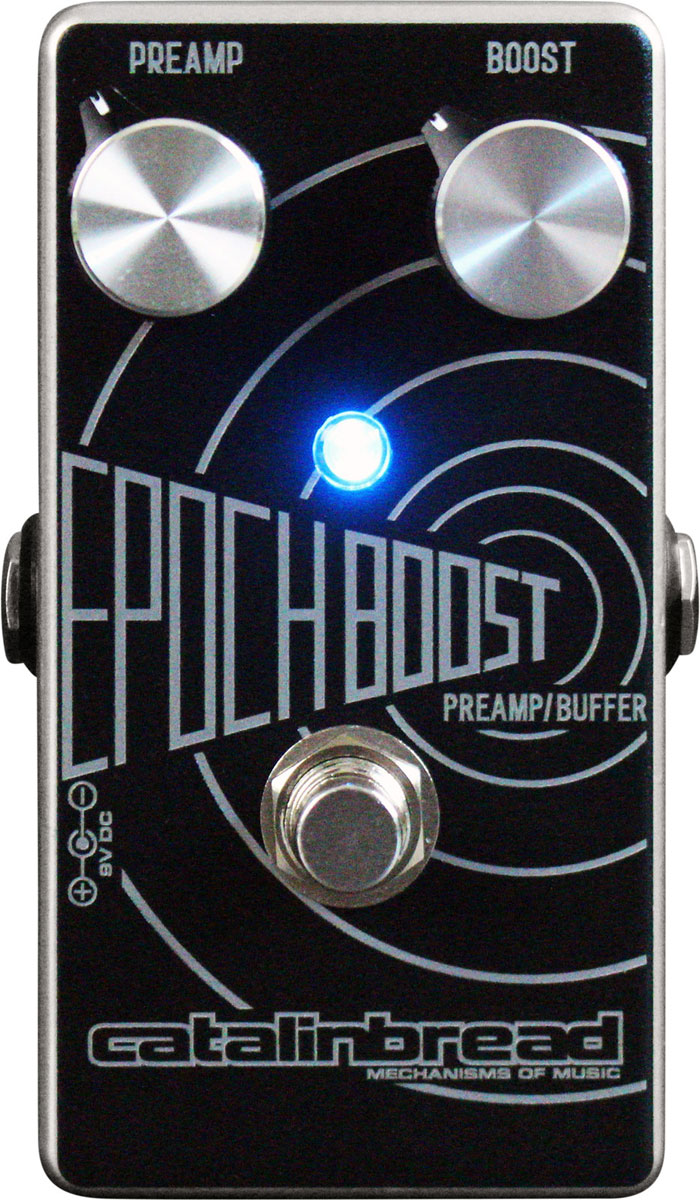
Iconic rock tones are often associated with a "directly plugged in" amp. Yet, part of the secret sometimes came from a discreet element placed upstream: the preamp of a tape echo. The Epoch Boost is precisely inspired by this preamp section made famous by the Maestro Echoplex EP-3, used both for its effect and its sonic imprint when the preamp remained permanently engaged.
Catalinbread captures the spirit of this circuit and adapts it into a pedal format, with a very "studio" approach: the Epoch Boost acts as a finishing stage, a kind of "mastering pedal" that preserves your sonic identity while making it fuller, clearer, and more flattering. It's the kind of tool you activate... and then don't want to turn off.
The Epoch Boost is aimed at guitarists who want to improve their basic tone without resorting to radical EQ or additional distortion. In other words, it suits both demanding beginners (seeking a more "pro" sound immediately) and seasoned musicians looking for a simple, reliable musical boost.
In terms of styles, it feels at home wherever dynamics and presence matter: blues, classic rock, punk, indie, hard rock, and even more modern contexts where definition is key. In the studio, it helps a guitar "cut through" without overloading the mids. Live, it becomes a "more" knob: more level, more grit, more authority, all while remaining controllable.
It works perfectly at the start of the chain to awaken somewhat tame pickups, or at the end of the chain to raise output volume and solidify the signal before the amp. And if you play with few pedals, its switchable Hi-Z buffer can also help maintain a clean, stable signal depending on cable length and the rest of your setup.
The approach is deliberately straightforward: there is a boost control that allows you to go from subtle enrichment (the always pleasant "preamp" character) to a clean, solid level increase up to 20 dB. The idea isn't to add an obvious effect, but to make your sound more present, firmer, and more coherent, as if the amp were breathing better.
The increased internal voltage (up to 22V) plays a key role: it provides headroom, thus less compression sensation when playing hard, more clarity on chords, and a more stable response with high-output pickups. The result: you can boost without the sound becoming muddy too quickly, which is especially appreciated with already well-opened amps.
Finally, the Epoch Boost includes a switchable Hi-Z input buffer. Depending on pedal order, guitar type, and cable length, you can choose the most natural feel: either a more direct path or a better "held" signal to preserve brightness and definition. It's a subtle detail but extremely useful on a real pedalboard.
The Epoch Boost's signature lies between enhancement and embellishment: it doesn't rewrite your tone, it highlights it. Expect a more solid rendering, with a sense of depth and presence, and an attack that remains clear. The boost is clean but not clinical: it retains a musicality reminiscent of vintage preamps, with that little extra relief that makes you want to play.
Dynamics are a strong point: fingerstyle response feels "larger," and with a pick, the sound projects better. On an amp already on the edge of crunch, the boost can act as a natural sustain trigger, without necessarily turning your base tone into distortion. It's easy to see why guitarists have relied on this family of preamps to push their sound further, from Eddie Van Halen to East Bay Ray.