30-day satisfaction guarantee or your money back
Call us : +33 257 880 074
 en
en 
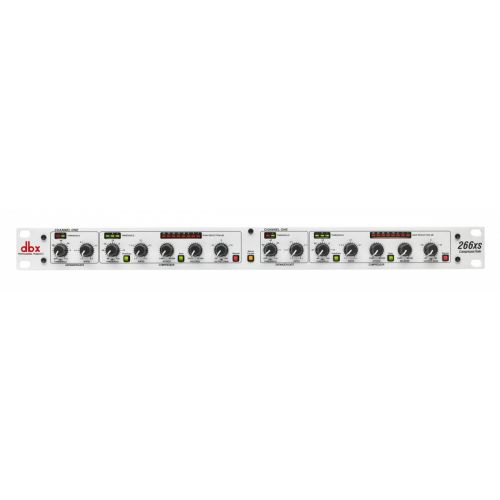
The dbx 266xs follows the tradition of dbx dynamic processors: offering direct control and immediately "mix-ready" results. Designed for easy rack integration, it delivers the essential compressor + expander/gate duo in a 1U format. Its approach prioritizes efficiency: quick settings, clear indication of processing action, and sufficiently comprehensive options to adapt equally well to front-of-house mixing or compact studio setups.
The 266xs is aimed at musicians, sound engineers, and content creators who want to stabilize levels and improve clarity without complicating the audio chain. On a vocal, it helps position the voice in front of the mix by controlling dynamic variations. On a guitar, it can increase sustain and even out the attack. On drums or percussive sources, it enhances impact while limiting peaks. In live settings, the expander/gate helps reduce stage noise and bleed; in the studio, it refines track cleanup and improves the sense of precision.
The compressor offers two complementary behaviors. OverEasy applies a smooth transition around the threshold, useful for "invisible" compression on vocals, keyboards, or clean guitars. Hard Knee provides a more direct action, helpful when you want obvious transient control or a more pronounced effect on percussive sounds.
The AutoDynamic control adjusts the compressor's behavior based on the audio program. The goal: preserve naturalness, limit artifacts, and facilitate adjustment when sources vary (dynamic vocals, slap bass, irregular guitar playing, etc.). Additionally, the 266xs benefits from return time optimization circuits to maintain smooth compression even during rapid level changes.
The expander/gate adapts to signal characteristics to close more coherently and avoid overly abrupt cuts. This is an asset for taming breaths, reducing bleed between drum mics, or controlling unwanted noises between vocal phrases. The gate threshold is adjustable over a wide range, allowing fine-tuning according to microphone sensitivity and the acoustic environment.
To speed up workflow, the unit features separate displays for gain reduction, compression, and gate: you immediately see what each section is doing to the signal. The RMS level detection favors a response consistent with human loudness perception. Finally, the separate detector input (sidechain) allows influencing compression via external processing, useful for more targeted mixing approaches (e.g., controlling compressor response with a filtered signal).

 Certified