30-day satisfaction guarantee or your money back
Call us : +33 257 880 074
 en
en 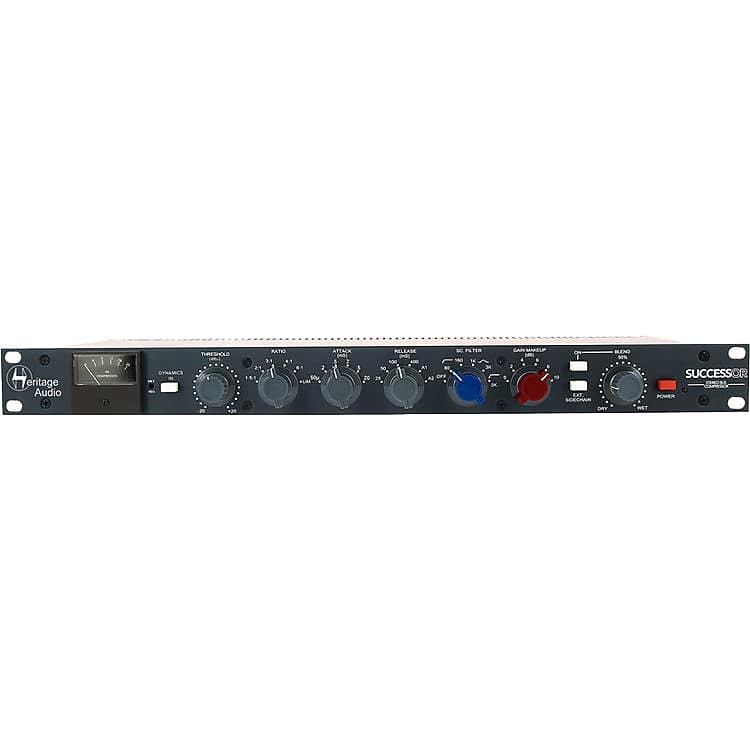
The Successor follows in the footsteps of vintage diode bridge compressors that have marked mixing history, known for their character, density, and their very particular way of "gluing" elements together. While bus compression has often been entrusted to VCA integrated circuit designs, effective but sometimes perceived as more neutral, Heritage Audio offers here a deliberate alternative: a discrete class A architecture, enriched by large transformers and stereo diode bridge gain reduction.
Beyond the sonic signature, the Successor positions itself as an evolution designed for current workflows: it preserves the DNA of legendary designs while adding tools expected in modern studios, notably more advanced sidechain filtering and integrated parallel processing capabilities. All this shares an output stage inspired by the class A "73" style that made the brand famous, delivering a sound that is solid, warm, and immediately mix-ready.
The Heritage Audio Successor is designed for mix engineers, producers, and studios who want to hear the compression working during the mix, not relegated to a mastering stage. Placed on the master bus or on an instrument bus (drums, music, guitars, keyboards, choirs), it allows you to feel how tracks interact, come closer, and naturally blend, with a sense of cohesion often hard to achieve otherwise.
On a drum bus, its reaction speed helps achieve larger-than-life sounds: snare more present, room more controlled, and an overall energy that remains stable. On the mix bus, it provides "glue" with more thickness and relief, while letting the stereo image breathe. And on vocals, it can help them stand out in the mix without making them overpowering or muddying guitars or harmonic elements.
The diode bridge gain reduction is at the heart of the Successor: it brings a more organic texture and a sense of "weight" associated with the most musical bus compressors. The result is especially convincing when seeking a mix that holds together without becoming flat: transients remain expressive, the center of the mix gains solidity, and the whole feels better "grounded."
The fully Carnhill transformer-coupled input and output stages are not just for show: they directly contribute to the compressor's character. The low end is more stable and firm, while the mids gain density, helping to achieve mixes that are more solid and readable. This coloration remains usable on varied sources, from aggressive drum buses to more subtle mix buses.
Sidechain filtering is a major asset once the mix becomes busy or the low end triggers compression too quickly. By adapting the detection, you retain the kick's impact and low-end stability while controlling overall density. The result: the stereo image opens up, the snare can appear more present, and there is more natural space for tracks to breathe.
The Successor integrates parallel processing capabilities designed for mixing: you can push for more marked compression (including very aggressive and fast sensations, close to what's appreciated in "all buttons" styles) while preserving the attack and clarity of your original signal. This approach is ideal on drum buses but also on a mix bus when you want more intensity without squashing the music.
In practice, this makes it a compressor you can leave permanently connected on the mix bus: it becomes a central piece of the sound, capable of making a mix shine in modern production environments, while staying true to a marked analog aesthetic.