30-day satisfaction guarantee or your money back
Call us : +33 257 880 074
 en
en 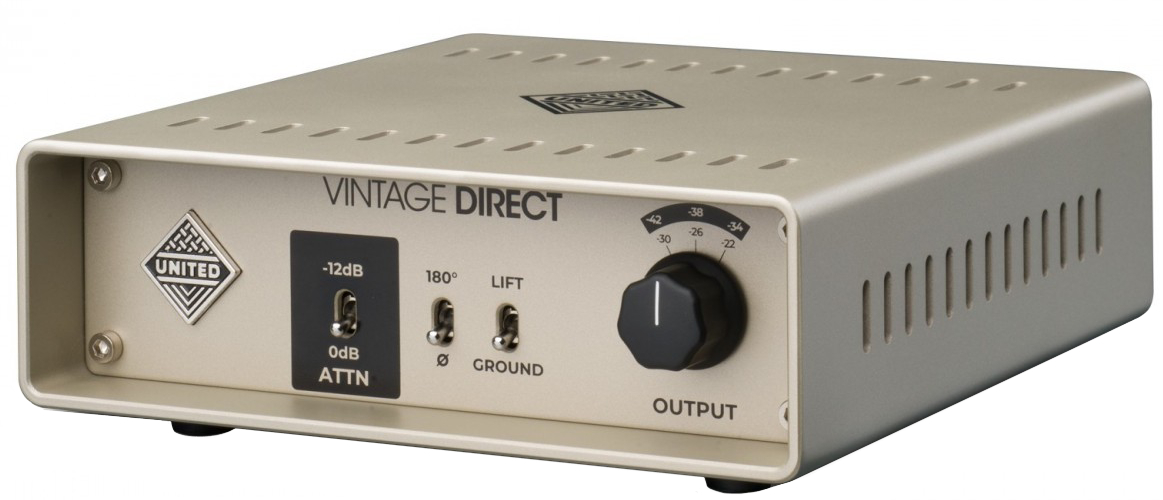
The United "Vintage Direct" follows the tradition of hand-wired passive DI boxes that shaped the sound of direct inputs since the 1960s. Its approach focuses on what truly matters in a high-end DI: the transformer, component quality, and a topology that avoids altering the signal before conversion to balanced. The result aims for an organic reproduction, with weight in the lows, coherent mids, and a sense of depth reminiscent of historical references, while meeting current requirements for reliability, level, and studio compatibility.
This passive DI box is tailored for bassists, keyboardists, guitarists, and sound engineers who want to capture an instrument direct without harshness, loss of punch, or unwanted noise. On electric bass, it helps preserve attack and note sustain while delivering a clean, stable mic-level signal to a live console or studio preamp. On synths, drum machines, and electronic gear, it handles peaks and secures the level before the mic input, with no latency and no digital conversion.
In the studio, ground isolation and ground lift become valuable as soon as a complex rig (computers, interfaces, amps, pedalboards, racks) generates ground loops or hum. On tour, the "road-ready" construction and recessed front panel protect controls: you keep a reliable DI, easy to adjust, and consistent from one stage to another.
At the heart of the "Vintage Direct" is the United 5078 transformer, deliberately oversized and shielded. This design aims for high dynamic reserve (headroom), stable bass, and excellent transient handling so the signal remains clear even when the instrument hits hard. For the user, this translates to a more "finished" capture: solid lows, sharp attacks, and a sense of silence between notes when stage wiring and power supply are less than perfect.
One of the unique aspects of this passive DI is avoiding traditional attenuators placed before the transformer. Here, adjustment is made via taps on the secondary windings, complemented by a precision six-position T-pad attenuator. The benefit is direct: your instrument "sees" a simpler path, with fewer elements likely to compress dynamics, soften transients, or alter tonal balance. In practice, you finely tune the level sent to a console or preamp mic input, whether working with a moderate instrument source, a very powerful keyboard, or a chain with lots of gain.
A DI is not only for converting an unbalanced signal to balanced: it must also quickly solve phase and ground issues without adding noise. The phase inverter manages certain interactions (multi-mic setups, reamping, combined DI plus amp sources) and optimizes low-end coherence. The ground lift and true ground isolation help eliminate hum caused by ground loops, a crucial point when combining instruments, computers, and PA systems. Finally, the aluminum chassis, recessed front panel, and removable feet confirm the "studio and stage" vocation: stable placement on a stage, protected controls, and easy integration into a busy environment.