30-day satisfaction guarantee or your money back
Call us : +33 257 880 074
 en
en 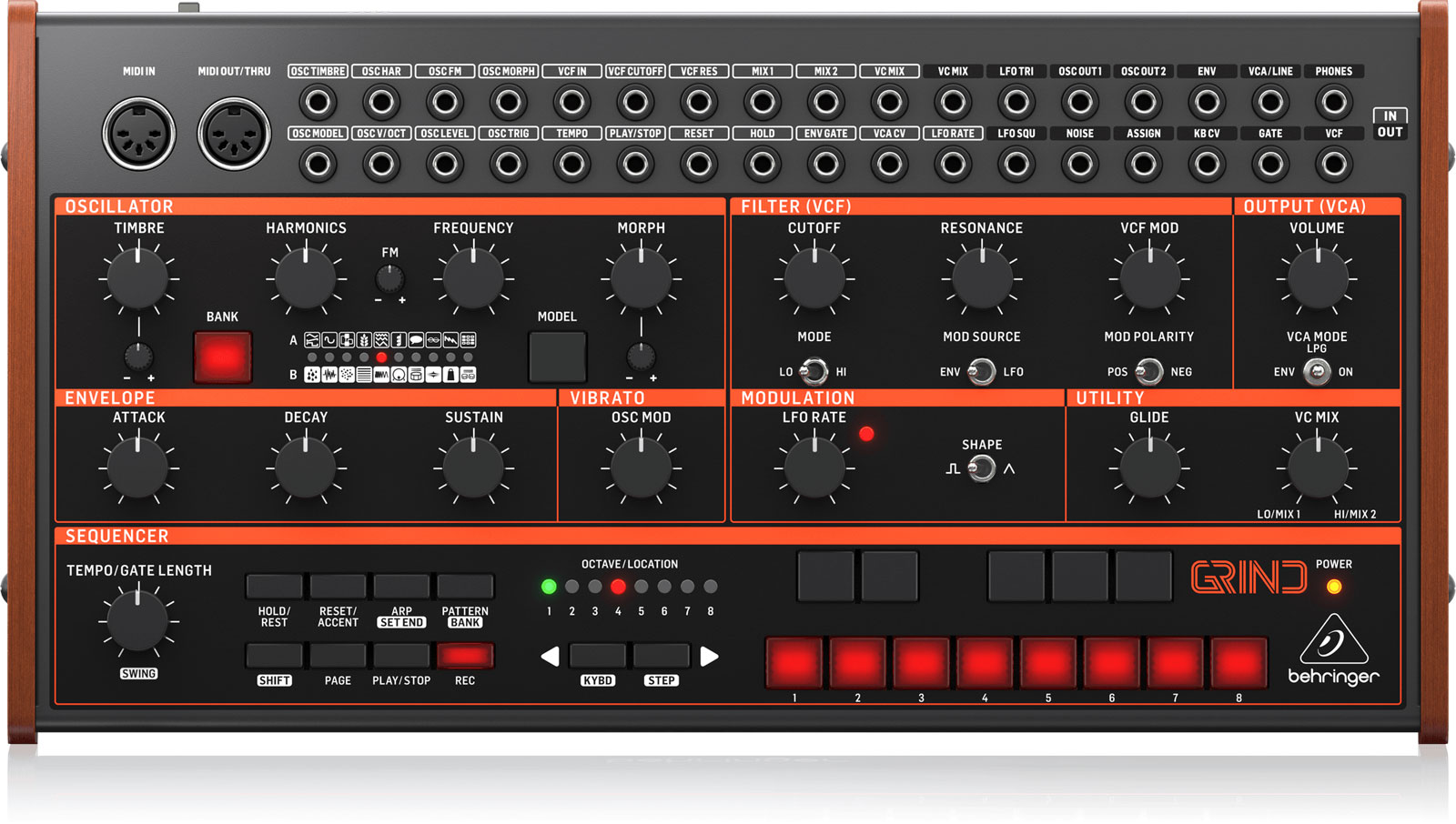
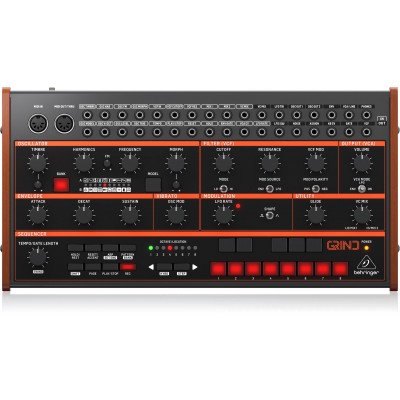
The BEHRINGER GRIND embodies a decidedly modern approach to synthesizers: the variety and precision of digital technology serving creativity, combined with the character of classic analog filtering. Its semi-modular concept allows you to start simply, then go very far once the desire to patch and sculpt sound takes over.
The GRIND is aimed at experienced musicians as well as curious creators looking for an inspiring instrument for studio and live use. It is particularly comfortable in techno, electro, ambient, synthwave, IDM, modern pop, and sound design (drones, FX, evolving textures). Thanks to its percussion/noise engines and sequencer, it can also become an excellent partner for building rhythmic patterns, basslines, and expressive leads in performance.
At the heart of the GRIND is a multi-engine digital oscillator totaling 24 sound engines, including 15 engines derived from Mutable Instruments Plaits, covering a spectrum from classic timbres to more experimental forms. The instrument offers 10 synthesis engines (virtual analog, FM, additive, wavetable) to create leads, chords, pads, and textures, as well as 10 dedicated percussion and noise engines (ideal for FM kicks, snares, hi-hats, and drum elements). Four additional engines complete the palette (DX7, TD-3 Bassline, Wave Generator, and Vox) to further diversify sonic signatures.
Signal processing goes through a 24 dB ladder analog filter with resonance, switchable between low-pass and high-pass, perfect for adding harmonic depth, refining a bass, or carving an aggressive timbre. An integrated oscilloscope helps visualize signals, while the Morph control facilitates smooth and musical transitions between different sound characteristics. On the composition side, the 32-step sequencer (with 64 memories) and the advanced arpeggiator enable generating patterns, variations, and expressive movements. Finally, the semi-modular design and the 22 x 12 matrix provide an ideal playground for patching and exploration, with 50 controls to maintain a direct and performance-oriented approach.