30-day satisfaction guarantee or your money back
Call us : +33 257 880 074
 en
en 
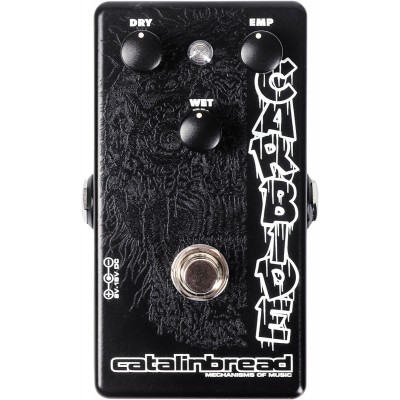
The Catalinbread Carbide follows in the lineage of extreme distortions associated with the famous "chainsaw" sound, popularized by the radical approach of maxing out all the settings on a Boss HM-2 Heavy Metal. Here, the idea is not to offer a simple copy, but a deliberately calibrated base for this signature saturation, then optimized to go further in crunch, density, and low-end sustain.
The Carbide's strong point is its way of preserving the DNA of this very characteristic EQ (with its iconic frequency boosts) while offering a more usable interface on a modern pedalboard. The result: a distortion that can be outrageously nasty but also surprisingly controllable once you start playing with the Dry/Wet blend and the Emp(hasis) control.
The Carbide is primarily aimed at guitarists who want a metal distortion with conviction: death metal, grind, hardcore, sludge, doom, but also all aesthetics that love abrasive textures and biting mids. It is particularly comfortable on guitars in lower tunings (drop, baritone, etc.), where many distortions become muddy or too flubby.
In live situations, it is designed to remain clear: the very present midrange character helps the guitar keep its place even in a dense mix. In the studio, it is an excellent source of texture: double-tracking, walls of rhythm guitars, screeching leads, or more industrial layers. Its parallel approach also helps preserve attack and "punch" of the playing, rather than flattening everything under classic distortion compression.
The Carbide splits your signal into two paths. The first goes through a powerful clean boost, specially configured to retain definition on instruments and lower settings. The second path contains the core of the "chainsaw" distortion.
Each path has its own volume before being mixed in parallel: Dry controls the boosted path level (attack, clarity, solid lows), Wet controls the distorted path level (grain, saturation, abrasiveness). This is not a simple "clean/dirty" mix: it's a very musical way to adjust the feel under your fingers, from palm-mute articulation to the density of the gain wall.
The Emp(hasis) control acts as a formidable sculpting tool: it tightens the extreme lows (by reducing sub frequencies) while softening the highs, which highlights the typical boosted frequency bands of this circuit. Practically, you can go from a very bright and raw sawtooth to a more compact, more "mix-ready" distortion without losing the sound's identity.
Expect a thick, granular, and very characterful distortion, with that midrange bite that immediately evokes the "chainsaw." The Carbide does not aim for transparency: it imposes a signature, ideal when you want a guitar that cuts and roars. The low end remains more usable than with many extreme distortions, notably thanks to the Dry path that can reinforce impact and precision.
By adjusting the Dry/Wet balance, you can either get a totally overwhelming saturation (Wet dominant) or keep a cleaner attack and better note separation (by raising Dry). The Emp(hasis) control helps lock down the lows and tame excessive highs depending on the amp, cab, or pickups. The result: a brutal sound that can remain surprisingly controlled for recording or playing loud without turning into mere "white noise."