close
filter_list

Digitech FREQOUT

Description

The Essentials to Know About the DigiTech FreqOut Pedal

  • Natural feedback at any volume: experience the sensation of an amp "on the edge of feedback" even in the studio, during silent rehearsals, or at home.
  • 7 types of harmonic feedback to choose a controlled rise (sub, fixed harmonics) or a more "lively" behavior (Natural modes).
  • Latching and Momentary modes: activate the effect like a classic pedal, or only while holding down the footswitch.
  • True Bypass (and buffered path in momentary mode) for clean integration into a pedalboard.

A "feedback creator" designed for modern rigs

Feedback is part of the electric guitar language: infinite sustain, singing harmonics, notes that "take off" as soon as you push the amp. The problem is that in practice, this sound depends on volume, stage position, the speaker cabinet, and quickly becomes unmanageable when you need to keep it discreet (booth, home studio, in-ear monitors, small stages).

The DigiTech FreqOut addresses exactly this point: it enhances a selected harmonic based on your input note to generate credible feedback without requiring excessive volume. The result: you keep the musical intention of feedback, but with control and repeatability suited to current setups (amps, pedals, modeling).

For whom, which styles, and in what contexts

The FreqOut is aimed at guitarists (and more broadly electric instrumentalists) who want to add sustain and controlled harmonics without relying on volume. It is particularly relevant if you play in studio, with a low-level amp, an attenuator, amp simulation, or if you need to avoid uncontrolled feedback on stage.

Regarding styles, it naturally fits in rock, blues, metal, post-rock, and ambient: note holding, phrase endings that soar, drones, leads that "sing". In practice, it can also become a sound design tool to create swells, transitions, or "electronic bow" type effects on isolated notes, even on a very crowded pedalboard.

Controls, modes, and ergonomics: everything to control the feedback rise

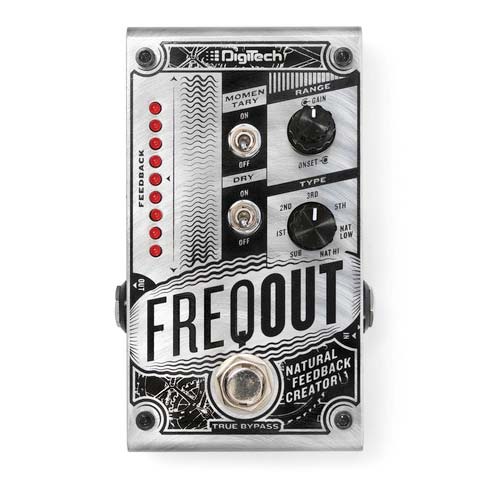
The handling is immediate: you adjust the Gain to dose the feedback intensity (from a slight quiver to very marked sustain), then the Onset knob to decide how fast the feedback "arrives" after the attack. This is one of the pedal's key points: you can get almost instant feedback for expressive leads, or a slow rise for more cinematic textures.

The Type selector offers 7 types: Sub (feedback one octave below), 1st (unison), 2nd, 3rd, 5th (fixed, predictable, and easy-to-repeat harmonics), as well as Nat Low and Nat High for a more organic reaction, close to a real guitar-amp pair, with possible variations from take to take.

Two switches complete the arsenal: Dry On/Off (keep or cut your dry signal during the effect) and Momentary/Latching. In Latching, the FreqOut behaves like a standard pedal (on/off). In Momentary, the effect is active only while you hold down the footswitch: ideal to "catch" a harmonic on a precise note, punctuate a riff, or trigger feedback only at the end of a phrase. A front LED indicator also allows you to visualize activation and onset progression.

Note on effect order: since the pedal builds its behavior from the cleanest possible guitar signal, it often performs best at the start of the chain (before modulation and delays), while remaining usable in other configurations depending on your rig.

Sound

The FreqOut aims for a natural sound: the feedback doesn't sound like a simple pitch shifter slapped over the signal, but like a note that "responds" and takes over, with a sensation of sustain and control. Fixed harmonic types allow targeting a precise frequency (useful in studio and for doubling lines), while the Natural modes bring a more realistic unpredictability, with behaviors reminiscent of the interaction between mic, amp, and position.

The dynamics depend directly on your playing and settings: a sharp attack triggers faster, onset adjustment lets the note breathe, gain moves from subtle feedback to a very present effect. It's a pedal that can stay musical even in a very clean set, but becomes particularly thrilling with overdrive or distortion (before or after, depending on the desired effect). Among musicians known to use this type of tool on pedalboards are Andy Summers, Mike Kerr, Nick Reinhart, Doyle Wolfgang von Frankenstein, Aaron Marshall, and Mike Stringer.

Technical Specifications

Features and modes

  • Creation of natural feedback at any volume level, with or without distortion
  • 7 types of harmonic feedback: Sub, 1st, 2nd, 3rd, 5th, Nat Low, Nat High
  • Controls: Gain (intensity) and Onset (speed of appearance)
  • Dry On/Off switch (dry signal enabled or cut during effect)
  • Momentary/Latching switch (momentary or classic activation)
  • Visual indication via LED bar (status and onset progression)

Bypass

  • True Bypass (in Latching mode)
  • Buffered bypass path in Momentary mode

Connectivity

  • Input: 6.35mm TS unbalanced jack
  • Output: 6.35mm TS unbalanced jack

Audio specifications

  • A/D and D/A conversion: 24 bits
  • Signal-to-noise ratio: greater than -106 dB (A-weighted, 22 kHz bandwidth)
  • THD: 0.004 percent at 1 kHz (reference 1 dBu, unity gain)
  • Max input level: +5 dBu
  • Max output level: +10 dBu
  • Input impedance: 1 megaohm (effect active or bypass with momentary mode active)
  • Output impedance: 1 kohm (effect active or bypass with momentary mode active)

Format and construction

  • Compact metal chassis
  • Dimensions: 120 mm (W) x 73 mm (D) x 44 mm (H)
  • Weight: 363 g

Included accessories

  • Documentation
  • Power supply sold separately

Power consumption

  • Required power supply: external 9 V DC adapter (no battery power)
  • Consumption: 235 mA (typical), 2.1 W
  • Polarity: center negative
  • Recommended adapter: 9 V DC, 1.3 A
Brand reference number: FREQOUT

Testimony

4,8 /5
5★
4★
3★
2★
1★
Quality
fullfullfullfullempty
Quality / price
fullfullfullfullempty
Use
fullfullfullfullempty
THE SOLUTION to make notes last without deafening your friends in the rehearsal room or at a concert. There can be occasionally some slightly artificial reactions, but it's rare. Anyway, I can play Santana or Gary Moore at a reasonable volume. Example: our cover of Bowie's "Heroes" allows me to play Robert Fripp's parts in a completely realistic way. Less violent than an E-Bow, and more natural than the EHX Freezer, I think this is the only solution. Unless you buy yourself a 70s Yamaha SG2000 with a maple neck and a Mesa Boogie Mark I with the equalizer to boost the mid frequency: 750 Hz. Damn, I don't have that... So, thanks to Digitech!
Certified
Posted on 10/07/2024
By Pierre Marie S.

I was warned: you have to take it in hand. Sometimes that's exactly it, other times it sounds strange, but I'm improving. You can't put it everywhere but occasionally, this on-demand feedback is exhilarating. I'm not convinced by the dry off option, maybe for "ambiences" but it's not my thing. A must-have, but occasional.
Certified
Posted on 14/03/2022
By Emmanuel G.

A very original pedal, which must be tamed.
Verified
Posted on 20/05/2024
By ludovic louvion
Quality
fullfullfullfullempty
Quality / price
fullfullfullfullempty
Use
fullfullfullfullempty

Works very well, the feedback is amazing and easily controllable. Sometimes there is like a digital saturation when you are not precise enough, so one star less but I reassure you, I'm nitpicking. With a delay it's great! (Big delivery problem because of GLS which is a real pain, I hope Woodbrass will change carrier)
Certified
Posted on 28/07/2019
By Lomig G.

Videos
Sales & Advice
thumb_up