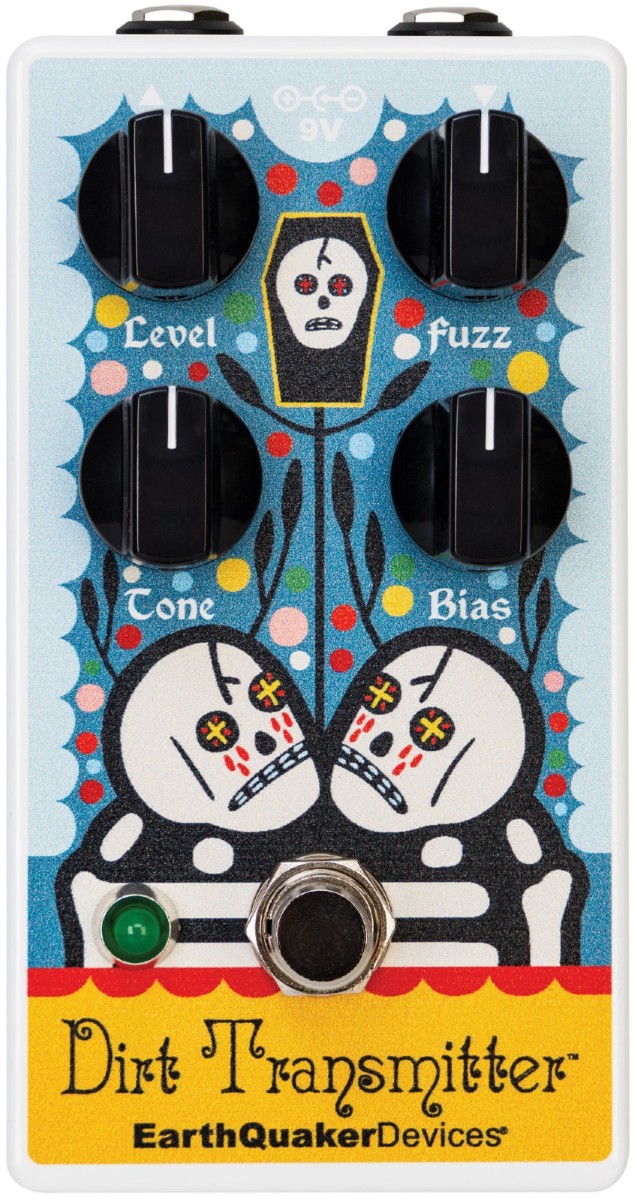
Dirt Transmitter Rancho De La Luna
Limited Edition Silicon Fuzz
In early 2023, Jamie Stillman was invited by legendary guitarist and producer Dave Catching to participate in a recording session at Rancho De La Luna, for an album celebrating the studio’s 30th anniversary, during which the Dirt Transmitter was used on a large portion of the recordings. After the session, the idea came up to release a Dirt Transmitter linked to the album, and Dave suggested reaching out to his friend Mike Egan to create a special design themed around the Rancho. It just so happens that Mike is from Ohio and lives just minutes from EQD, so everything seemed to align perfectly.
The Dirt Transmitter is one of the brand’s oldest circuits. Its design is inspired by the Fuzz Face, and the idea was born when Jamie Stillman got his hands on some very particular silicon transistors. These transistors have a lower gain and a warmth similar to germanium transistors when saturated. But they also retain the typical silicon fuzz brightness in the highs, which pushes the mids and allows the sound to cut better in the mix.
The first Dirt Transmitters started production in January 2008 and featured a small enclosure with only three controls: Fuzz, Tone, and Level. Shortly after the release, Jamie decided to add an external Bias control which opened up the circuit and gave it new life. By modulating the Bias, the transistor is deprived of voltage. The Dirt Transmitter is “properly” calibrated when the Bias is at maximum.
Reducing it weakens the voltage, and the fuzz sound becomes more chopped and “broken.” This produces a velcro-like fuzz that becomes more intense as the Bias is lowered. The combination of these rare transistors and reduced voltage allows for a wide variety of textures with a simple control, which made the Dirt Transmitter a staple of the brand until its premature discontinuation in 2017.
Controls
- Fuzz: For heavier or lighter sounds.
- Tone: For a brighter, sharper sound, or to roll off the highs for a softer tone.
- Bias: Affects the transistor voltage, allowing for either a chopped velcro fuzz or a thicker, more natural fuzz.
- Level: Output volume
 en
en