30-day satisfaction guarantee or your money back
Call us : +33 257 880 074
 en
en 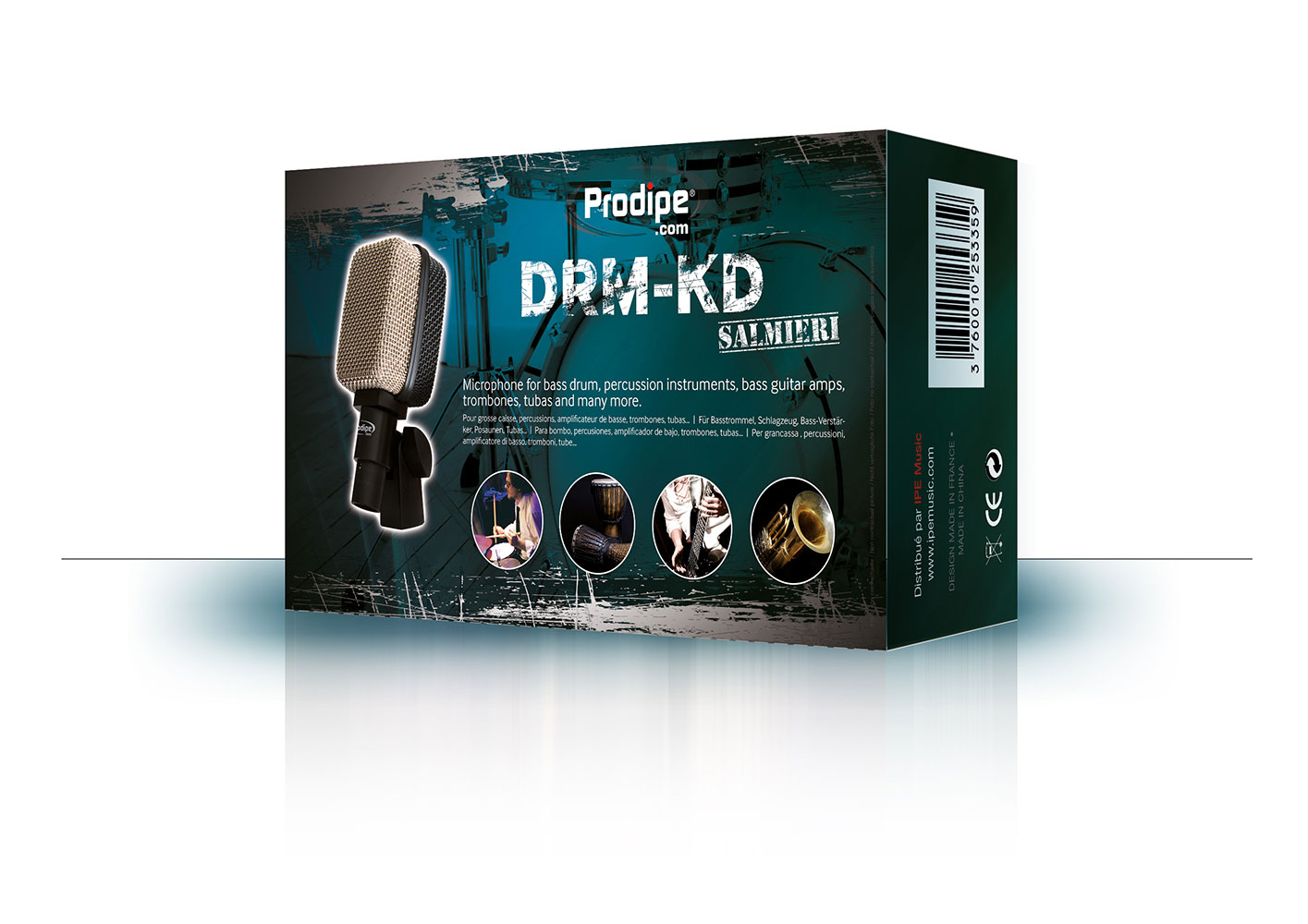
The DRM-KD follows the tradition of dynamic microphones dedicated to kick drums, recognizable by their distinctive look and their ability to deliver solid bass without collapsing. Its design immediately evokes certain standards that have marked generations of sound engineers, but the goal here is not nostalgia: it is to recapture that warm, dense, and precise sound that works equally well in a modern mix or a more organic production.
Where many current microphones immediately "sculpt" the signal with a deeply carved curve (emphasizing bass and treble while cutting mids), the DRM-KD adopts a different philosophy: it captures the entire useful spectrum of the kick drum and lets the engineer decide on processing depending on style, tuning, drumhead, striking technique, and arrangement.
The DRM-KD is aimed at drummers, front-of-house and monitor technicians, home studio users, and studios seeking a microphone capable of being placed very close to a highly energetic source without unwanted distortion, while maintaining an immediately usable sound. On a kick drum, it allows working on both roundness and attack depending on placement (in the port, inside the drum, right at the resonant head) and the processing applied afterward.
Its versatility goes beyond drums: on a bass amplifier, it reproduces the low end with body; on powerful percussion (djembes, surdos, large percussion), it provides a solid foundation; on low brass such as trombone and tuba, it helps capture projection and density without excessive harshness. It is a relevant choice whenever the instrument "pushes hard" and a simple, robust, and consistent mic is desired both live and in recording.
With a stated response of 30 Hz to 15 kHz, the DRM-KD is comfortable with low fundamentals (weight and depth) while retaining enough information in the upper spectrum for attack, "click," and definition. This approach facilitates mixing: you start with a complete foundation, then equalize according to the musical genre (rock, metal, funk, jazz, world music) and the role of the kick drum or bass in the arrangement.
The supercardioid pattern helps focus the capture on the targeted source. On a kit, this generally means less bleed from snare, hi-hat, or stage monitors, resulting in a cleaner signal to process. In concert, this directivity also provides better overall control, especially when stage volumes are high and every dB of clarity counts.
Dynamic technology is particularly appreciated on high-level sources because it combines robustness, reliability, and stable low-frequency behavior. The DRM-KD was designed for this use: kick drums, percussion, and amps can generate very pronounced transients, and this microphone is built to remain clear without collapsing or becoming muddy as levels rise.
The character described as full, warm, and precise corresponds to a capture that preserves the material without imposing an overly extreme signature. The result: you retain the freedom to shape the sound (compressor, gate, equalization) according to your method and context. Whether you seek a very round kick or a more snappy one, the DRM-KD provides a solid and balanced foundation to build your sound.

 Certified