30-day satisfaction guarantee or your money back
Call us : +33 257 880 074
 en
en 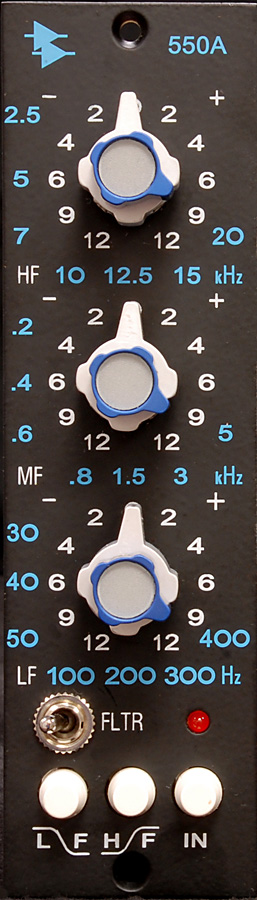
Few equalizers have marked the history of recording as much as the API 550A. Designed by Saul Walker in the late 1960s, this discrete design initially existed as an embedded module (OEM) before being adopted by engineers and integrators building high-end "homebrew" consoles. Many configurations from that era are still in use today, proving the longevity of the concept.
Over time, the 550A became a benchmark: an immediately recognizable sound, often imitated but difficult to replicate exactly. When API began manufacturing its own consoles in 1971, the 550A naturally established itself as the standard equalizer module. Due to persistent demand, production was relaunched in 2004, allowing current studios to regain this historic character in the API 500 series format.
The 550A is aimed at sound engineers, producers, and demanding home-studiers who want an efficient, repeatable, and decision-oriented equalization. Its switched frequencies, dual-knob ergonomics, and silent insertion encourage working by ear, without getting lost in infinitely variable settings.
It excels both during tracking and mixing: adding attack to a snare, opening overheads, solidifying a bass, bringing out a guitar, or simply placing a vocal in the mix with clean and musical corrections. In the 500 series, it easily integrates into a compact chain (preamp, EQ, compressor) to build a custom channel strip, both in the studio and in production racks.
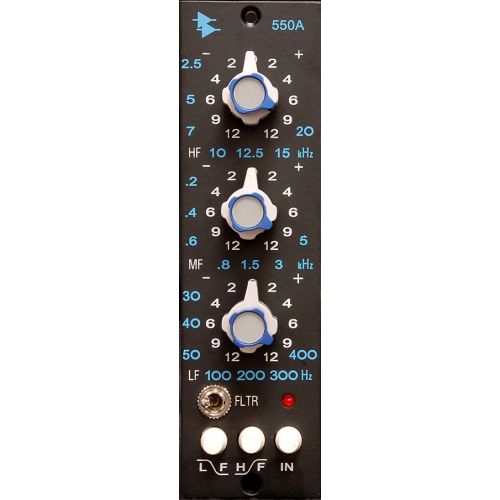
The API 550A is based on a 15-point reciprocal equalization, organized into 3 overlapping bands. Each band offers 7 selectable frequencies, with progressive gain steps up to +/-12 dB per point. This "switched" approach is ideal for working quickly, instantly comparing multiple options, and recalling settings from session to session.
To adapt to the real needs of a mix, bands 1 (bass) and 3 (treble) can be individually switched to shelf. This lets you choose between targeted correction (bell) or a broader, more "tonal" action (shelf), useful for thickening a source, lightening an overpowering low end, or adding air without harshness.
The 550A can receive an insertable band-pass filter via a dedicated button, independently of other equalization settings. Another " in " push-button allows silent insertion of the EQ into the signal path, facilitating A/B comparisons and contextual work without glitches.
True to the brand's tradition, the 550A adopts a typical API discrete circuit design. The result: a clear response, a dynamic feel, and the ability to handle high levels, with headroom of +30 dB before clipping. It's an EQ designed for studio reality, where transients and rich signals can quickly challenge electronics.