30-day satisfaction guarantee or your money back
Call us : +33 257 880 074
 en
en 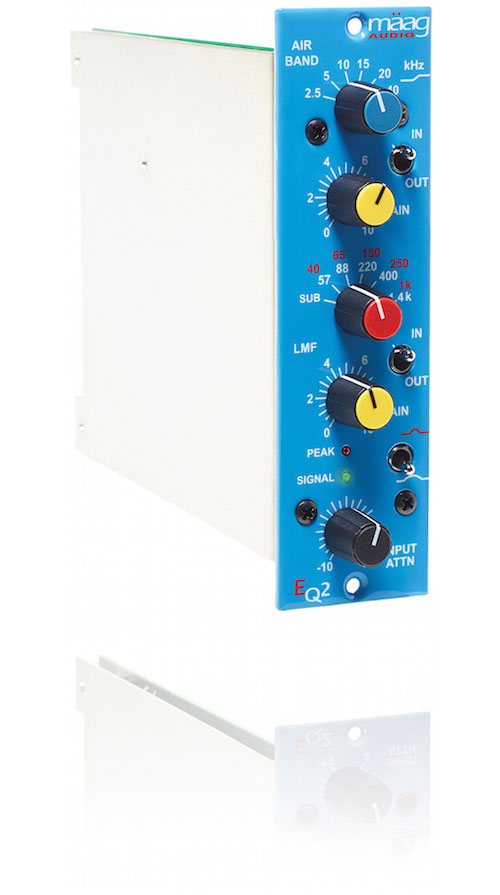
The Mäag Audio EQ2 continues the legacy of the famous EQ4: it retains the same component quality and the renowned sonic signature known for its clarity and presence in the high-frequency range. While the EQ4 offers a broader equalization with multiple bands, the EQ2 goes straight to the point with a single-channel 2-band architecture designed for speed without compromising processing quality. Its 500 format makes it particularly relevant for building a high-end recording chain or multiplying channels in a rack, while maintaining a "recall-friendly" approach thanks to the detents on the potentiometers.
In tracking, the EQ2 becomes a natural ally of preamps: the INPUT ATTN allows calming an overly enthusiastic input stage, recovering headroom before conversion, or correcting transformer saturation on a mic preamp. Once the level is controlled, the AIR BAND and LMF provide quick, very clear equalization that helps to place a vocal, add attack to an acoustic take, or open up a guitar track without making it harsh.
In mixing and on the stereo bus, the LMF is particularly useful for adjusting density and warmth: its wide or narrow bell curves allow thickening the low-midrange area or, conversely, clearing up a mix without losing body. The AIR BAND complements the set by adding the often sought-after sense of "air" and depth on vocals, overheads, strings, synths, or the final mix.
The AIR BAND is part of Mäag's DNA: it is designed to open the high-frequency spectrum with a sense of detail and relief, without turning the highs into an aggressive zone. On the EQ2, the AIR BAND additionally features a secondary frequency selector centered at 15 kHz, particularly precise for adjusting the brightness of a vocal, the finesse of a reverb, or the "light" of a bus without overloading presence.
The LMF (Low Mid Frequency) covers a wide range from sub-bass up to 1.4 kHz. This is the area where most mixing decisions are made: body, warmth, proximity, but also muddiness and masking. Thanks to the choice of wide or narrow bell curves, you can either gently shape for roundness or intervene more firmly to clean up a stack of tracks.
The INPUT ATTN (input attenuator) makes a real difference in practical situations: rather than suffering from an overly high upstream level, you adapt the signal before equalization, with attenuation up to -12.5 dB. Combined with generous headroom, this facilitates modern recording chains where one seeks to maintain controlled analog behavior while avoiding unwanted overloads.
Finally, the EQ2 relies on a design favoring minimum phase, and on detented potentiometers for immediately reproducible settings, a valuable quality when recalling a session, doubling takes, or balancing processing across multiple tracks.