30-day satisfaction guarantee or your money back
Call us : +33 257 880 074
 en
en 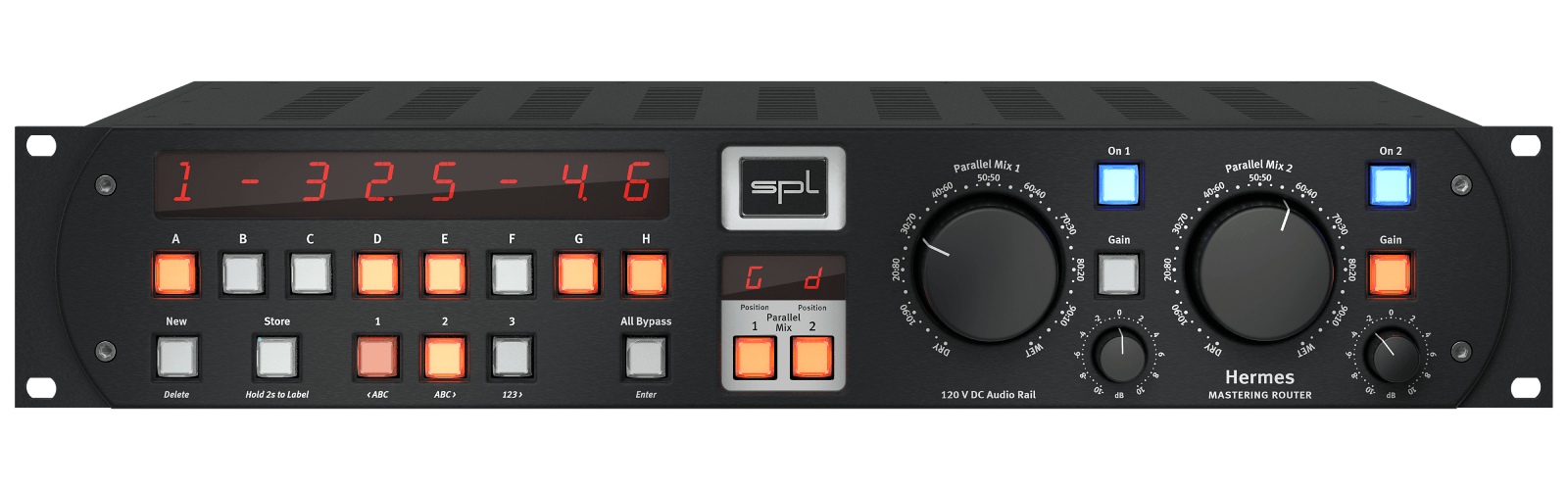
Hermes follows the SPL "120V" philosophy, developed by Wolfgang Neumann in the 1990s with a simple idea: to achieve truly superior audio quality, a very high operating voltage is required. This approach took an iconic form in the early 2000s with the SPL MMC1 mastering console (designed for demanding environments), and has since become the foundation of SPL's premium products, from mastering to studio and hi-fi listening.
On Hermes, this signature is not a "boutique" effect: it secures levels, stabilizes playback, and keeps the chain calm when modern conversions and chained analog processing push peaks higher. The result: a more relaxed listening experience, rich in micro-details, and the ability to work for long periods without fatigue.
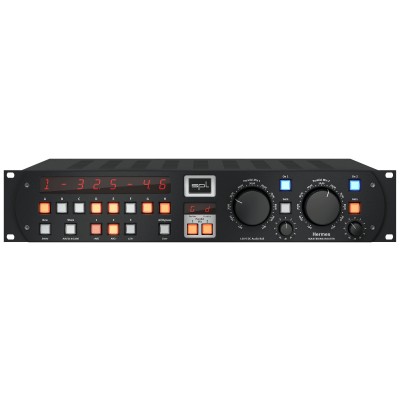
Hermes is designed for mastering engineers (and mix engineers focused on the "mix bus") who use multiple stereo analog processors and want reliable recall and immediate comparisons without complex patchbays or multiplying conversions. It's also a formidable tool for hybrid studios: you keep your DAW as the control center while benefiting from an analog architecture capable of chaining sophisticated processing cleanly.
Its value becomes clear as soon as you need to answer concrete, typical pro session questions: "This EQ before or after the compressor?", "What if we do 30% parallel on this VCA, then 10% on an opto?", "Which chain holds up best when pushing the level?" Hermes turns these hesitations into quick, reproducible, and perfectly comparable decisions.
The heart of Hermes is freedom: your signal can be processed by up to eight 2-channel processors (EQs, compressors, de-essers, saturations, M/S, etc.) in the exact order you decide. Once the chain is built, it can be stored and recalled, providing real comfort in modern mastering: consistency across tracks, client revisions, alternative versions, or simple A/B/C/D comparisons.
In mastering, quality depends not only on good gear but on the right scenario: the sequence of processing, their interactions, and the subtle tweaks that change perception. Hermes allows you to face off up to four chains and switch between them at the push of a button. You compare "structural" decisions (order, insertion, parallel) as easily as if you were toggling a simple bypass.
Where many setups stop at a single parallel path, Hermes offers two stages of parallel mix (dual Parallel Mix) that you can freely assign to the eight processors, then store with the chain. Practically, you can test two different compressions in parallel, each with its own level, without rebuilding your routing or changing your global gain staging.
This is especially effective for: enhancing impact without crushing transients, thickening low-mids without blurring the image, or adding cohesion to a mix while preserving openness. And since these parallels are designed for "mastering," the goal remains precision, quick decision-making, and reproducibility.
SPL's 120V technology relies on very high internal voltage (analog audio at +/- 60 V) and proprietary operational amplifiers designed to handle these conditions. Compared to more conventional circuits (often around +/- 15 V), this provides significantly greater headroom: your peaks pass without distortion, your serial processing remains clear, and connected devices operate in a more comfortable zone.
In practice, this translates to calmer, more detailed playback, a more stable sense of depth, and more natural behavior when driving a compressor or EQ with already high levels. For mastering, this is an immediate advantage: you gain confidence in micro-decisions, and your chain stays coherent even when multiplying stages.