30-day satisfaction guarantee or your money back
Call us : +33 257 880 074
 en
en 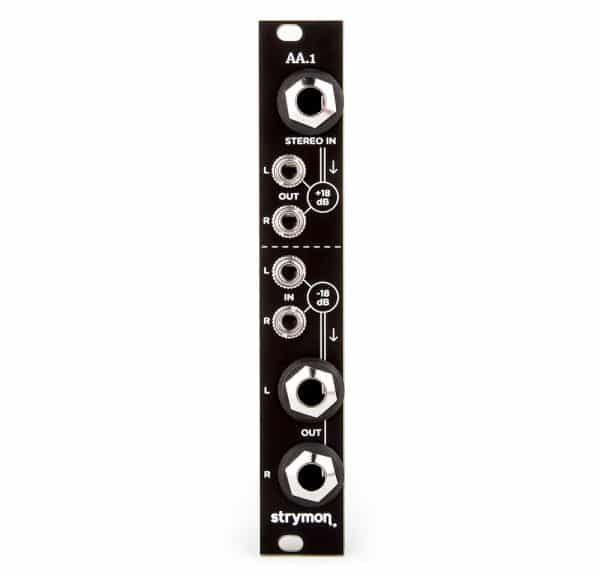
The Strymon AA.1 was designed for a very practical need: to make the "instrument level" world (guitar, bass, effect pedals) coexist with the "modular level" world (Eurorack), without patchwork or compromise. Eurorack modules can output high levels capable of saturating the input of a pedal or audio interface, while a guitar signal is often too weak to properly drive a module's audio input. The AA.1 sits at the heart of this workflow to boost what needs boosting and attenuate what must be brought back to instrument level.
This module is aimed both at guitarists curious about sound design and modular enthusiasts who want to integrate high-end pedals into a Eurorack chain. In the studio, it facilitates reamping and creative routing: sending a guitar into modular processing (filters, wavefolders, delays, granular, etc.), or conversely outputting from the rack to overdrive, modulation, or reverb pedals while maintaining the correct level. Live, the AA.1 secures the chain (less unexpected clipping) and speeds up patch changes thanks to a clear connection: instrument to modular, and modular to instrument level.
Regarding styles, it excels whenever textures and transformation are sought: ambient, experimental, post-rock, electro, techno, but also rock and modern pop to thicken a guitar with modular treatments. Bassists also find an effective solution to inject a clean signal into the modular system, then return to a rig or interface with controlled dynamics.
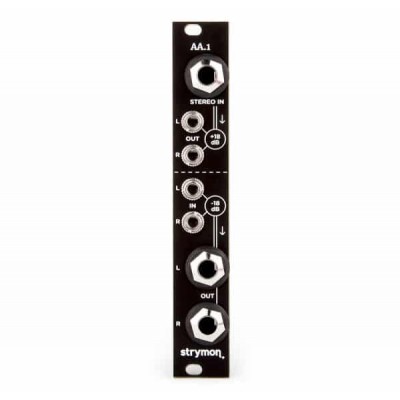
The AA.1 relies on a direct approach: no menus, no presets, just the right gain in the right place. Its stereo input in 6.35mm Jack format amplifies guitar-level signals up to +18 dB, then delivers this signal to the rack via 3.5mm mini-jack outputs left and right (use the left output for a mono source). In the other direction, the 3.5mm mini-jack inputs left and right receive a Eurorack signal and attenuate it by -18 dB, outputting to 6.35mm Jack outputs suitable for a pedal, amp, or audio interface at instrument level.
This dual section (amplifier and attenuator) allows very practical scenarios: connecting a pedal in a module's insertion loop (send/return), using the guitar as a source to sculpt in the modular, or retrieving a stereo output from your rack to gear designed for instrument level. The idea is to maintain a usable signal, with a comfortable headroom on the Eurorack side, without crushing the tone or creating unintended digital distortion downstream.
The Strymon AA.1 is not an effect in the "artistic coloration" sense: it is a gain management and impedance adaptation tool designed to remain faithful. Its behavior aims for a wide and even response to preserve the pick attack, sustain, bass transients, or the harmonic detail of a modular source. In practice, the sonic benefit is indirect but significant: by setting levels correctly, you regain a healthier dynamic, less clipping, a better perceived signal-to-noise ratio, and especially pedals that respond as expected (more controllable drive, cleaner modulations, delays and reverbs less "crushed" by an overly hot level).