The Essentials to Know About the Strymon Deco Pedal
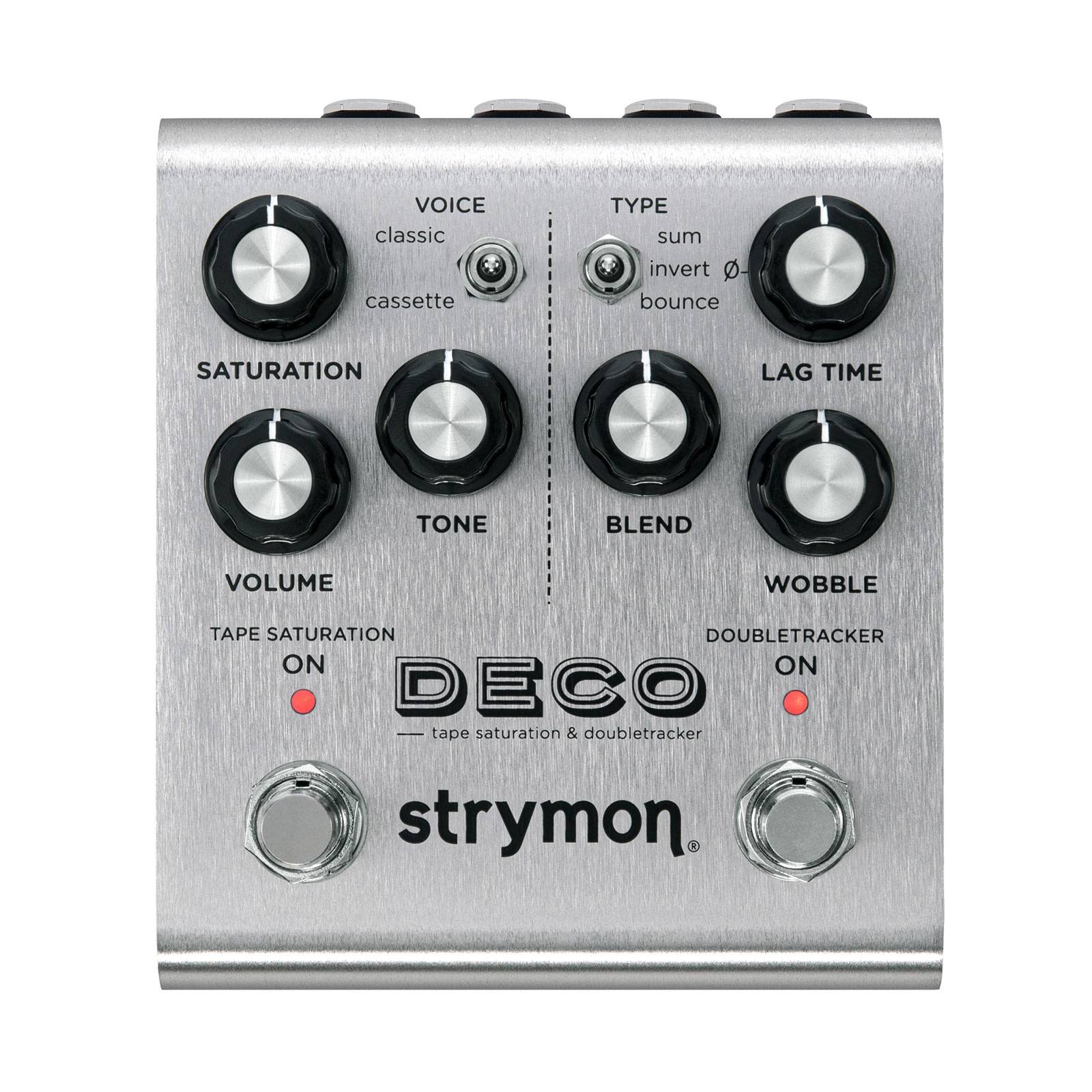
- Two complementary sections: "Tape Saturation" for tape compression/overdrive, and "Doubletracker" for short delays, tape chorus, and flanger effects.
- Second-generation version with new tonal options (ALC "cassette" voicing, "Tone" knob) and increased DSP power.
- Full MIDI control (TRS/USB-C), 300 presets, MIDI Clock synchronization for "Lag" time.
- Stereo inputs/outputs, "Studio" mode (+10 dB headroom), selectable true or buffered bypass.
From Tape Studios to Modern Pedalboards
Inspired by 1950s/60s tape recorders, the Deco recreates the warmth, smooth compression, and musical grain of these legendary machines. Where engineers once manipulated two decks to thicken and double takes, the Deco condenses these techniques into a compact, reliable pedal ready for both stage and studio.
Who Is It For and What Are Its Uses?
Ideal for guitarists and bassists seeking natural analog coloration, it also appeals to keyboardists and producers thanks to the "Studio" mode. From vintage blues to indie rock, silky pop to ambient textures, the Deco excels as a "sweetening" tool on a pedalboard, in studio inserts, or in effects loops.
Key Features and Controls
The "Tape Saturation" section adds compression, thickness, and transparent overdrive, now sculptable via a dedicated "Tone" knob and a new ALC "cassette" voicing that is richer and tighter. The "Doubletracker" offers micro-delays for doubling a take, syrupy short echoes, psychedelic tape flanging, and lush chorus, with precise control over "Lag" time, mix, and modulation.
The second generation brings full MIDI implementation (TRS and USB-C) to automate parameters and preset changes, a high-end JFET input circuit, selectable true/buffered bypass, a global +/- 3 dB boost/cut, stereo I/O in a compact format, and a modern ARM DSP for more nuance with less power consumption.
The Sound
Analog warmth, rounded transients, and musical compression characterize the "Tape Saturation," which responds impeccably to playing dynamics and guitar volume. The "Doubletracker" thickens the signal without clouding, from simple stereo widening to more pronounced modulated textures. The dynamic response of the JFET preamp preserves attack and clarity, while the new tonal options allow switching from a dark, smooth voicing to a brighter, more present sound.
Technical Specifications
Processing and Conversion
- 520 MHz superscalar ARM processor
- 32-bit floating-point processing
- 24-bit / 96 kHz A/D and D/A converters
- Frequency response: 20 Hz - 20 kHz
Connections and Controls
- High-impedance JFET Class A stereo TRS input, ultra-low noise (mono/stereo selection via rear switch)
- Independent low-impedance stereo TS outputs
- EXP input for TRS expression pedal, MiniSwitch, MultiSwitch Plus, or TRS MIDI
- USB-C port for MIDI and firmware updates
- Two dedicated footswitches: "Tape Saturation On/Off" and "Doubletracker On/Off"
MIDI and Presets
- Full MIDI implementation via TRS EXP/MIDI and USB-C
- "Lag" time synchronization via MIDI Clock, saveable per preset
- 300 MIDI preset slots
Audio, Bypass, and Gain
- Selectable bypass: relay true bypass or high-quality buffered bypass
- Global boost/cut: +/- 3 dB
- Audio input impedance: 1 M Ohm
- Audio output impedance: 100 Ohm
Build Quality and Dimensions
- Silver anodized aluminum chassis, sturdy and lightweight
- Dimensions: 11.4 cm (D) x 10.2 cm (W) x 4.4 cm (H) - 4.5" x 4" x 1.75"
- Designed and manufactured in the USA
Studio Mode
- Increased headroom by +10 dB for active basses, synths, keyboards, console inserts, and effects loops
Included Accessories
- 9 V DC power supply included
- Documentation
- Original box
Power Consumption
- Required power: 9 V DC center negative
- Consumption: minimum 300 mA
 en
en