30-day satisfaction guarantee or your money back
Call us : +33 257 880 074
 en
en 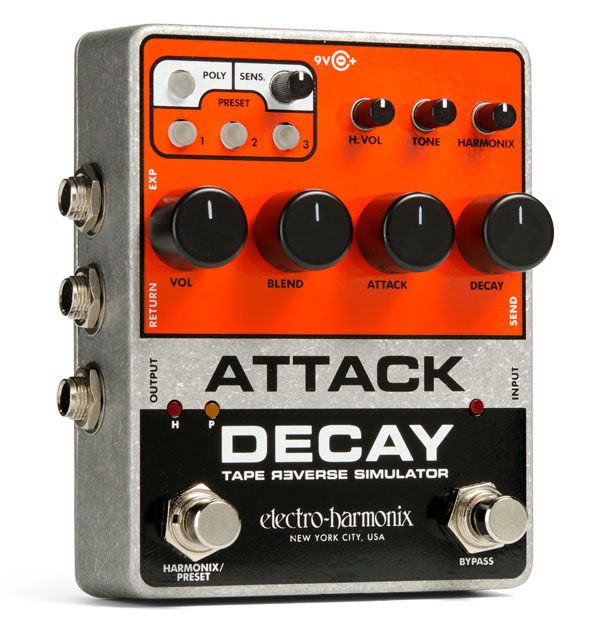
In the world of vintage pedals, the Attack Decay holds a unique place. Around 1980, Electro-Harmonix introduced an effect with an evocative name, initially presented as a "Tape Reverse Simulator": the idea is not to literally reverse your signal like tape but to recreate the sensation of sound "arriving backwards" through a volume envelope. The result: softened attacks, gradual swells, artificially shortened notes, and that "pulled" phrasing impression instantly reminiscent of bowing techniques or studio sounds.
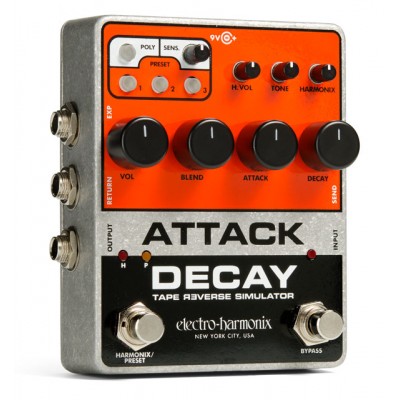
The current version of the Electro-Harmonix Attack Decay retains this creative grain and very "EHX" identity while bringing it into a more practical logic: memory, external control, and an effects loop to integrate your other pedals right into the heart of the envelope. A reinterpretation designed for today's musicians without losing the experimental charm that made the original model famous.
The Attack Decay is aimed at musicians who want to go beyond the traditional overdrive/delay combo and introduce a sound-shaping tool. In practice, it can be both a "signature" pedal and a subtle ingredient in a mix: it excels when seeking swells without a volume pedal, arpeggios that open progressively, or notes that cut off sharply to create pseudo-staccato rhythms.
Style-wise, it naturally fits in ambient, post-rock, shoegaze, film music, but also alternative rock and modern pop whenever a more "orchestral" guitar is desired. In the studio, it allows building very clean and consistent layers (especially in Poly mode). Live, it becomes an arrangement pedal: a simple sustained chord can turn into a hypnotic swell without changing right-hand technique.
At the core of the pedal is the volume envelope manipulation with adjustable attack (rise) and decay (fall) times. This combination grants access to "reverse-like" effects, progressive violin-style entries, or conversely very short, almost percussive notes. The pedal offers two triggering logics: Mono mode applies a single envelope at a time and resets it with each new note, favoring precise playing and clean phrases. Poly mode assigns an envelope to each played note: perfect for chords and layering, with a wider and more "synth-like" feel when stacking voices.
The built-in Harmonix fuzz section (fully adjustable) is a real plus: it can simply thicken the signal to make the envelope more present or become the basis of an aggressive, singing tone reminiscent of bowed instruments. Another strong point: the integrated effects loop allows inserting your own pedals inside the volume envelope. This is a huge creative lever: placing modulation, delay, or reverb "inside" the envelope does not react as if you just put them after in the chain, opening textures impossible to achieve otherwise.
Finally, the Attack Decay is designed for expression: you can control each setting via an expression pedal or a CV control. This allows evolving a slow swell into an ultra-fast one, transforming a lead line into a violin effect, or switching from a soft envelope to a sharp cut mid-song. And to move quickly in performance, it lets you save and recall up to three presets, handy for switching from a rhythmic setting to a pad setting without reprogramming everything.
The Attack Decay's sonic signature starts with a remodeled attack: the guitar loses its natural "pick attack" in favor of a rounder, more controlled onset. With longer attack settings, chords begin to float, ideal for airy layers that leave space for vocals or keyboards. With short decay, notes fade quickly, perfect for simulating short bow strokes or chopped patterns while maintaining a very musical touch.
Poly mode brings a broader feel to harmonies: each note "breathes" independently, avoiding the crushing effect when playing rich chords. With the built-in fuzz, the envelope gains a more organic and textured dimension: sustain, density, and grain combine to deliver expressive timbres between guitar, bowed strings, and synth. This is a pedal that rewards playing: by adjusting your attack, muting, and vibrato, you can go from ultra-clean swells to rawer, almost cinematic textures.