30-day satisfaction guarantee or your money back
Call us : +33 257 880 074
 en
en 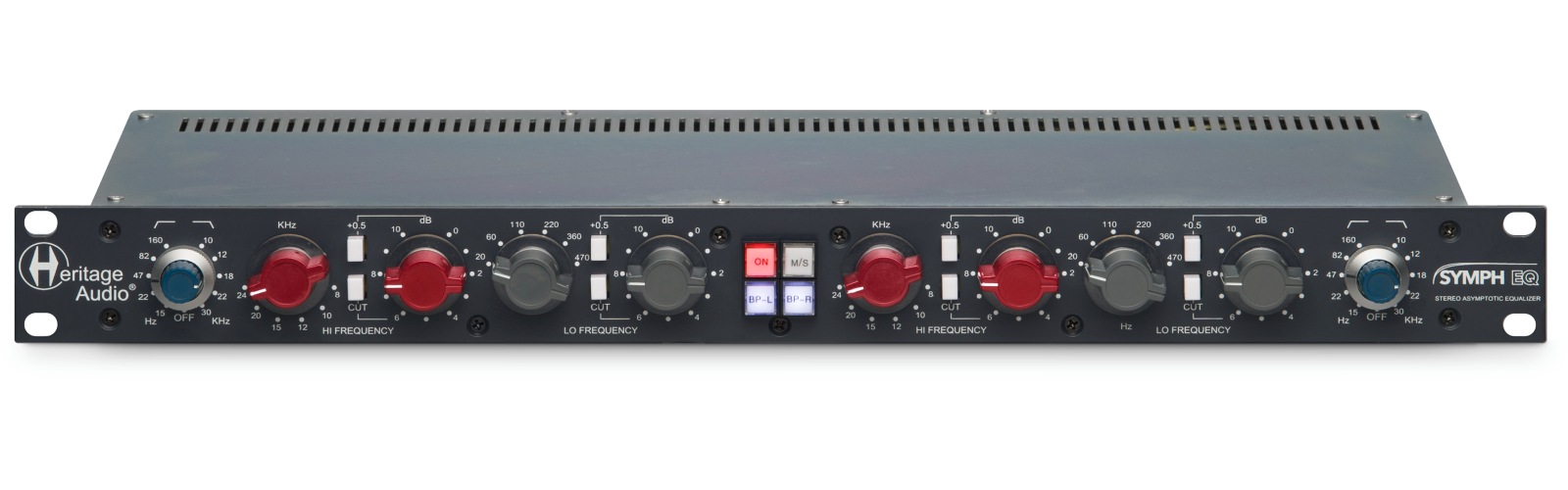
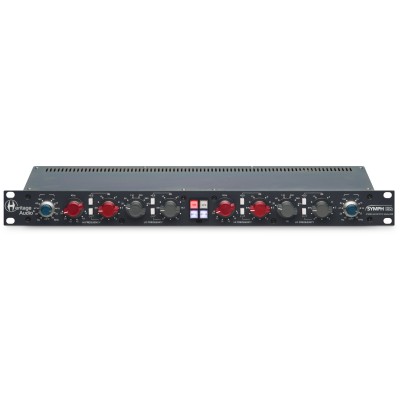
In 1952, Peter Baxandall popularized a now-iconic equalizer topology, notably for its elegant way of offering bass and treble corrections with boost and cut, without resorting to expensive rotary switches. The Heritage Audio Symph EQ adopts this philosophy of efficiency but translates it into an asymptotic concept designed for today's demands: more control at the spectrum extremes, an immediate sense of musicality, and ergonomics geared towards instant recall in mastering.
Placed at the heart of the brand's studio range, this approach makes the Symph EQ an equalizer dedicated to finishing touches: it does not seek spectacular effects but the fine-tuning that stabilizes a mix, opens the stereo image, and polishes the top end without harshness.
The Symph EQ is aimed at mixing and mastering engineers, as well as any studio wanting a 1U stereo equalizer capable of subtle interventions on a master bus, a stem, a subgroup (drums, music, vocals), or a summing chain. Its asymptotic behavior is particularly relevant when adding air or reinforcing the bass while keeping "at-risk" zones (sub and ultra-high) under control.
Thanks to the adjustment steps and control logic, it also perfectly suits hybrid workflows: settings can be documented and recalled quickly, reliable A/B comparisons can be made, and work can be done with half-dB precision on decisions that truly matter.
The core of the Symph EQ is based on so-called asymptotic equalization: the boost or cut curve gradually increases until reaching a limit value. The benefit is immediate on a master bus: you can impart character in the bass or treble without letting sub-bass overwhelm the dynamics or making the ultra-highs brittle. This curve philosophy is accompanied by parallel equalization aimed at maintaining exceptionally low phase behavior and artifacts, for corrections that remain natural even when fine-tuning at the very end of the chain.
The circuit and control layout have been optimized to achieve a maximum of 10.5 dB boost/cut with a granularity of 0.5 dB. The main rotary switch sets 1 dB steps, while a dedicated button adds +0.5 dB to the displayed value. A CUT button reverses the logic to turn boost into cut, making decisions quick and consistent: the same gesture, the same precision, whether boosting or cutting.
Each band offers six frequencies chosen to cover the truly useful zones on a final mix. In the high range, there are perfect points for presence and air, from controlled brilliance to very high openness. In the low range, the selections allow both tightening a "broad" bass and adding foundation without unnecessarily thickening the low-midrange.
To complement the equalization, the Symph EQ adds high-pass and low-pass filters on concentric rotary switches, with a slope of 12 dB per octave. The idea is simple: control sub-bass and ultra-high frequencies before (or during) tonal adjustments to prevent unwanted information from triggering compression, reducing headroom, or biasing the perception of brightness.
The Symph EQ features exclusive Carnhill input transformers made in Oxford, identical to those used in the Successor. On the output side, the design relies on Class A output amplifiers of the 73 type, paired with Carnhill St'Ives output transformers as in the rest of the family. The result: a sense of solidity, density, and cohesion perfectly suited for mastering use, while remaining transparent enough for subtle adjustments.
Where the Symph EQ truly shines is in its integrated Mid/Side (M/S) capabilities. This approach allows different treatment of the center content (kick, bass, vocals, snare) and the sides (ambiences, reverbs, width, overheads) with surgical precision but a musical result. It's a powerful tool to open the image without weakening the low end, brighten busy sides, or refocus energy in the mid.