30-day satisfaction guarantee or your money back
Call us : +33 257 880 074
 en
en 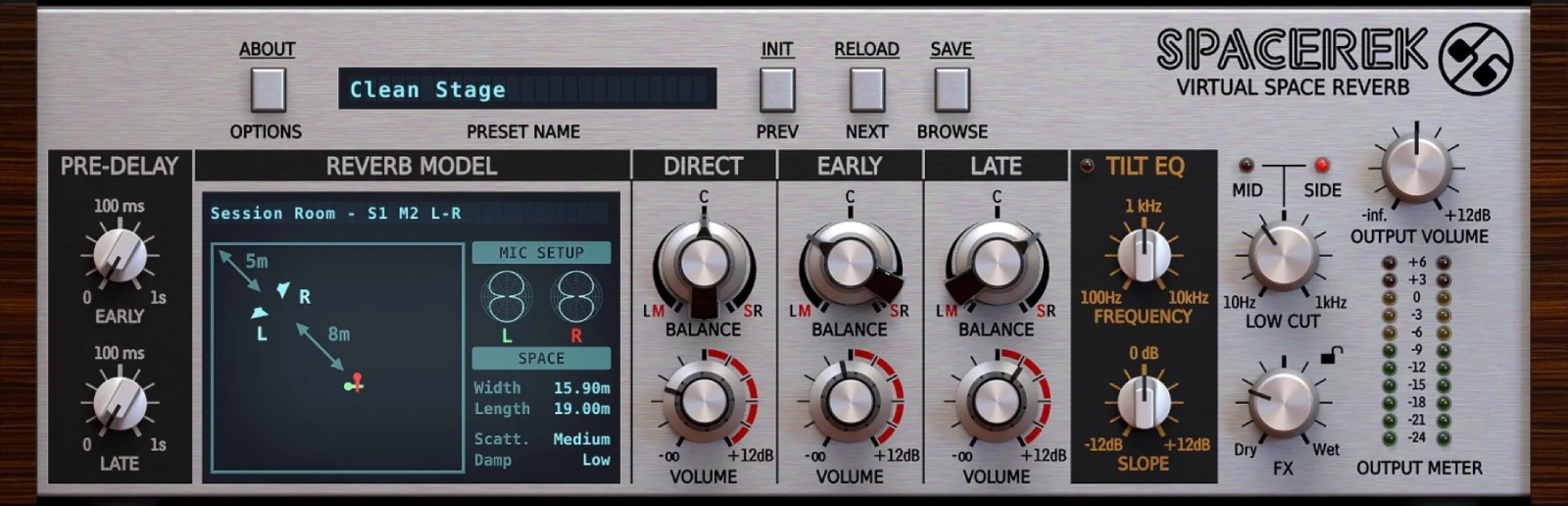
D16 Spacerek is a spatial processor designed to give a credible and lively dimension to your sources, whether you are in mixing (vocals, guitars, drums, synths, orchestra) or sound design (cinematic ambiences, evolving textures, depth effects). Its "Virtual Space" approach aims for a realistic room sensation right from the early reflections, which helps a sound to position itself naturally in a stereo field without stacking multiple effects.
Thanks to its structure that clearly separates early and late reflections, Spacerek is also very effective for creating "custom" spaces: a precise and clear attack followed by a broader, colored, and immersive tail. The result: reverbs that enhance the perception of distance and room size while maintaining control over mix clarity.
The Virtual Space Reverb engine generates early reflections based on a detailed simulation of real-inspired spaces. Each model is not limited to a "color" of reverb: it also includes the logic of positioning stereo speakers and microphones in the environment, providing a more credible stage sensation, particularly useful on vocals, percussion, acoustic guitars, and solo instruments.
For late reflections, Spacerek uses a dynamic delay network that blends smoothly with the early reflections. You get a dense and musical reverb tail, capable of ranging from a subtle studio ambience to more impressive spaces (tunnels, towers, chapels), without any glued feeling between the start of the space and its diffusion.
The dual control of Pre-Delay Early and Pre-Delay Late is a real mixing lever: you can independently delay the start of early and late reflections (up to 1 second) to preserve the attack of a source, improve vocal intelligibility, or create a more cinematic depth effect. Fine adjustment in nanoseconds, microseconds, and milliseconds facilitates precise settings, especially on fast transients (snare, clap, pizzicato, plucks).
Spacerek includes a simple mixer to balance the Direct, Early reflections, and Late reflections. This approach speeds up decisions: for example, you can keep a lot of early reflections to "anchor" an instrument in a room while reducing the tail, or conversely minimize early and boost late reflections for a more dreamy and enveloping reverb.
Two filtering modules help integrate the reverb into the mix without weighing it down. The Tilt EQ allows you to quickly brighten or darken the tail by shifting the bass/treble balance, while the Low Cut cleans up low-mid buildup and unwanted vibrations. The filter can target the mid and/or side, which is ideal for maintaining a solid center while opening up the sides.
Each reverb model is preconfigured to work in Left-Right or Mid-Side, making width and spatialization adjustment particularly straightforward. You can thus switch from a centered and controlled reverb to a wider image without losing placement coherence or mix balance.
Spacerek offers 114 models covering various spaces: booths, rooms, halls, tunnels, chapels, towers, and more. Each room type includes multiple microphone and diffusion configurations, multiplying staging options: close and intimate, wide and airy, or spectacular and deep. Useful for unifying a mix (space coherence) as well as creating contrasts between verses and choruses.
To adapt to all studio setups, Spacerek offers multiple interface sizes with HiDPI support. MIDI Learn simplifies parameter assignment to a controller, useful for real-time automation of depth, early/late levels, or tail tonality, especially in live or studio performance.