30-day satisfaction guarantee or your money back
Call us : +33 257 880 074
 en
en 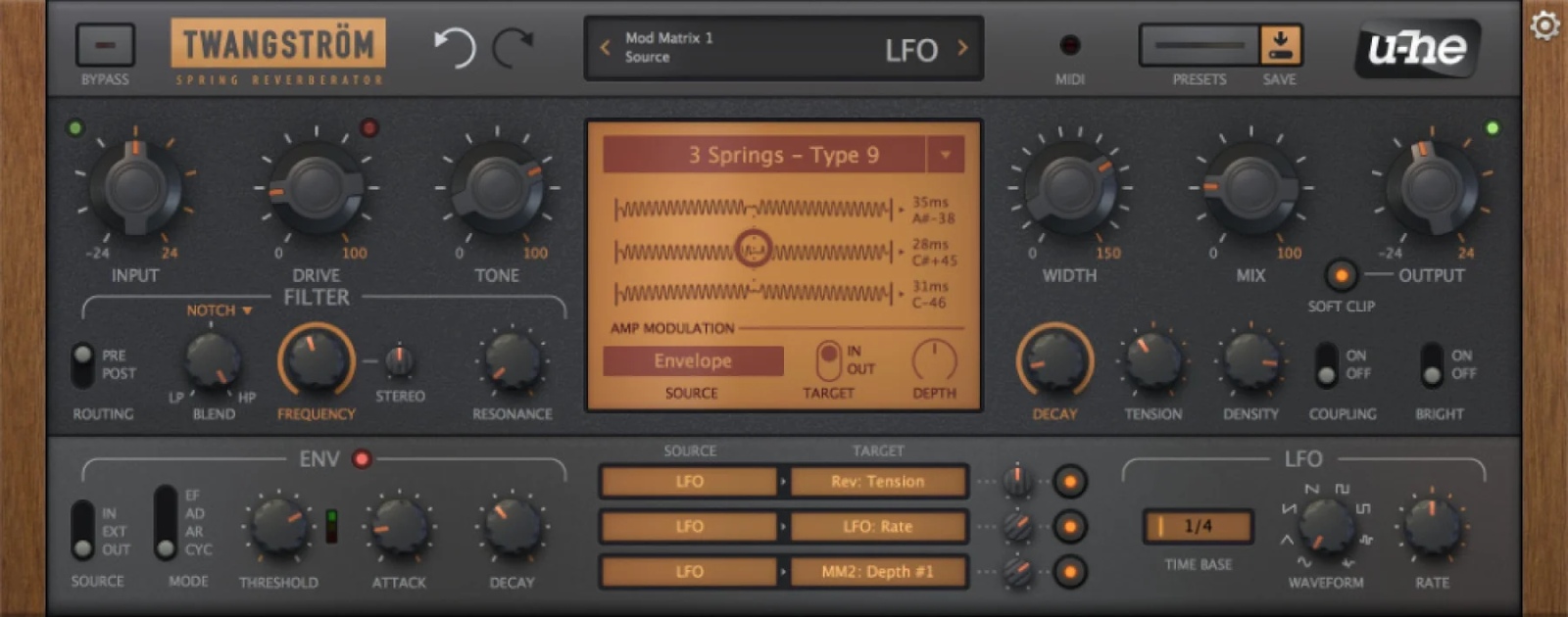
u-he Twangstrom is an effect plug-in designed to recreate and repurpose the behavior of a spring reverb. It is suitable both for adding vintage depth to a guitar, organ, Rhodes, or snare drum, and for transforming modern sources (synths, vocals, drums, FX) into unstable, bright, metallic, or outright experimental ambiances. Thanks to its modulation modules and resonant filtering, Twangstrom excels in productions seeking movement and personality: rock, dub, psychedelic, electro, ambient, sound design, and film music.
Unlike a convolution reverb (IR) that reproduces a fixed result, Twangstrom relies on physical modeling: it simulates the wave's path through a mechanical system, including excitation, reflection, dispersion, and interference phenomena. The result is a more organic reverb with a response that finely reacts to the signal. To capture the unruly aspect of a real spring, the Twang parameter allows you to "shake" the mechanics manually, via automation, or modulation, adding micro-accidents and making the sound "breathe."
The plug-in offers 3 reverb tanks inspired by classic models found in legendary amplifiers. To shape the sound, Twangstrom adds a drive and tone section: ideal for thickening a source, dirtying the reverb tail, accentuating the attack, or conversely softening the highs. It's an excellent way to integrate the reverb into the mix without losing character.
Twangstrom includes a resonant multimode filter with a variable blend type, perfect for shifting from a bright reverb to a darker ambiance or creating synth-style sweeps. To animate everything, the modulation matrix provides 3 versatile slots and can even target the "shake" (Twang) control to achieve evolving textures, subtle oscillations, or more chaotic movements.
The envelope offers 4 modes (Envelope Follower, Attack/Decay, Attack/Release, Cyclic) and can analyze the input, output, or an external sidechain to trigger dynamic effects: reverb opening on the snare, tremble controlled by vocals, resonances following the bassline, etc. The LFO provides several time bases, including a free-running mode in seconds, as well as sync options with dotted and triplet values. With 8 waveforms (including stepped or smooth random), it's easy to set up rhythmic or organic modulations.