30-day satisfaction guarantee or your money back
Call us : +33 257 880 074
 en
en 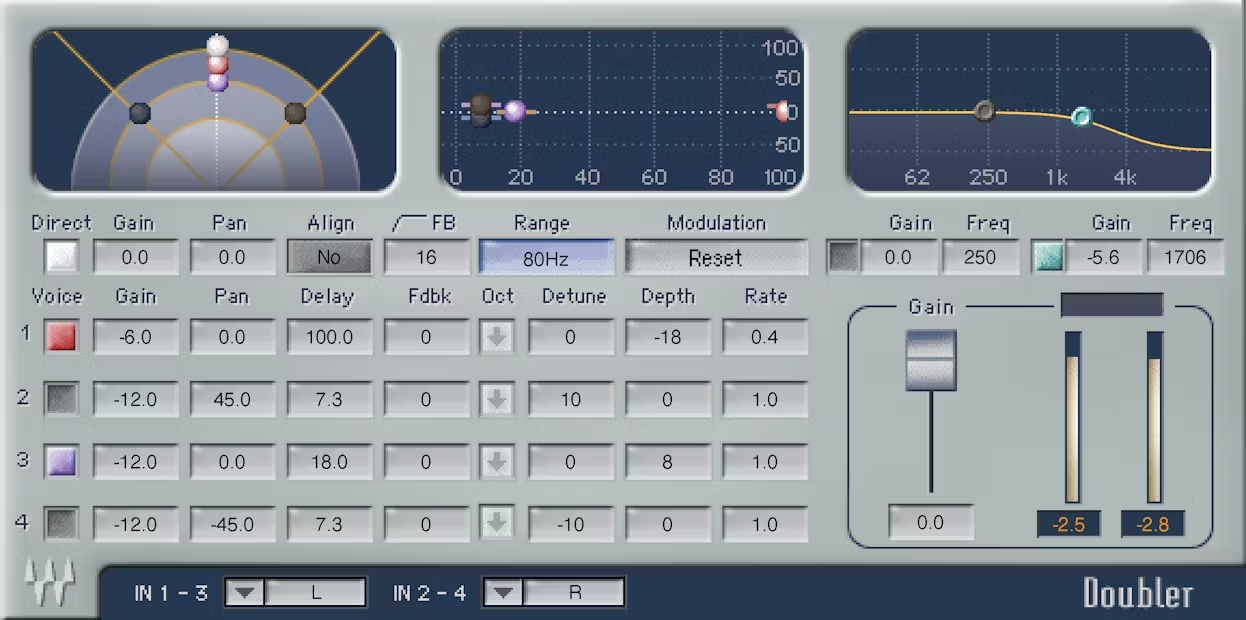
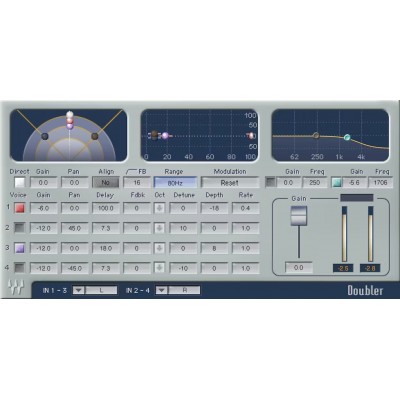
Waves Doubler is a doubling and stereo widening plugin designed to create the illusion of multiple takes from a single source. It is mainly used on lead vocals (to make them denser and more "forward"), background vocals (to embellish and spread them), as well as on instruments like acoustic guitar, keyboards, strings, or any mono element to "open up" in the mix.
Thanks to its 4-voice structure, Doubler can also serve as a tool for light harmonization, micro-chorus, or space generation on subgroups. On buses or even a master, it adds a sense of width and imaging, with precise control to avoid cluttering the center.
The core of Doubler is based on 4 independent delay lines, each equipped with the same parameters to build a custom doubling effect. You can set short delays for a very natural "studio" thickening, or push the value up to 100 ms for more spatial and pronounced effects.
Each voice has pitch modulation (depth and speed) to introduce micro-variations close to a real double take. Then add detune (up to plus or minus 100 cents) to enrich harmonic thickness, or activate the one octave down option to reinforce body, create a foundation, or explore sound design textures.
To sculpt the space, Doubler offers per-voice panning and fine level management. The workflow is accelerated by a graphical display with drag-and-drop for gain and pan, ideal for quickly placing each voice in the stereo field and building a wide, stable, and musical image.
Beyond doubling, Doubler becomes a true creative tool: use straight delays for a soft and airy rendering, then increase modulation and pitch shifting for more movement. By raising the feedback, filtering, extreme panning, and playing with pitch, you get more radical effects: evolving textures, modulated echoes, "bell tree" impressions, and atypical treatments for sound dressing.
The output shelving filters help integrate the effect into the mix: they can boost up to +12 dB or cut up to -24 dB depending on the range. It is also possible to filter the feedback path to avoid frequency buildup and keep the effect clean, even when repetitions are pronounced. Finally, the ability to reset all modulation via automation facilitates clean transitions between sections (verse, chorus, break) and spot effects.