30-day satisfaction guarantee or your money back
Call us : +33 257 880 074
 en
en 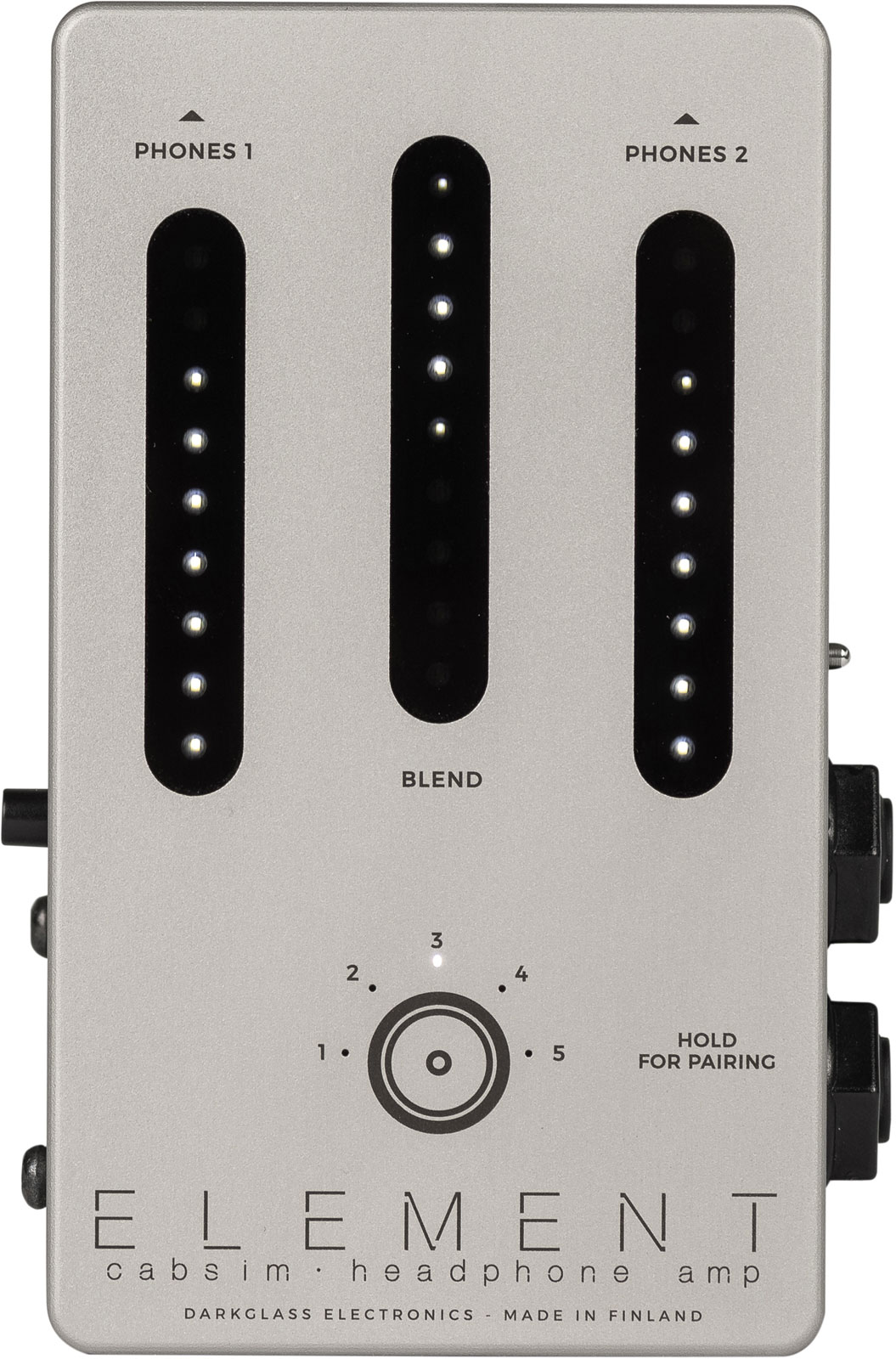
With the Element, Darkglass offers a compact solution designed for musicians who want to regain realistic feel without relying on a loud amp. The idea is simple: keep the touch of your instrument and pedals, then finalize the sound with a speaker simulation (and the ability to load impulse responses) to get a coherent sound on headphones, in the studio, or directly into a console during a gig.
At the crossroads of a DI, a practice tool, and an IR loader, the Element naturally fits on a pedalboard: you keep your usual effects chain and finish with a clean, controlled output usable anywhere.
The Darkglass Element is aimed at both guitarists and bassists looking for a reliable solution to play silently on headphones at home, rehearse quietly, work on precision with a metronome, or record ideas without setting up a mic in front of a cabinet. Beginners will appreciate its ease of use, while experienced musicians will see it as a monitoring "hub" and a direct output ready for the studio.
It is especially comfortable in home studio, rehearsal, lessons, and live contexts (in-ear monitors, mixing console). The dual headphone output facilitates sessions for two, and the auxiliary/Bluetooth input makes work sessions smoother: playbacks, demos, backing tracks... everything stays in one place.
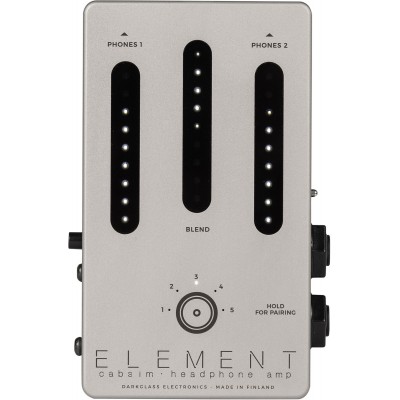
The Element focuses on immediate usability: three main controls to manage your headphone outputs, adjust the blend (dry/cab sim), and select the speaker simulation. The 5 speaker simulations provide effective starting points, then editing becomes more advanced via the USB-C connection: you can load your impulse responses and tweak various parameters from a computer.
To adapt to all sources, an input attenuation selector (0 dB / -12 dB / -30 dB) manages levels, whether you plug in an instrument, a hotter pedal output, or an already preamplified signal. The Ground lift button ensures safe integration into PA systems and reduces the risk of ground loops in certain setups.
The Element's character primarily depends on your chain (instrument, drive, preamp, modulation), but its role is clear: to provide a credible cabinet-style finish, more natural and more "mixable" than a raw direct signal. The speaker simulation helps smooth harsh highs, adds coherence to the spectrum, and restores that "displaced air" feel expected from an amplified sound, even on headphones.
Thanks to the blend control, you can switch from a very direct sound (sharp attack, immediate feel) to a more "cab" sound (tight low end, softened high frequencies), allowing you to adjust the response to your playing, perception of dynamics, your headphones, style, and monitoring volume.