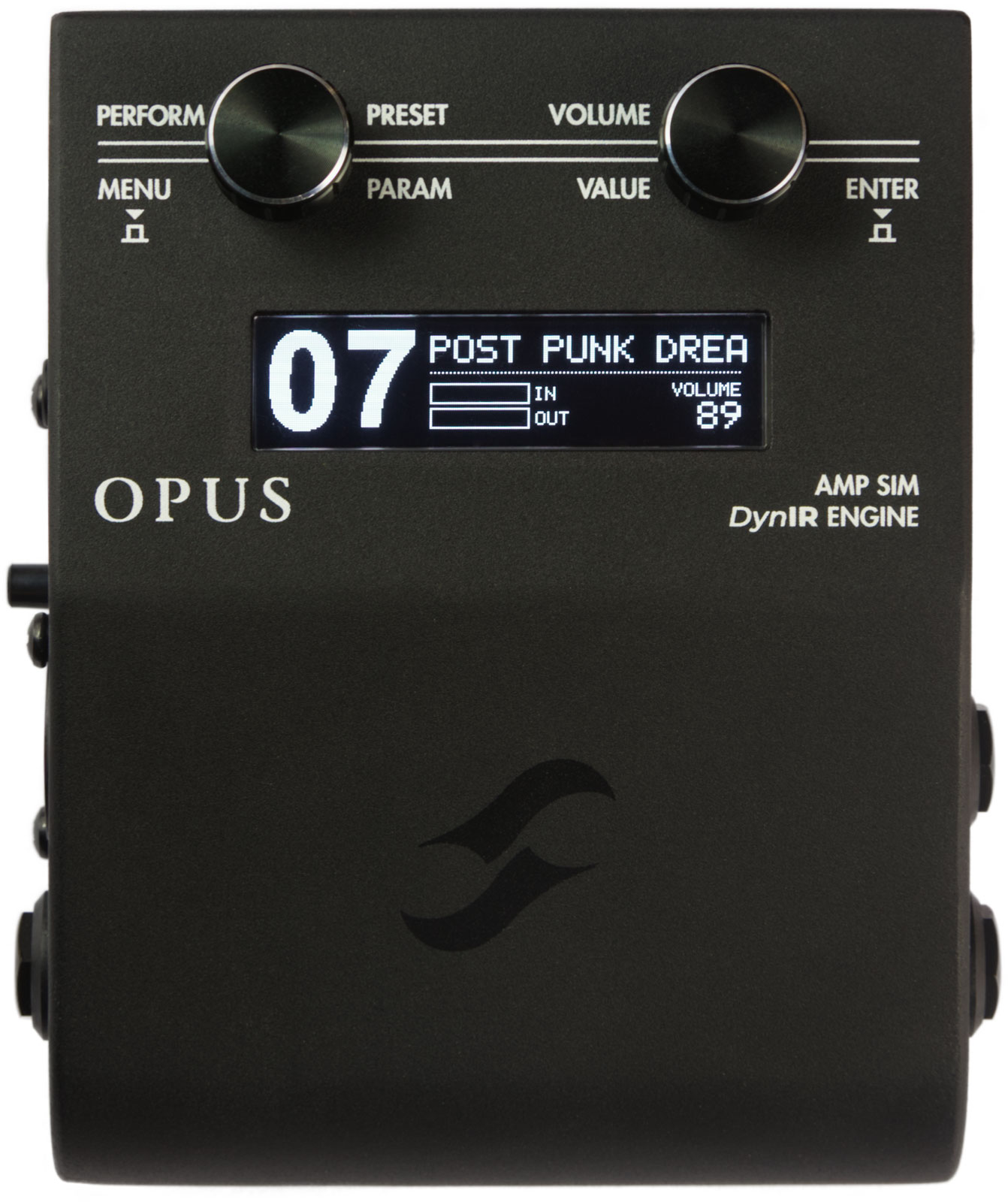
The Essentials to Know About the Two Notes Opus Simulator
- Amp Sim + DynIR Cabinets in an ultra-portable pedal format, designed for studio, stage, and headphone/DI use.
- Tube-Stage Modeling (TSM): 5 built-in preamps + 10 slots ready for future models via free firmware updates.
- High-end DynIR engine: dual microphone capture, 8 mics per cabinet, 12 room ambiances, and a large library of preloaded cabinets.
- Modern control: MIDI, USB-C, and Torpedo Remote integration for editing, preset management, and quick sound tweaking.
A New Level in the Torpedo Ecosystem: From C.A.B. to Opus
With the Opus, Two Notes extends the DNA of the Torpedo pedals renowned for their DynIR cabinet simulation by adding a true "full amp" approach through TSM modeling. The idea is simple: to recreate the feel of a tube preamp and power amp while maintaining the precision and flexibility of the cabinet simulation that has become the brand's signature.
Who It's For, Which Styles, and In What Contexts?
The Opus is aimed at guitarists (and pedalboard users) who want professional sound direct: recording, silent rehearsal, live with in-ear monitors, or as a clean/platform edge-of-breakup base to stack your overdrives and fuzz pedals. From detailed clean tones to high-gain saturation, including more "British" flavors, it fits equally well in a small minimalist pedalboard or a full MIDI setup.
Controls, Simulation Engines, and Workflow
At the heart of the Opus, the TSM amp section offers 5 preamp emulations, complemented by a power amp simulation with 4 tube models (6L6, EL34, EL84, KT88). You can shape the response via Pentode/Triode architectures and Push-Pull (Class AB) or Single Ended (Class A) topologies. On the cabinet side, the DynIR allows for dual microphone capture, access to 8 mics per cabinet, and 12 room simulations, enabling you to switch from a tight, close sound to a wider, mix-ready image.
To finalize, a set of DSP tools is integrated: equalizer, enhancer, noise gate, and reverb. The Opus features 99 preset slots and a collection of DynIR cabinets from the Opus series (32 cabinets), including captures associated with Steve Stevens, Dave Friedman, Pete Thorn, George Lynch, and Phil X.
The Sound
The Opus's sonic signature is based on an "amp" playing feel: precise attack, pick-responsive dynamics, and saturation that cleans up naturally depending on your volume and touch. The DynIR engine provides realistic depth (mic placement + room) and definition that helps you quickly find a mix-ready sound, whether modern and tight or more open and organic.
Technical Specifications
Digital Audio
- AD/DA Converters: 24-bit / 96 kHz
- Frequency Response (-1 dB): 30 Hz - 19 kHz
- Dynamic Range: 101 dB
- Internal Processing: 32-bit floating point
- Latency: 2.2 ms (line input to line output)
Simulation, IRs, and Presets
- Amp Sim + DynIR Engine platform with Tube-Stage Modeling (TSM)
- 5 TSM preamp emulations + 10 slots for future models (free firmware updates)
- TSM power amp: 6L6 / EL34 / EL84 / KT88 tubes
- Modes: Pentode / Triode, Push-Pull (PP) "Class AB", Single Ended (SE) "Class A"
- DynIR: dual microphone capture, 8 mics per cabinet, 12 room simulations
- DSP Effects/Processing: equalizer, enhancer, noise gate, reverb
- IR: dual static IR loader + acoustic DI, over 40 acoustic impulse responses included
- Presets: 99 slots + over 40 artist presets available for download after product registration
Connectivity & Control
- Torpedo Remote integration: iOS / Android / macOS / Windows (wireless and USB) for editing, preset management, and real-time listening to over 600 DynIR cabinets
- MIDI input (MIDI cable included)
- USB-C for data transfer
Format
- Compact, ultra-portable metal chassis
- Dimensions: 121 x 100 x 60 mm
- Weight: 450 g
Included Accessories
- 1x OPUS unit in a protective pouch
- 1x power adapter
- 1x USB cable
- 1x 256 MB memory card
- 1x MIDI to mini-jack cable
- 1x quick start guide
Power Consumption
- Required voltage: 12V DC
- Polarity: center negative
- Current: 200 mA
- Power consumption: approximately 2 W
- Adapter connector provided: 2.1 mm x 5.5 mm
- Maximum current (adapter provided): 2000 mA