30-day satisfaction guarantee or your money back
Call us : +33 257 880 074
 en
en 









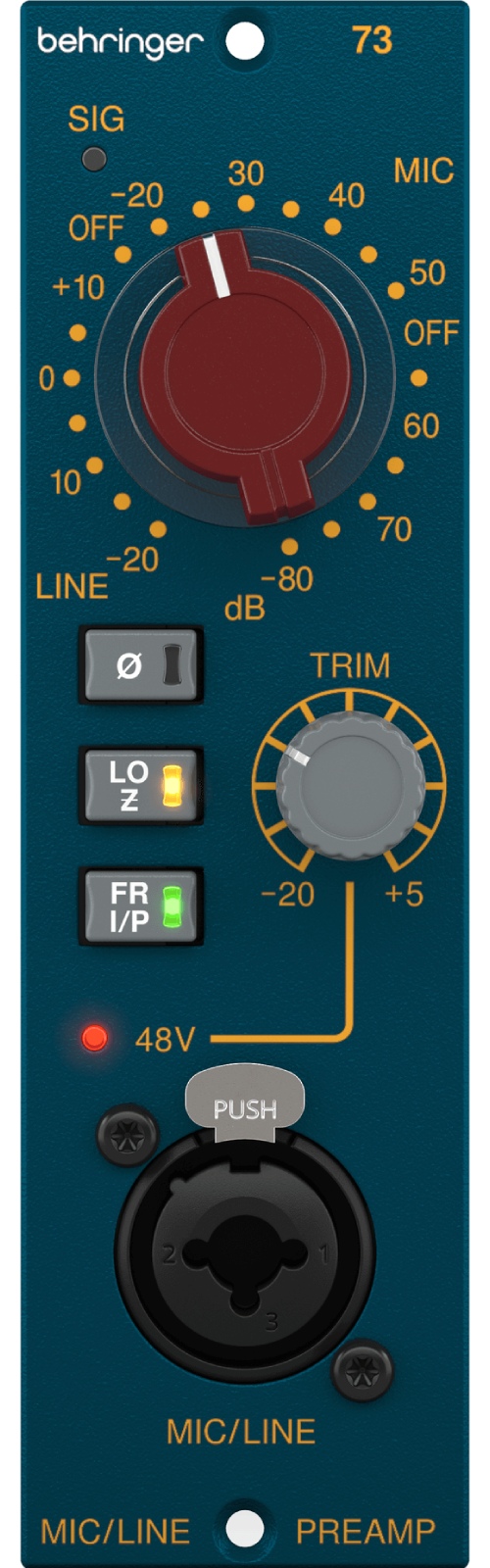


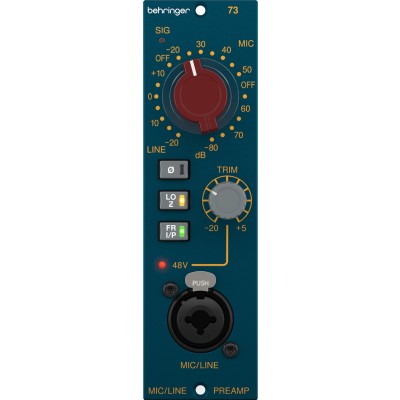
The 1073 is one of those devices that have marked recording history: a mic preamp synonymous with presence, density, and analog "finish" on vocals and instruments. This type of sound is associated with legendary studios and artists who defined decades of production, from rock classics to contemporary pop productions.
With the Behringer 73, the goal is not to evoke nostalgia but to make this character accessible in a more compact format, designed as a condensed version of the Behringer 1273. The project claims technical continuity and fidelity to the original philosophy, while meeting current sound engineering constraints: easy integration, channel stacking, and smooth association with the rest of your processing chain.
The development relies on the expertise of an original engineer, whose feedback and experience aim to ensure that the 73 not only references a classic but respects its sonic spirit in an approach adapted to modern production.
The Behringer 73 targets demanding home studios as well as advanced production environments seeking a studio mic preamp capable of adding character without complicating workflow. It is ideal for enhancing a recording chain focused on musicality: lead vocals, backing vocals, acoustic guitars, miked amps, drums (close mics, overheads), or any source where a more "produced" texture is desired right from the recording stage.
Its compact positioning and direct lineage to the 1273 also make it an excellent choice if you like building custom chains: the 73 naturally pairs with your favorite equalizer and/or compressor to create a tailor-made channel strip. And if you work in multitrack, the idea of "creating a whole range of preamps in a single rack" becomes tangible: you standardize the base color, then modulate the rest according to each source.
The 73 is described as a 1273 in a compact chassis and shares the same architecture. In practice, this means a coherent approach for those who like the 1273 but want a format that's easier to multiply, place, and combine with other processing modules. It's a very "studio" logic: a preamplification block with a strong character, followed by total freedom on EQ and dynamics downstream.
At the heart of the Behringer 73 is a Class A discrete circuit. This design aims to maintain high signal integrity and a musical response, with coloration announced as minimal. In a recording context, the benefit is twofold: retaining the precision required for modern productions while benefiting from an analog foundation that helps the source sit more naturally in the mix.
The input and output stages are equipped with custom-made Midas transformers. This is a key point for those seeking a sense of density and stability on transients while maintaining clarity and signal integrity suited to current demands. In recording, this type of component choice directly contributes to the preamp's identity: a solid, coherent reproduction that is pleasant to process afterward.
The Behringer 73 is housed in a solid steel chassis. Beyond the feeling of robustness, this aspect contributes to better durability and isolation from other equipment in a setup (power supplies, adjacent modules, dense cabling). This detail matters when gear lives in a rack, moves during sessions, or needs to remain reliable over the long term.