30-day satisfaction guarantee or your money back
Call us : +33 257 880 074
 en
en 









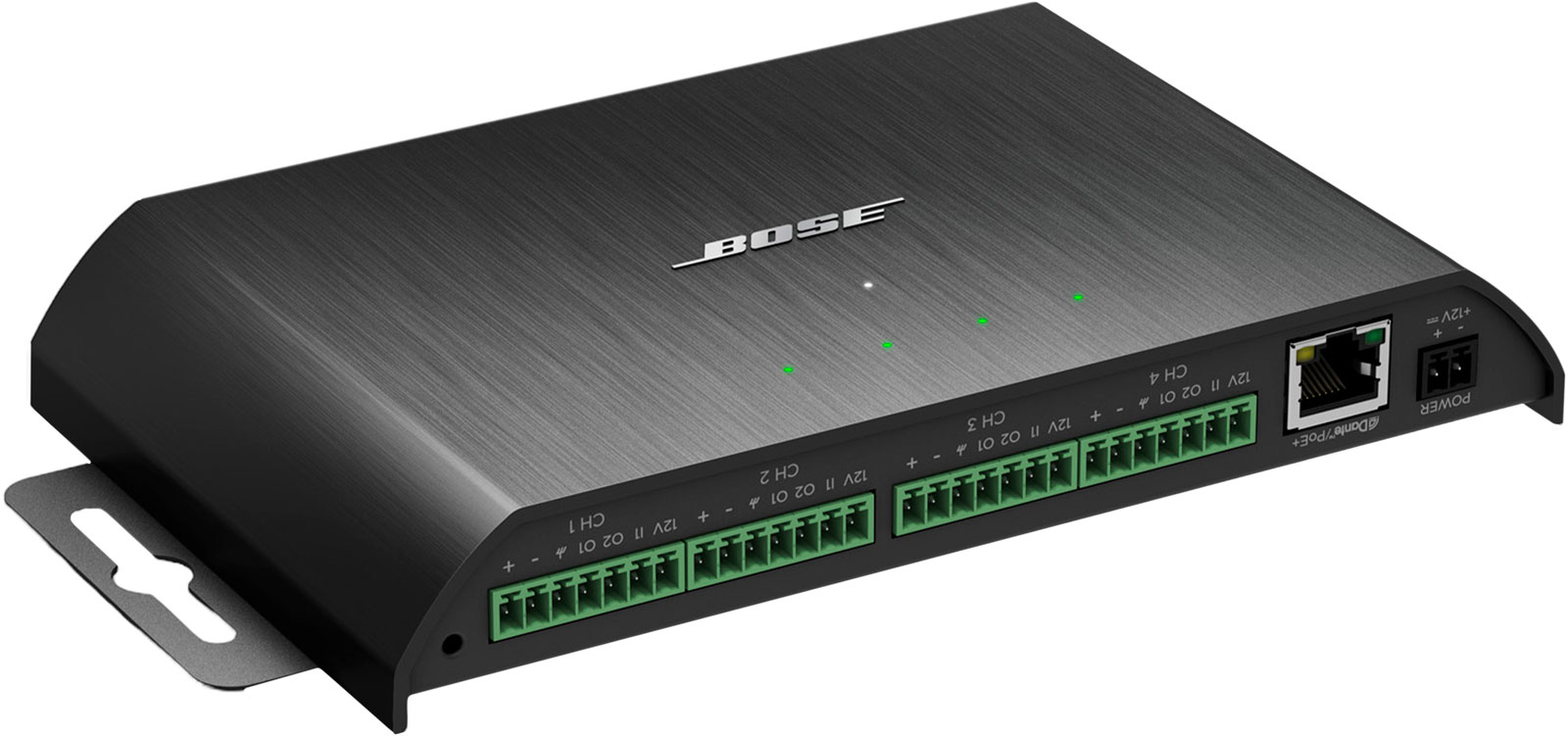


The Bose Pro EX-4ML fits within the logic of audio-over-IP extensions: bringing connection points closer to users (conference tables, lecterns, stages) while centralizing audio processing in a compatible processor. This approach reduces analog cable lengths, simplifies maintenance, and facilitates system evolution (adding stations, reconfiguring a room, changing usage).
Within an integration-focused range, the EX-4ML plays a clear role: providing 4 mic inputs where you need them, while maintaining a consistent deployment over a Dante audio network. It thus becomes a particularly relevant link for medium to large installations, with multiple zones, multiple tables, or frequent flexibility needs.
The Dante EX-4ML terminal primarily targets environments where voice intelligibility, reliability, and quick installation are essential: meeting rooms, medium and large conferences, courtrooms, distance learning, auditoriums, and multi-purpose spaces. In these contexts, the multiplication of microphone sources and the need to keep cabling discreet make the network solution particularly effective.
It is suitable for both integrators and internal technical teams (municipalities, companies, educational institutions) who want a system that can be deployed and adjusted quickly without complicating topology: connect the microphones, integrate the terminal into the network, and finalize routing in the software.
The EX-4ML allows connection of 4 conference microphones via Cat 5/6 cable, a solution particularly suited when distances increase or when bulky analog bundles are to be avoided. In practice, this provides a clearer installation, better scalability, and perfect consistency with professional audio-over-IP architectures.
With its 2 Dante RJ-45 ports, the terminal naturally integrates into a Dante infrastructure. This connectivity facilitates networking and cable management in racks or conduits, while aligning with common deployment methods in integrated audiovisual systems.
The design emphasizes quick configuration: automatic discovery, automatic routing, and drag-and-drop logic. The goal is to reduce manual steps and secure startup, especially useful when replicating a design across multiple rooms or when rapid intervention is needed before a meeting, hearing, or recording.
Depending on the microphones used, the 48V phantom power can be software-selectable, allowing proper adaptation of each input to the microphone inventory's needs. The simplified mic LED configuration also helps achieve consistent behavior in the room (visual cues, status, usage) while limiting tedious adjustments.
Finally, the terminal relies on ControlSpace Designer 5.0 or later on Windows for configuration, offering workflow continuity with existing ControlSpace installations.