30-day satisfaction guarantee or your money back
Call us : +33 257 880 074
 en
en 









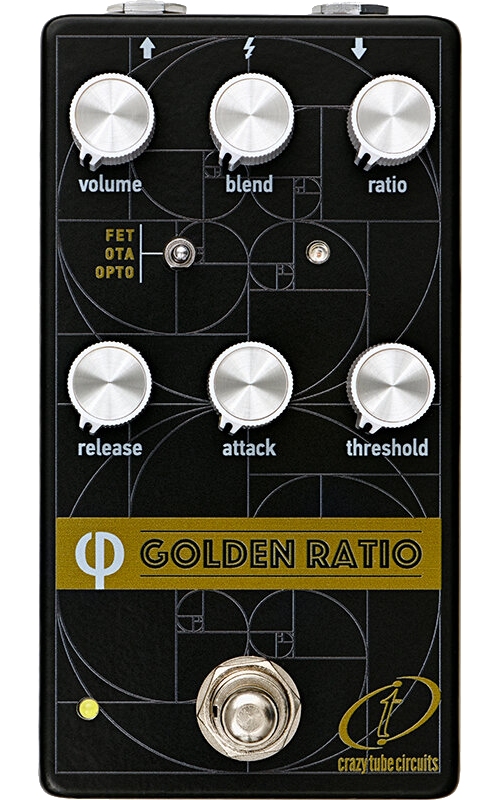


The Golden Ratio Phi was designed as a true "compression toolbox": instead of a single fixed-character circuit, it offers three independent analog architectures, each with its own voice and way of responding to your playing. This approach allows you to choose the compression based on the role in the mix: transient control, sustain, smoothing, or simple signal enhancement. The result: a pedal capable of covering typical studio uses while remaining immediate on a pedalboard.
The Phi is aimed equally at demanding guitarists and bassists seeking a silent, precise, and versatile compressor. In clean settings, it provides tightness and clarity for funk, pop, country, jazz, or worship. In crunch and overdriven tones, it helps stabilize levels, even out riffs, and make leads more present without pushing volume.
On stage, its low noise and full frequency response make it an excellent choice for modern pedalboards. In the studio, the parallel compression and three voicings allow fine-tuning placement in the mix, whether you play directly into an interface, in front of an amp, or on instruments other than guitar and bass.
The heart of the Golden Ratio Phi is its circuit selector, granting access to three compression personalities. An intelligent internal switching circuit lets you choose the compression type that matches your musical intent, with a very wide ratio range (from 1:1 to 20:1). Each analog circuit is completely independent, so the control behavior, response, and feel under your fingers truly change from one mode to another.
The pedal also includes an internal 9V or 18V DC choice, from a standard 9V DC power supply thanks to an internal voltage multiplier. The 18V setting increases headroom: useful if you play loudly, use high-output pickups, stack boosts, or seek a more "open" compression less prone to saturation.
The FET mode delivers a distinctive color and potentially very fast response: ideal for adding bite, emphasizing attack, and injecting a bit of character, with the possibility of slight musical distortion when pushing the circuit. The TA mode offers a more direct and punchy behavior, very effective at capturing fast transients, tightening rhythmic playing, and moving toward more pronounced limiting, while maintaining a very controllable feel. The OPTO mode, with its hand-selected photoelectric cell, favors softer attack and release: an organic, round, and "singing" compression, capable of being very neutral when you just want to enhance the signal without revealing the pedal is engaged.
Thanks to the parallel compression, you retain the grain and dynamics of your instrument while adding tightness, sustain, and a very "studio" clarity. Even with little gain reduction, the Phi can give the impression of a more solid, clearer, and better-situated signal in the mix, with very low background noise.