30-day satisfaction guarantee or your money back
Call us : +33 257 880 074
 en
en 









Complete software

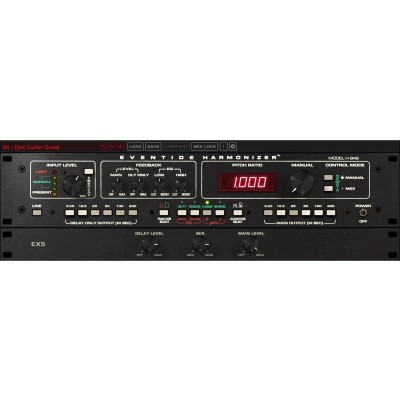
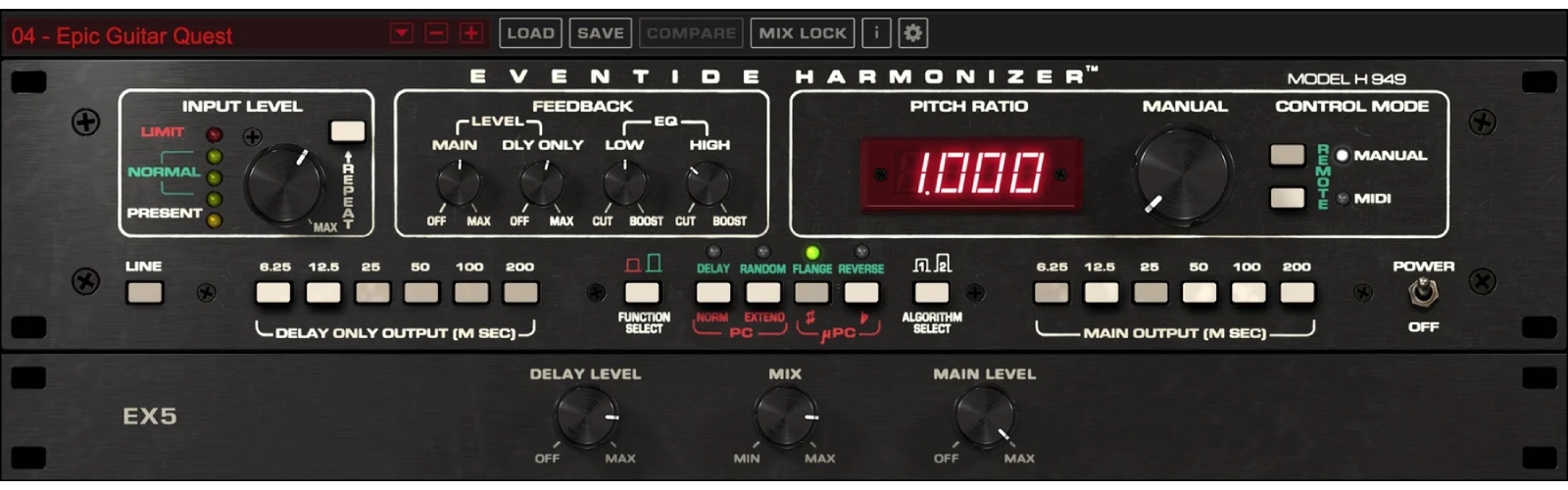
H949 Harmonizer is a creative and utility effects plug-in focused on pitch shifting and delay, designed for both mixing and sound design. It allows you to build harmonies, define musical intervals on a monophonic source, or push the signal towards more radical treatments: "otherworldly" vocals, widened guitars, destabilized synths, thickened drums, and spectacular reverse transitions.
In production, it excels at "quick but decisive" tasks: doubling a track without copying it, adding width to a chorus, creating a choir effect on a lead vocal, or transforming a simple synth note into a living pad. In post-production and sound design, the reverse, modulation, and randomization functions become a playground for mechanical ambiances, moving drones, and variable-speed tape effects, all while remaining controllable and synchronizable to musical intent.
The H949 is historically recognized as one of the first "de-glitched" pitch shifters. This approach aims to reduce typical pitch-shifting artifacts to maintain a more stable feel on vocals, guitars, or harmonic instruments. However, the plug-in is not limited to cleanliness: you can intentionally simplify the crossfade algorithm to regain a more "rough" behavior, useful for granular textures, lo-fi effects, or deliberately unstable attacks.
The MicroPitch function is ideal when you're not seeking obvious harmonization but rather a sense of size and depth. By applying very slight pitch shifts, you get natural thickening and a wider stereo image without falling into an overly pronounced chorus effect. On vocals, this can bring a "radio-ready" presence; on guitars, an impression of double tracking; on synths, an instant openness that lets reverb and delay breathe.
The H949 offers rare combinations of delay, pitch shifting, and nonlinear behaviors. Reverse delays allow you to create sucked-in rises, swells, and very cinematic links between phrases, particularly effective on guitar leads or isolated vocals. Randomized delays introduce a controlled element of unpredictability, perfect for evolving ambiances without obvious loops, or to break a synth pattern's monotony.
Beyond a simple flanger, the Harmonizer architecture provides access to unique modulation colors: more metallic, more unstable, sometimes "tape-like" in spirit. It's an excellent base for sci-fi effects, pronounced phase movements, or dub treatments where you want to feel the sound shift into another dimension. On a snare drum, a light treatment can densify the impact; on an effects bus, a more aggressive setting can transform a mundane source into a sonic signature.
The native version includes H949 Dual, which replicates the popular use of two units in parallel. This configuration is formidable for modern mixes: you can widen the stereo image, create lush doubling, or perform simultaneous upward and downward transpositions. In practice, this allows you to keep energy in the center while deploying harmonics on the sides, or to build massive "pitch spread" effects while remaining musical.