30-day satisfaction guarantee or your money back
Call us : +33 257 880 074
 en
en 









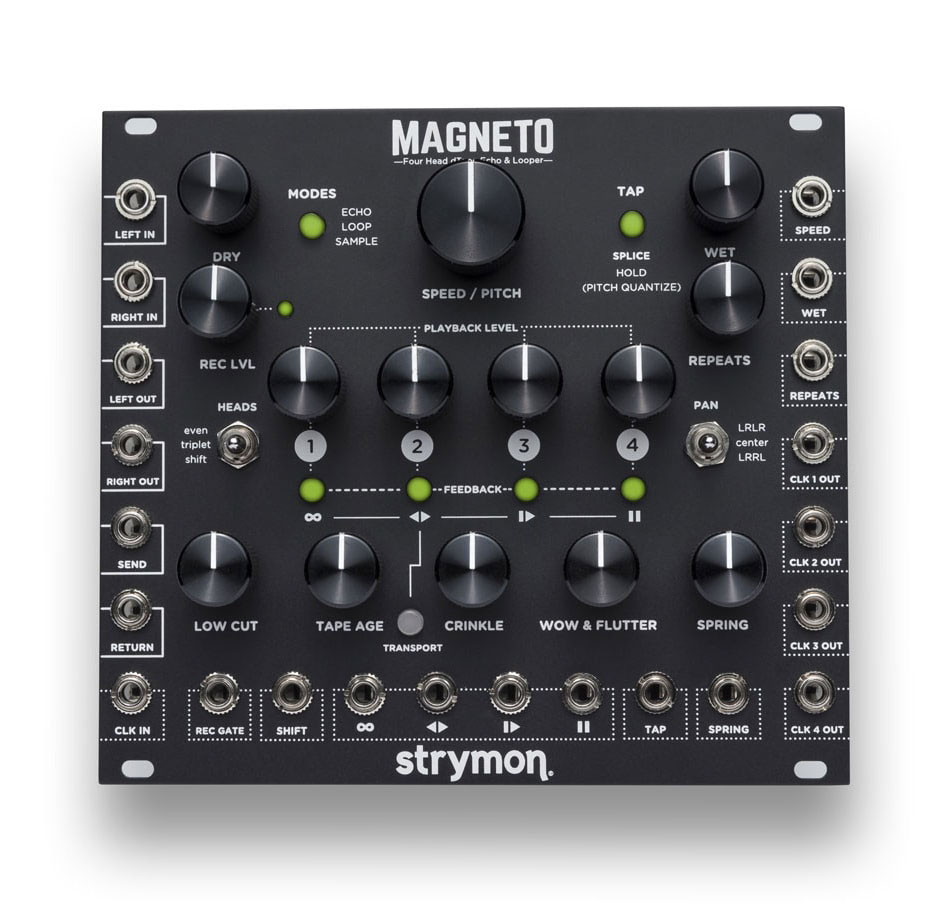


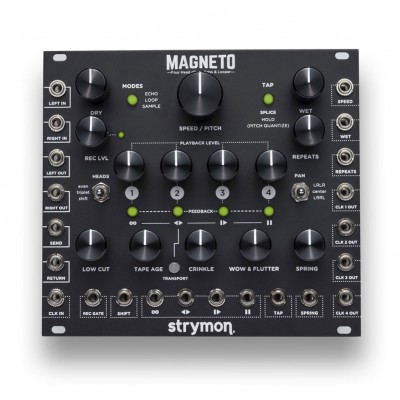
Introduced at NAMM 2018, the Strymon Magneto marks the brand's entry into the Eurorack world with an ambitious proposal: to recreate the character of a stereo tape echo while opening it up to modular logic (clock, modulation, real-time play). Whereas a classic delay merely repeats, Magneto behaves like a living machine, with its "transport," tape behaviors, and a performance-focused approach.
Magneto is aimed at advanced to expert Eurorack musicians, producers, and live performers seeking a stereo delay that becomes an instrument. It excels in techno, ambient, electro, synthwave, dub, and sound design for film music, thanks to its looper/sampler capabilities, pitch control, clock synchronization, and self-oscillation. In the studio, it adds depth and movement; on stage, its transport controls (buttons and CV) transform every patch into a musical gesture.
At the core of Magneto is a stereo tape echo simulation based on the proprietary dTape algorithm, with four playback heads and one recording head, enabling the construction of rhythmic patterns, complex ping-pongs, or textured soundscapes. The module offers 3 operating modes: echo with inversion, looper, and phrase sampler. The Varispeed algorithm (8:1 range) allows very musical speed variations, up to a Stop/Start effect, with a maximum delay/loop time of 15 seconds at maximum speed, and up to two minutes at minimum speed, while the minimum delay time drops to 200 microseconds at maximum speed. Parameters dedicated to "mechanical behavior" (tape age/wear, machine condition, wow and flutter, low-cut filter) and repetitions (up to self-oscillation) provide that typical organic grain, from clean delay to saturation. For live play, the transport controls (and their CV inputs) notably include Infinite to freeze a moment or use Magneto as an oscillator, as well as Restart with dedicated CV input. Advanced functions complement the modular approach: pitch quantization, Shift mode for rhythmically pitched delays, 15 scales, control over playback head levels, and individual feedback assignment per head. Stereo is carefully managed with 3 panning options (left/right/left/right, left/right/right/left, and a customizable Center). Finally, synchronization is designed for clocked systems: CV clock inputs/outputs with phase alignment (50 ms to 15 s), Tap Tempo (50 ms to 15 s), and Tap CV (10 ms to 15 s). An independent spring reverb and a self-oscillating sound generator further expand the palette.



 Verified