30-day satisfaction guarantee or your money back
Call us : +33 257 880 074
 en
en 











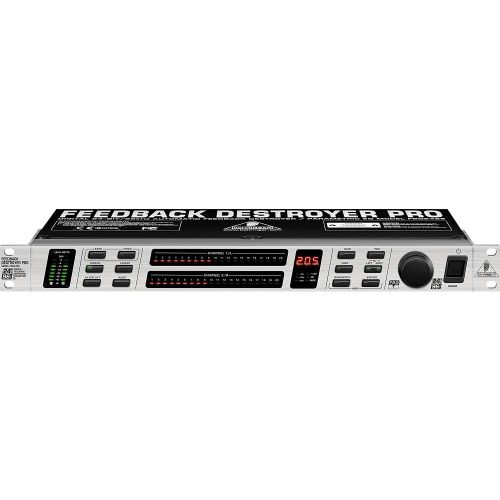
In sound reinforcement, feedback is the number one enemy of stages, halls, places of worship, conferences, and sound systems where microphones and monitors coexist at high levels. The FBQ2496 fits into this "field" equipment logic: a processor designed to quickly analyze critical frequencies and intervene in a targeted manner without altering the overall tonal balance. Its 96 kHz resolution and approach based on very narrow notch filters make it a precision-oriented solution, particularly appreciated when aiming to maintain a natural sound while gaining usable gain margin.
The Behringer FBQ2496 is intended for all setups where one seeks to secure and stabilize an audio system against feedback: sound engineers on gigs, venue technicians, self-sufficient musicians, stage managers, as well as integrators in fixed installations. It is especially useful when multiple microphones are open (vocals, sections, speeches), when stage monitors are pushed, or when the venue's acoustics complicate the setup. Its automatic and "intelligent" operation allows for quick results while retaining the possibility to fine-tune the approach according to stage constraints and desired sound levels.
The FBQ2496 is based on a feedback detection algorithm designed to react quickly: it locates feedback frequencies and acts immediately to prevent runaway feedback. This speed is an asset on stage when a microphone changes position, a musician moves closer to a monitor, or a front-of-house EQ alters the overall balance. The goal is simple: reduce the likelihood of feedback while maintaining an exploitable and coherent sound.
Its automatic "intelligent" mode can detect up to 20 frequencies per channel and eliminate them using extremely narrow notch filters. This precision is essential: instead of cutting broadly (and thus impoverishing the timbre), the processing targets precisely the problematic area. The result is a more transparent action that leaves the original signal virtually unchanged and preserves vocal clarity, instrument attack, and the sense of air in the mix.
With 24-bit processing and a 96 kHz sampling rate, the FBQ2496 relies on high resolution, useful for working precisely on narrow and fast corrections. This approach is particularly relevant when aiming to keep a natural sound while increasing the feedback margin. In practice, this allows treating feedback suppression as a technical "insurance" rather than an audible correction that colors the sound.



 Verified