30-day satisfaction guarantee or your money back
Call us : +33 257 880 074
 en
en 









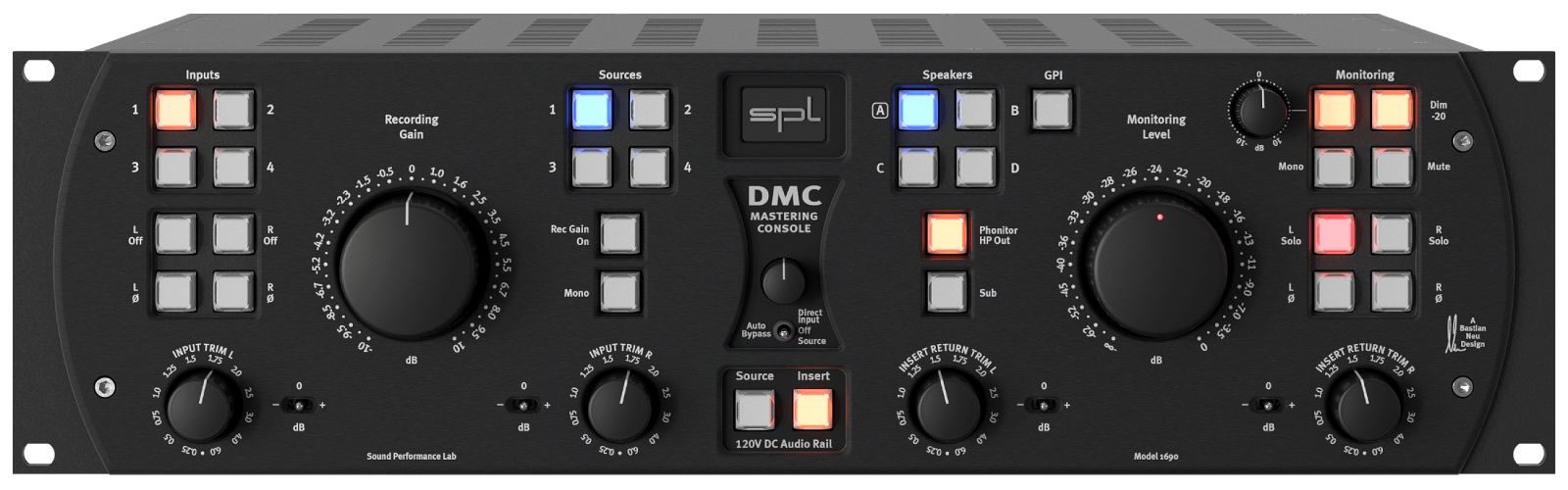


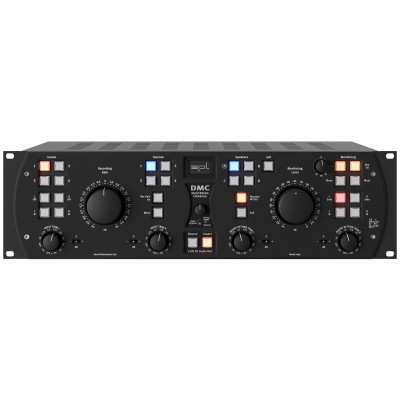
In a mastering studio, every link counts, but some links matter more than others: those through which everything passes. The DMC fits precisely within this philosophy. As the nerve center, it brings together playback sources, the digital audio workstation, recorders, and speaker monitoring into a single point. This strategic position imposes a simple requirement: to betray nothing of the signal, to complicate nothing of the workflow.
The DMC belongs to a series dedicated to mastering, reflected in a "studio first" approach: clear routing logic, installation coherence, and priority given to audio quality. The choice of a 120V operating voltage, common to the series devices, aligns with this performance- and stability-oriented approach, supporting intensive use and long sessions where consistency is paramount.
The DMC is primarily aimed at mastering engineers and studios seeking to structure a control room around a single control point. If your chain includes multiple sources (players, converters), speaker monitoring, and a DAW environment that must remain fluid, the benefit is immediate: reducing handling, securing switches, and maintaining a stable, recallable, and understandable organization.
It is also relevant for high-end mixing studios and hybrid setups (analog and digital) where back-and-forth between DAW, converters, and external recording must remain simple. When comparing versions, checking a render, or validating an EQ or dynamics decision, quick access to the right monitoring and sources becomes a factor of creativity as much as precision.
Mastering demands ruthless listening: tonal balance, micro-dynamics variations, stereo width, and depth perception sometimes hinge on very subtle differences. In this context, the console connecting your converters, players, DAW, recorders, and speakers must not be a simple "hub," but a trusted link. The DMC is presented as this studio heart, exactly where impeccable behavior is expected: stability, coherence, and audio quality that does not call your decisions into question.
In practice, the DMC allows structuring the studio around a fixed point: playback sources on one side, the DAW environment in the center, recording and monitoring at the chain's end. This setup reduces reconnections and limits routing errors, especially when switching between multiple players, conversion paths, or different monitoring contexts (validation, comparison, rendering, capture). Result: more time spent listening, less time spent "following the cable."
The DMC adopts, like other devices in the mastering series, a 120V operating voltage. Without going into unspecified details, the general idea is clear: a power supply designed to support the device's overall performance in an environment where stability and consistency matter as much as sound quality. For a studio, this translates into a feeling of a "settled" system, ready to work, and coherent integration when combining multiple elements from the same family.