30-day satisfaction guarantee or your money back
Call us : +33 257 880 074
 en
en 









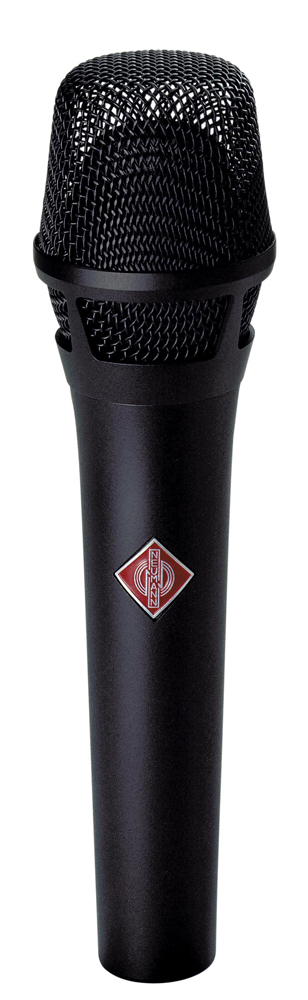


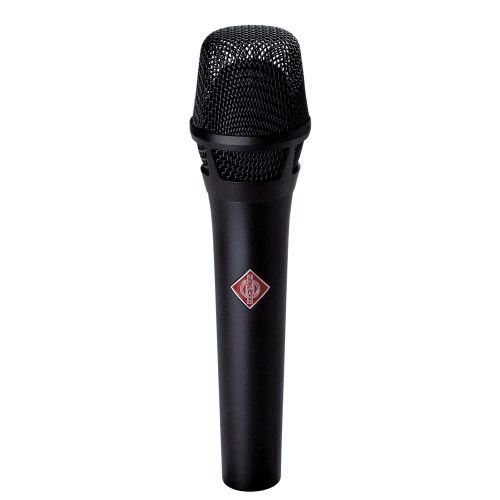
Developed for optimal capture of the human voice, the Neumann KMS 104 belongs to the brand's high-end stage microphone family. Within this range, the KMS 105 has become a recognized standard over the years, and the KMS 104 follows the same philosophy: to bring to the stage the finesse and resolution usually associated with studio condenser microphones, while remaining perfectly usable in live conditions.
The goal is clear: to achieve a present and faithful voice without unwanted coloration when the source moves off-axis. This timbre consistency helps the singer maintain their cues and also facilitates the work of the sound engineer, especially in professional contexts (studios, venues, tours).
The KMS 104 is aimed at singers who want a precise, articulated, and expressive reproduction with an extended frequency response. It is particularly relevant if you are looking for a "studio-friendly" handheld microphone on stage: dynamic nuances, sharp attacks, and a well-controlled sense of proximity.
Thanks to its ability to effectively reject off-axis sounds and its very low self-noise, it is also comfortable with personal monitoring systems (in-ear), where every detail (breath, residual noise, harshness) is immediately audible. It is a coherent choice for demanding stages, concerts where vocal intelligibility is crucial, and situations where feedback stability is a real concern.
Unlike many handheld microphones that use a dynamic capsule, the KMS 104 features a static capsule. The result: a more transparent reproduction, a wider frequency response, and a finer reading of micro-variations in the voice. The stated frequency response contributes to a "high-resolution" listening experience, useful for maintaining control over the performance even in a dense mix.
Its cardioid pattern is designed for stage use: the KMS 104 is particularly effective at attenuating sounds coming from the rear area (180-degree hemisphere behind the microphone). This rejection, combined with low off-axis coloration, helps better isolate the voice from monitors, amplifiers, and stage ambience.
Carefully tuned acoustic filters improve protection against plosives while preserving directivity, including in the low-frequency range. Sibilance and "S" sounds remain reproduced with their natural accentuation, characteristic of condenser microphones, which results in a lively and realistic sound (to be managed if necessary via equalization or placement).
The transformerless impedance converter is designed to handle high sound pressure levels to avoid overload, even with pronounced attacks. Finally, a non-disableable high-pass filter is integrated, with a cutoff frequency of 120 Hz (-3 dB point, free-field measurement), useful for limiting handling noise and intrusive bass on stage.
The steel grille is designed to withstand the rigors of live performance. It can be easily unscrewed if necessary to allow cleaning of the internal acoustic filters: a real plus for maintaining consistent performance throughout concerts and rehearsals.