30-day satisfaction guarantee or your money back
Call us : +33 257 880 074
 en
en 










The Octave Divider follows the great tradition of "secret weapon" effects that marked the 70s: you activate it at the key moment and suddenly the sound gains a broader, bolder, almost orchestral dimension. The principle is simple on paper (adding a sub-octave), but the result is formidable in practice: a guitar that gains depth, a riff that becomes more massive, or a funk pattern that transforms into an almost synth-like groove.
Where this approach stands out is in its decidedly vintage spirit (sub-octave with a strong character) while remaining suitable for contemporary use. The goal is not to replace your instrument but to add a controllable sonic foundation, usable both in studio and live, and flexible enough to shift from subtle reinforcement to a fully embraced effect.
This octave pedal is aimed at guitarists and bassists who want to expand their palette without complicating their signal chain. If you enjoy building arrangements with few elements (trio, power trio, guitar-drums duo), the sub-octave becomes an immediate ally to fill the space and give the impression that a bass is following your notes. Musicians in funk, rock, blues, psychedelic, prog, and even some more modern genres (electro-rock, indie) will find a very effective color here.
In practice, it shines on monophonic lines, well-articulated riffs, and parts with a clear attack. On bass, it can reinforce the low end and add an organic "synth bass" vibe. On keyboards or other sources, it serves as a low layer to thicken a pattern or as a texture effect to create unexpected timbres. On a pedalboard, it is often placed early in the chain to optimize tracking accuracy, then pairs very well with overdrive/fuzz and filter/envelope filter for ultra-expressive sounds.
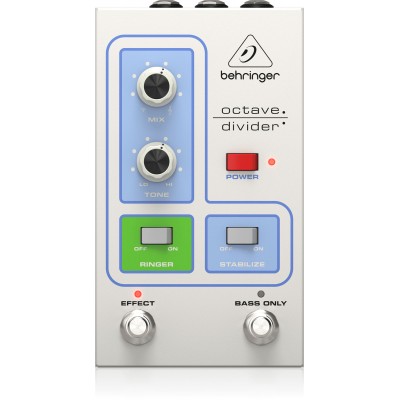
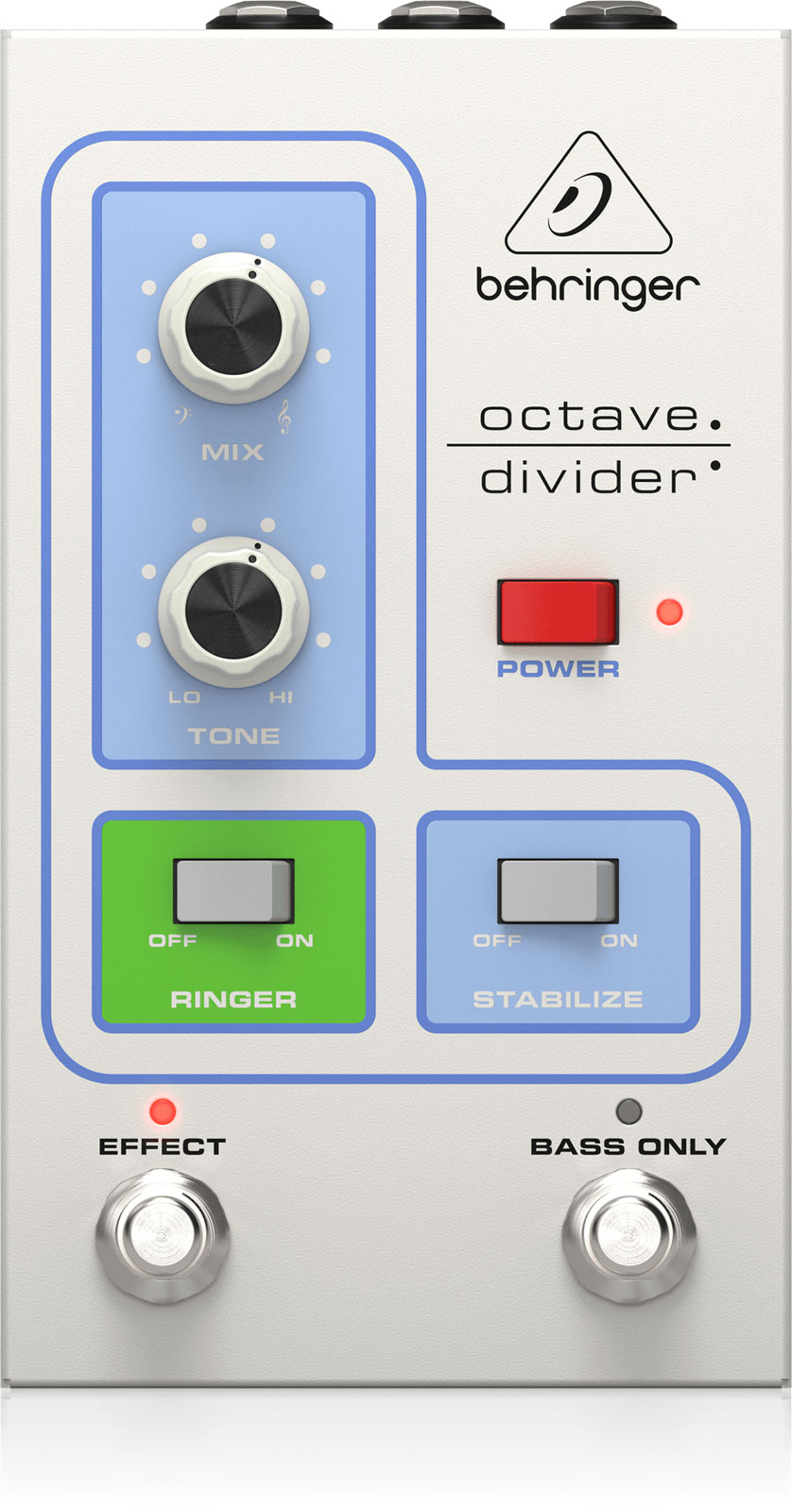
The heart of the Octave Divider is the ability to finely blend your original signal with the sub-octave using the MIX control. You can thus stay in a "reinforcement" logic (just a bit of thickness under the note) or switch to a more radical effect where the sub-octave becomes dominant. The TONE control allows you to adjust the tonal contour of the effect: rounder and softer for a warm foundation, or sharper to stand out in a dense mix.
The BASS ONLY switch goes further: it removes the direct signal to leave only the sub-octave. This is a particularly creative option to simulate a bass line, create strongly marked low unisons, or make the guitar "disappear" as we know it in favor of a dedicated bass texture.
The RINGER function adds a layer of harmonic accentuation on the upper frequencies, with a ring modulation character capable of generating more metallic colors, richer harmonics, or even multi-note effects depending on what you play. Finally, the Stabilize mode is designed to improve note tracking: very useful if you thicken more complex riffs, play legato, or want a more stable response when the sub-octave must remain tightly "locked."
This is a sub-octave with a vintage grain: a present, organic low end that can range from simple thickening to a true transformation of the instrument. With a moderate MIX, the effect provides an immediate foundation while preserving your guitar or bass identity. Increasing the level pushes the pedal toward a more characterful, more massive sound, perfect for riffs that need to carry the song.
The TONE setting allows you to choose between a rounder sub-octave (ideal for a "foundation" role) and a brighter texture that stands out better when playing in a band. RINGER, on the other hand, opens the door to more abrasive and harmonic sounds, very effective for leads that need to "bite" or for experimental textures. Stabilize helps maintain a sense of control and precision, especially appreciated when seeking a clean and readable low line.