30-day satisfaction guarantee or your money back
Call us : +33 257 880 074
 en
en 









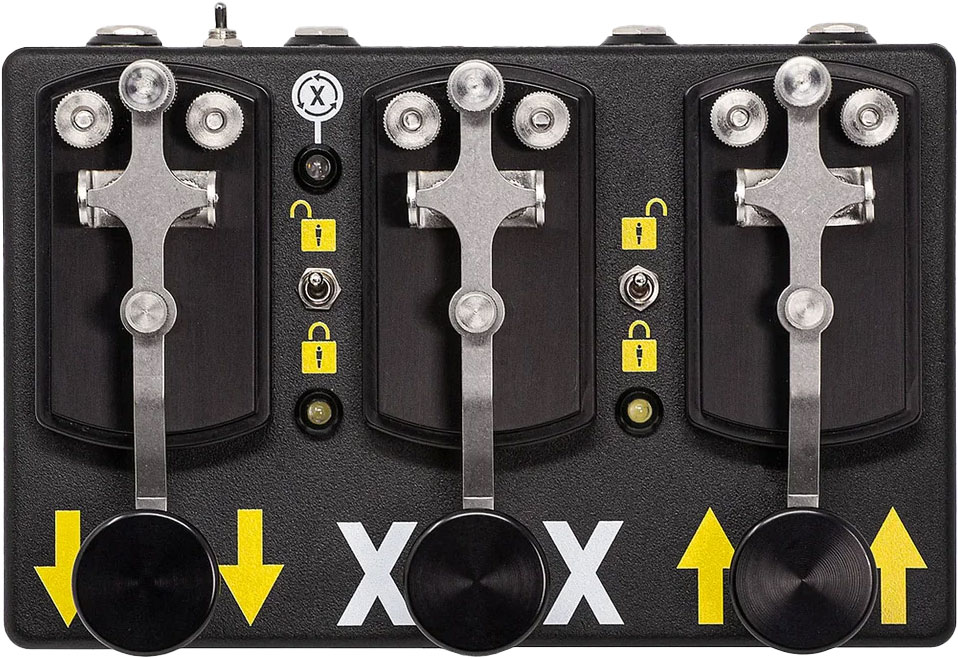


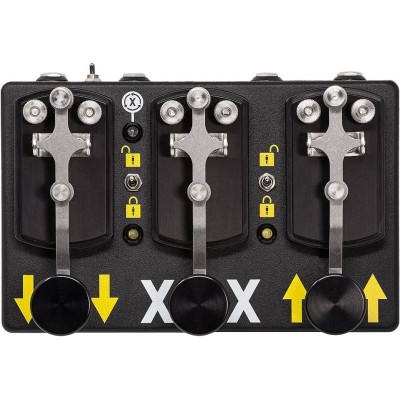
The Triplegraph was born from a long-term collaboration with Jack White, developed over several years with a clear obsession: to make an octave pedal a performance tool, as expressive as a standalone instrument. Here, the octave is not just an "always-on" effect: it is triggered, locked, cut, combined with other pedals, and played by foot (or even by hand) to create accents, breaks, and instant textures.
With its look inspired by telegraph keys and road-ready design, the Triplegraph follows the tradition of signature effects that do not merely imitate a classic but redefine the ergonomics of the effect to serve a highly musical approach to pitch.
The CopperSound Triplegraph is aimed at guitarists (and bassists) who want to play with the octave in real time : riffs that instantly gain foundation, leads that suddenly take off, "stutter" passages like a killswitch, or more experimental effect stacks. It suits both seasoned musicians and creative home-studio users, as long as the goal is clear: to interact with the effect, not just activate it.
Style-wise, it excels in rock, modern blues, garage, indie, metal, and anything involving "synth"-type textures (without guitar-synth). Live, it is a weapon to bring out an octave up on a sustained note or transform a mono-note phrase into a massive bassline with the octave down.
The concept is as simple as it is inspiring: the left switch triggers an octave down, the right switch an octave up, and the center switch serves either as a killswitch or as activation for the auxiliary loop. All this relies on a high-performance Blackfin DSP for smooth and precise tracking, ideal for clean and articulated phrases.
The Kill mode is formidable: it allows you to cut the original (dry) signal so you only hear the octave up and/or octave down. The result: isolated, more "synthetic" sounds, perfect for bass lines, very prominent harmonizations, or ultra-clean break effects.
The Aux mode opens another dimension: you insert one or more pedals into the loop via the send/return jacks, then trigger them in a performance logic simultaneously with the octaves. This is ideal for creating an "octave + fuzz," "octave + filter," or "octave + modulation" block without rewiring the pedalboard.
Finally, the Locktave selectors allow you to choose between momentary operation (active only while pressed) and on/off (latching) for instant, very musical changes in the middle of a song. Switching is announced in Soft Touch, designed for stage use.
The Triplegraph aims for a clean, stable, and clear octave, with digital tracking designed to remain musical on sharp attacks and mono-note phrases. The octave down provides a solid and defined foundation, while the octave up adds brightness and a "fake organ / fake synth" character very effective in a mix, especially with an already loaded amp or fuzz downstream.
The real pleasure comes from the responsiveness to playing : in momentary mode, you can "punctuate" a melody with an octave up, thicken the end of a phrase with the octave down, or switch to 100% wet sound (via Kill mode) to create a radically different texture without changing your playing style. And with the performance approach popularized by Jack White, the pedal becomes a generator of accents, silences, and contrasts as much as a simple harmonization effect.