30-day satisfaction guarantee or your money back
Call us : +33 257 880 074
 en
en 









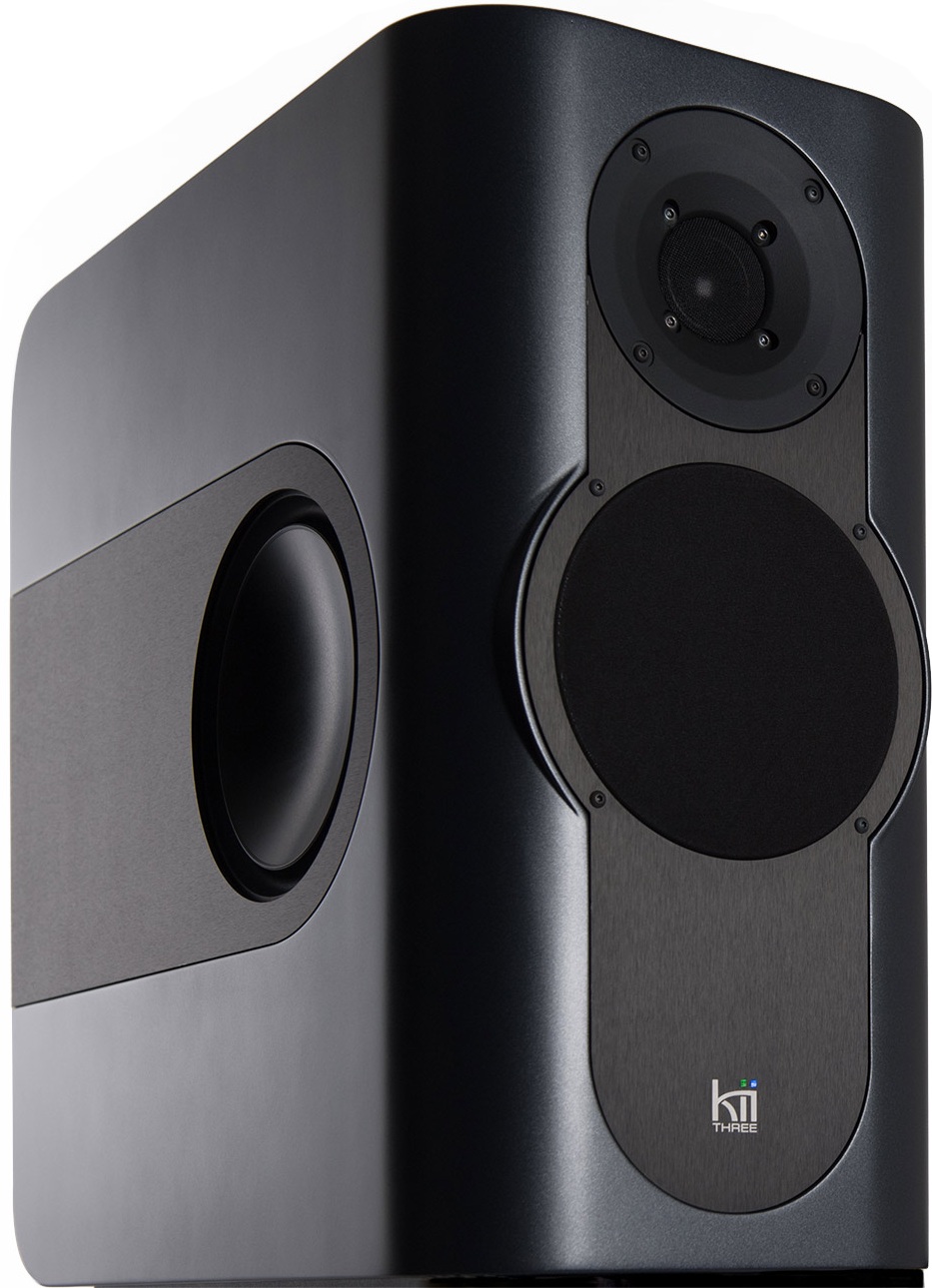


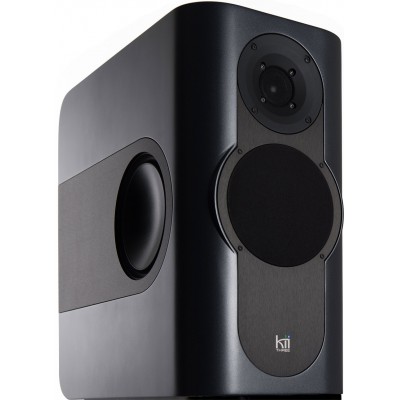
The Kii THREE were designed with a clear goal: to address the acoustic challenges of current studio setups, where deep room treatment is not always possible and speakers cannot always be placed far from walls. Rather than relying solely on power or large speaker enclosures, this model focuses on a combination of custom amplification, DSP, and directivity control. The claimed result is a "mini main monitoring system": a speaker compact and light enough to integrate easily, yet ambitious enough to serve as a reference listening tool for critical tasks.
The Kii THREE are aimed at sound engineers, producers, mixers, and studios seeking monitoring that is both analytical and powerful, without depending on a perfect room. They are relevant in mixing rooms, production, light mastering, or high-end mobile studios, especially when the setup requires proximity to a wall or corner. Thanks to their management of bass and low midrange dispersion, they aim to provide clearer listening in areas where untreated or semi-treated rooms often complicate work (bass energy buildup, less stable imaging, congested low midrange).
The Kii THREE do not just aim to "play loud." The Active Wave Focusing technology is designed to control acoustic dispersion and channel sound energy towards the listening position. The DSP enables a cardioid-type dispersion in the bass and low midrange, a behavior generally associated with much larger systems. In practice, this approach aims to reduce room influence and improve perceived accuracy, especially in the lower spectrum where reflections and room modes can obscure decisions.
Each speaker integrates 6 amplifiers of 250 watts, each dedicated to one driver: four woofers, one midrange, and one tweeter. This active architecture optimizes control of each transducer and leverages DSP for overall coherence (phase, impulse, spectral balance). The amplifiers use the latest version of Ncore Class D technology, chosen to balance efficiency, headroom, and control.
To match the amplification level, converters are integrated into the Kii THREE. Digital inputs are oversampled and locked via a jitter rejection algorithm developed by Kii Audio. The goal is to preserve definition and stability, particularly for studio digital sources. The complete signal path through the processing board (AD/DA) is claimed to be inaudible and transparent, so the final character is dictated by the mix, not the conversion chain.
Because actual placement is not always ideal, the Kii THREE include correction functions for installation constraints near a wall or in a corner. There are also intelligent limiters for protection, built-in tone control, and an automatic standby mode for daily studio use.