30-day satisfaction guarantee or your money back
Call us : +33 257 880 074
 en
en 









Complete software

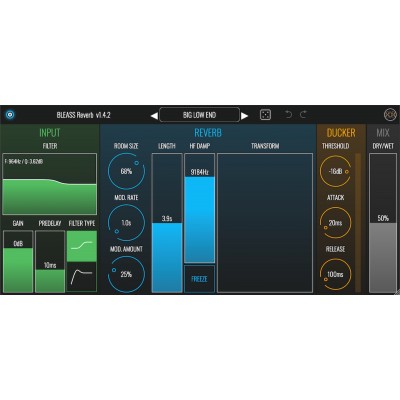
BLEASS Reverb is a reverb plugin designed for modern production, suitable for both sound design and creative mixing. While a classic reverb simply adds a sense of space, BLEASS Reverb invites you to sculpt the material itself: density, movement, texture, and harmonic colors. It is equally suitable for adding depth to a vocal, snare, or guitar, as well as transforming a simple source (synth, piano, FX, field recording) into a cinematic soundscape.
Thanks to its real-time manipulation tools, it integrates perfectly into electronic, ambient, pop, hip-hop, techno, or film music workflows. The Freeze mode allows you to lock an atmosphere to build drones, transitions, and risers, while the ducker helps maintain a clean and punchy mix, even with large reverbs.
BLEASS Reverb offers a "mutable" approach to reverb: you are not limited to choosing a room type. You shape the effect's response with controls designed to be manipulated during playback, enabling quick transitions from a short, precise reverb to a wide, dense, enveloping space. This responsiveness makes it an excellent choice for automation, studio performances, and sound design.
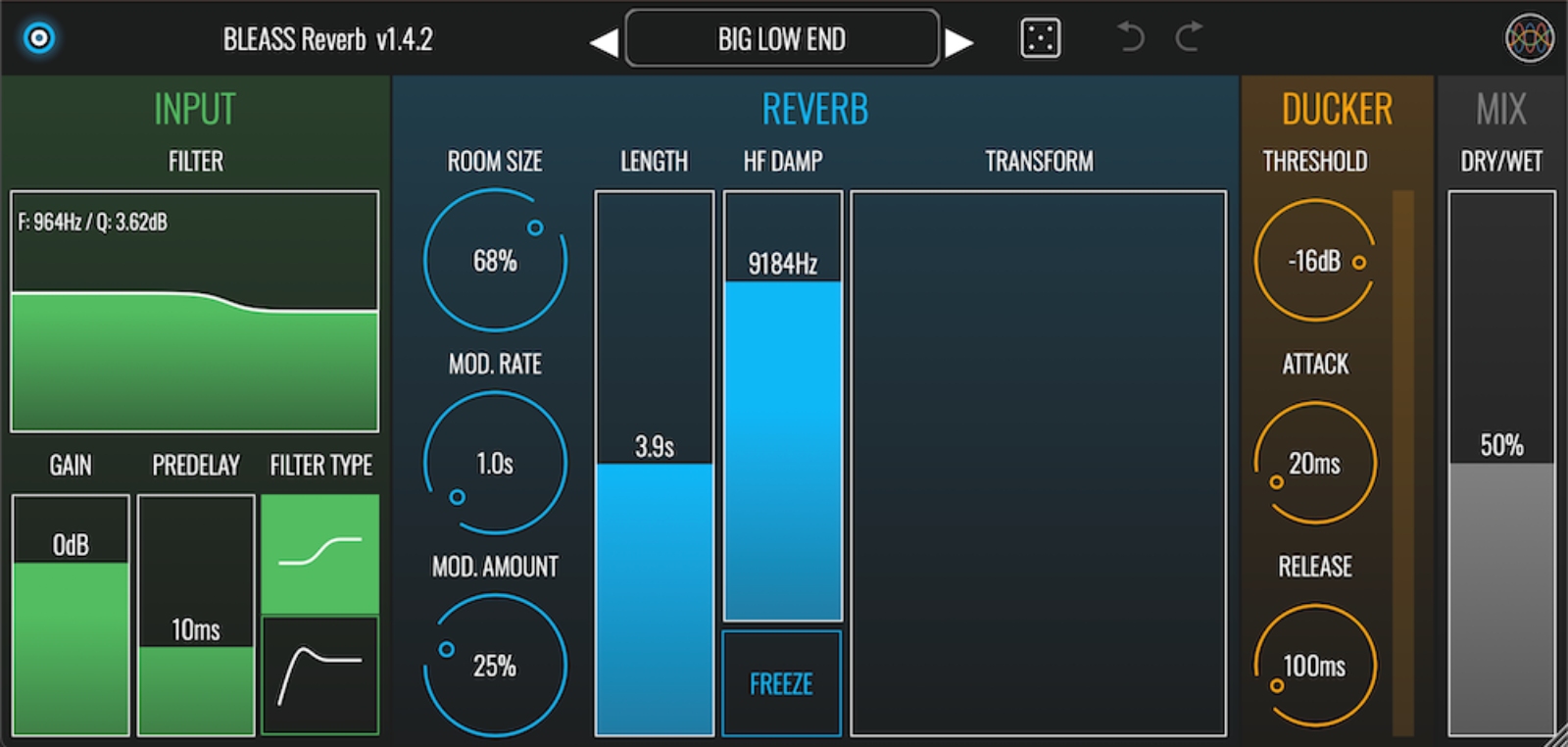
The Freeze button allows you to lock and hold the reverb tail, instantly turning a signal into a continuous pad. This is ideal for creating atmospheric backgrounds, extending a note, building a harmonic drone, or generating organic transitions between sections. In ambient or cinematic production, it's a quick tool to "fill" the space without layering multiple tracks.
The built-in ducker relies on side-chained compression triggered by the dry signal. The result: the reverb becomes more discreet when the source plays, then naturally rises during silences. This approach improves clarity and attack perception, especially useful on kicks and basses, but also on vocals and leads when you want great depth without losing intelligibility.
The X/Y panel opens a more experimental dimension: you can evolve the character of the reverb by combining frequency shifter and wave shaper. This allows you to create metallic, unreal, granular, or more harmonic textures, going beyond a simple acoustic space. In automation, this morphing becomes a true movement tool, perfect for risers, transition effects, and reverb tails that "tell" a story.
The input filters facilitate cleaning and shaping the signal before it enters the reverb. You can control the spectrum sent to the effect, limit low frequencies to avoid muddiness, or conversely emphasize a range to get a more present and characterful reverb. This pre-filtering step helps position the effect in the mix faster, with a more controlled result.