30-day satisfaction guarantee or your money back
Call us : +33 257 880 074
 en
en 









Complete software

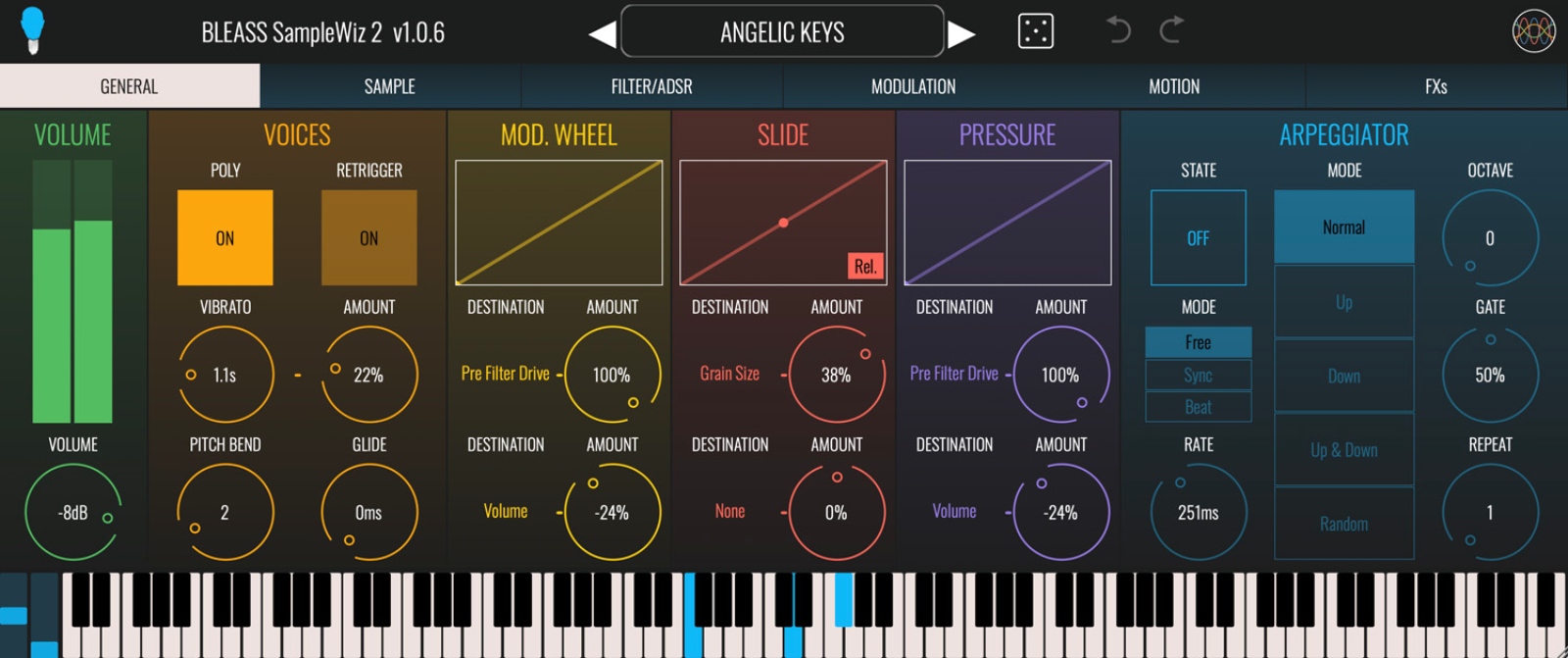
BLEASS SampleWiz 2 is a virtual instrument designed for modern music production, whether you compose, arrange, or do sound design. Its goal is to enable you to build expressive sounds from ready-to-use sound materials and to have a wide choice of presets to speed up work in your DAW. This pack is especially aimed at producers who want to maintain a creative workflow, with sounds immediately usable for electro, pop, film music, ambient, hip-hop, or any aesthetic requiring evolving timbres and good presence in the mix.
With over 800 presets provided in total, you have a wide range of starting points for your tracks. The advantage of such a volume of presets is twofold: on one hand, you can lay down a harmonic or rhythmic idea quickly (bass, lead, pad, texture), and on the other, you can explore less obvious colors to create transitions, atmospheric layers, accents, or spot effects. In a production context, this translates to fewer interruptions and more continuity between the creation phase and the arrangement stage.
The 12 packs included are not just to "add sounds": they bring musical directions and different signatures, useful for adapting the character of a track. You can thus switch from a soft and musical rendering to more pronounced textures, or seek sharper sounds to cut through a busy mix. This diversity also facilitates commissioned work (briefs, film music, content for social networks), where multiple intentions often need to be proposed within a limited time.
BLEASS SampleWiz 2 naturally fits into a sound design approach by layering: stacking multiple instances, distributing roles (attack, body, air), then balancing in the mix becomes a simple gesture. In practice, you can use it to create wide pad layers, background ambiances, or shorter elements that rhythm an arrangement. It is also a good choice for working on "ear-candy": small details, impacts, textures, and variations that bring life to the track without overloading the structure.
This pack emphasizes efficiency: you load a preset, play, record. Then, you adjust according to the project context, depending on tempo, key, or the space you want to leave for vocals and main instruments. The preset-based approach also allows quick learning: by browsing and adapting sounds, you better understand how to achieve coherent results (sharper attack, stronger presence, airier texture) while maintaining a consistent sonic identity throughout the track.