Essential Information About the Pulsatec Software
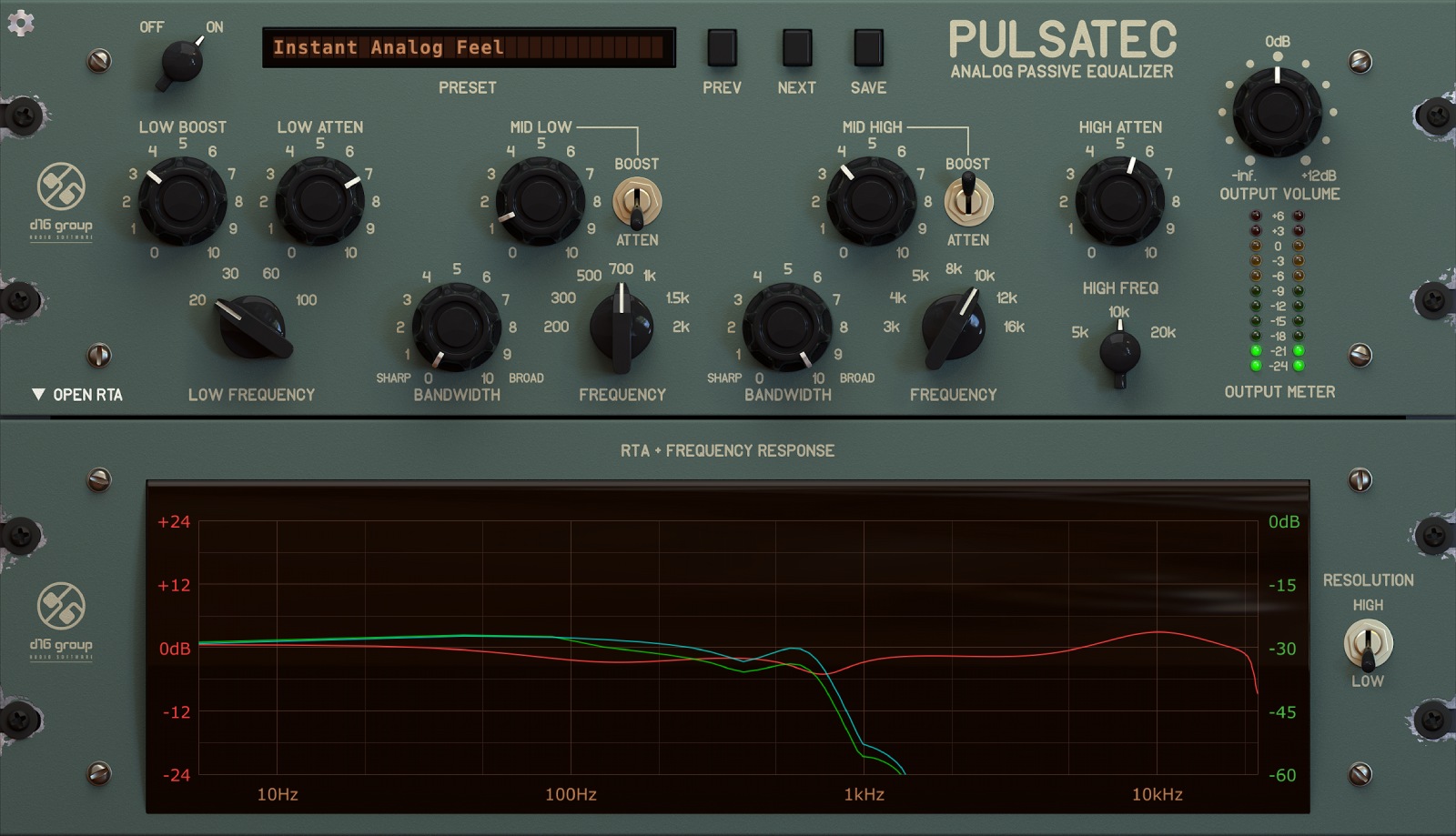
- Vintage Passive Sound: an EQ inspired by classic passive equalizers for a warm and musical tone, ideal from mixing to mastering.
- Creative Sculpting: ability to simultaneously boost and cut the same band to shape a punchy low end and silky highs.
- Intuitive Controls: bass, mids in two sections, and highs with selectable frequencies and bandwidth control.
- Real-Time Visualization: built-in RTA with input/output comparison and overlaid target curve for quick and reliable decisions.
What Pulsatec Is For
Pulsatec is a
passive equalizer plugin designed to add character to your tracks, buses, and masters. It excels at adding body to kicks and basses, opening up the top end on vocals or acoustic guitars, and softening harshness while preserving musicality. Its "boost & cut" approach allows for rich textures typical of analog chains, with the precision and repeatability of a modern workflow.
Main Features
Passive "Boost & Cut" Workflow
Pulsatec's philosophy is based on the combined use of boosting and cutting within the same band. This process creates controlled resonances and elegant dips, perfect for a solid low end without muddiness and airy highs without harshness.
Ultra-Flexible Bass, Mid, and High Bands
The bass section offers musical frequencies and independent
Boost and
Attenuation controls. The mids are divided into two bands to work on body and presence with precise
Bandwidth control. The high section adds brilliance and air while taming sibilance and harshness.
Intelligent Real-Time Analysis (RTA)
Instantly visualize the impact of your settings with dual input/output spectral display. A predefined EQ curve can be overlaid as a reference, while adjustable resolution adapts from quick listening to detailed monitoring.
Modern Studio Ergonomics
Quick Bypass, output volume control, and
metering ensure consistent gain staging. Interface size management with
HiDPI support optimizes visual comfort, and
MIDI Learn facilitates assignment to your controllers.
Technical Specifications
Equalization and Processing
- Bass (Low-Frequency Control): selectable frequencies 20, 30, 60, 100 Hz; independent Boost/Attenuation controls; creation of punchy low resonance via simultaneous "cut & boost".
- Two-Band Mids (Mid-Frequency Control): low mid band - 200, 300, 500, 700 Hz, 1, 1.5, 2 kHz; high mid band - 3, 4, 5, 8, 10, 12, 16 kHz; adjustable Bandwidth (narrow to wide); independent Attenuation/Boost mode per band.
- Highs (High-Frequency Control): attenuation frequencies 5, 10, 20 kHz; adds brilliance/air in synergy with the high mid band while controlling harshness and sibilance.
Analysis and Visualization
- RTA (Real-Time Analyzer): dual spectrum for real-time input/output comparison.
- Overlay of a predefined EQ response for immediate visual reference.
- Adjustable display resolution according to monitoring needs.
Controls and Ergonomics
- Quick Bypass to instantly assess the impact of processing.
- Output volume control for precise balancing.
- Output Metering for consistent levels in the signal chain.
- Screen size adjustment, multiple UI sizes, and HiDPI support.
- MIDI Learn for quick assignment to controllers.
System Requirements
- Mac: macOS 10.13 to macOS 15; Intel x86 or Apple Silicon CPU; 8 GB RAM.
- Windows: Windows 7 or later; Intel x86 or AMD x86 CPU; 8 GB RAM.
Supported Formats
- macOS: VST-2, VST-3, AU, AAX.
- Windows: VST-2, VST-3, AAX.
 en
en