Complete software
SA-3 Spectral Processor Native v7 is a spectral cleaning plugin designed to automatically control problematic elements in an audio signal, especially spectral peaks (localized resonances, harsh sibilance, prominent harmonics) and persistent overtones that linger over time. It is suitable for both post-production needs (dialogue, voice-over, podcasts) and music (sung vocals, guitars, keyboards, overheads, instrument buses), whenever timbre stabilization is required without altering the artistic intent.
Where a dynamic equalizer or de-esser acts on a few bands, SA-3 works deeply with a large number of bands to "calm" excesses more continuously and transparently. The result: more consistent vocals, takes that are easier to place in the mix, and less time spent manually hunting problematic frequencies.
The core of SA-3 is based on spectral processing with more than 1,000 bands. This resolution allows reducing narrow peaks and unwanted harmonics at almost any frequency in the spectrum, while avoiding the "filter" effect that can be perceived when processing is too broad. For mixing, this translates into more discreet correction, especially useful on vocals, where the slightest alteration of formants becomes immediately audible.
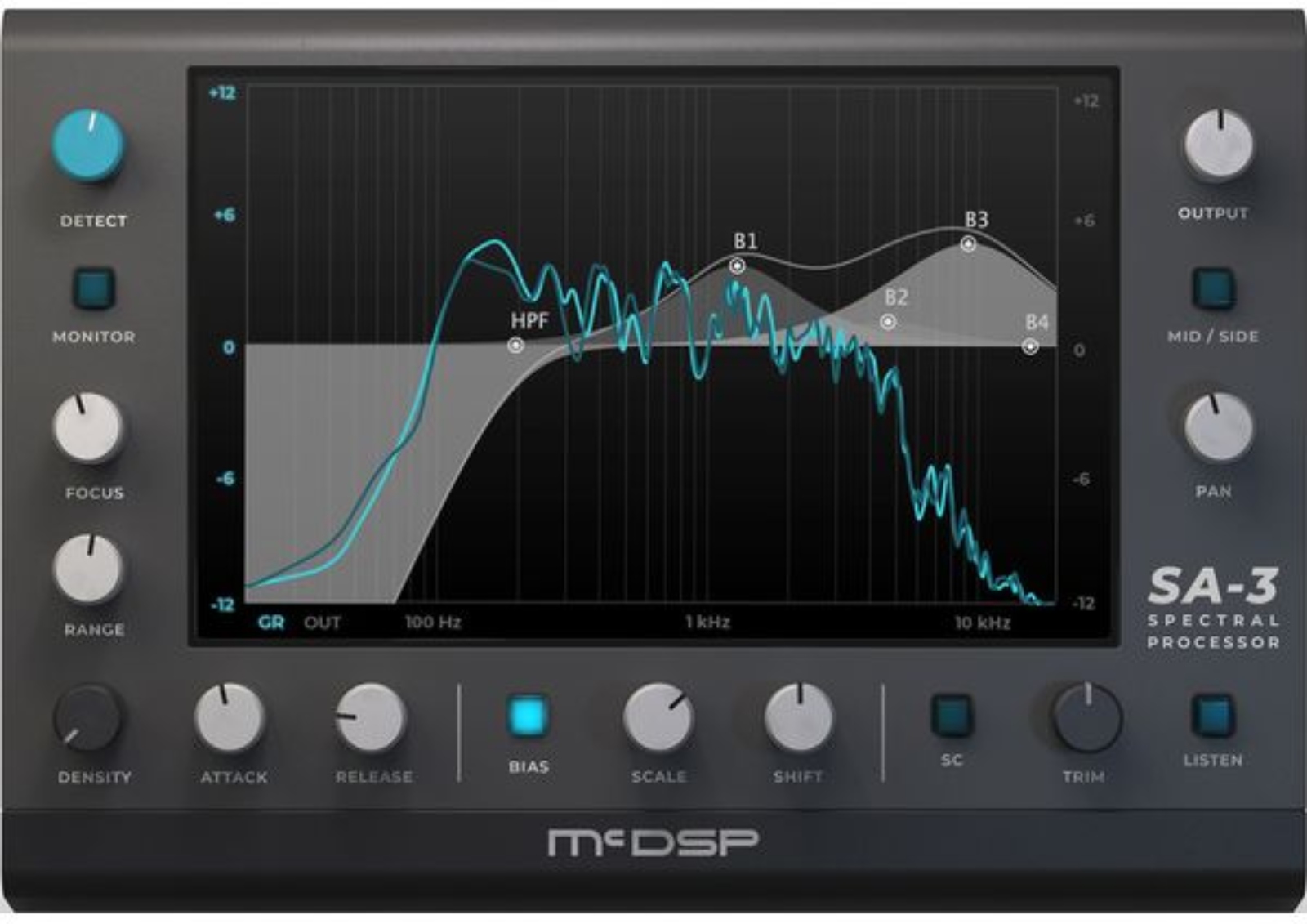
SA-3 offers a very musical approach to spectral processing through three complementary axes. Focus helps concentrate the action on the most relevant part of the signal. Range defines the frequency extent and "zone of influence" of the processing, useful for avoiding affecting the fundamentals of a voice or the body of an instrument. Density adjusts the density of the spectral processing to achieve a more subtle result (light correction) or a firmer one (strong cleaning), while maintaining control over the natural feel.
With the user-programmable Bias Curve, you can steer the processor to favor certain spectral areas or specific reduction behaviors. This is a decisive advantage for quickly switching from a "dialogue" use (priority on intelligibility, reduction of resonances and harshness) to a "singing" use (control of sibilance and overly present harmonics) or "instruments" (reduction of body resonances, overly bright strings, persistent overtones).
The Detect and Monitor controls are designed to speed up decision-making. You can spot spikes and harmonics that stand out, then listen to what the plugin removes to adjust the amount. SA-3 allows you to monitor either gain reduction, final output, or the removed signal, which helps maintain clean correction: if you hear too much "voice" or too much "music" in the removed signal, it often indicates the need to reduce intensity or tighten the targeted area.
The sidechain enables advanced uses: triggering correction based on another track (for example a guide vocal, a reference track, or a bus) to stabilize a source contextually. The mid/side processing provides additional control over the stereo image: you can clean the center (Mid) to improve vocal clarity while preserving air and width on the sides (Side), or conversely control lateral resonances on ambiances and stereo takes.
Double precision processing ensures high calculation stability and increased accuracy in reduction operations. SA-3 is available in mono and stereo versions, allowing you to optimize your session according to tracks and adapt the plugin to the nature of each signal.
The interface emphasizes readability in real situations: measurement and visualization (gain reduction, output level, removed signal) are directly available on the main screen. The plot scales can be adjusted to refine the analysis of reduction and output, useful for precisely dosing intervention on sensitive sources such as dialogue.