30-day satisfaction guarantee or your money back
Call us : +33 257 880 074
 en
en 









Complete software

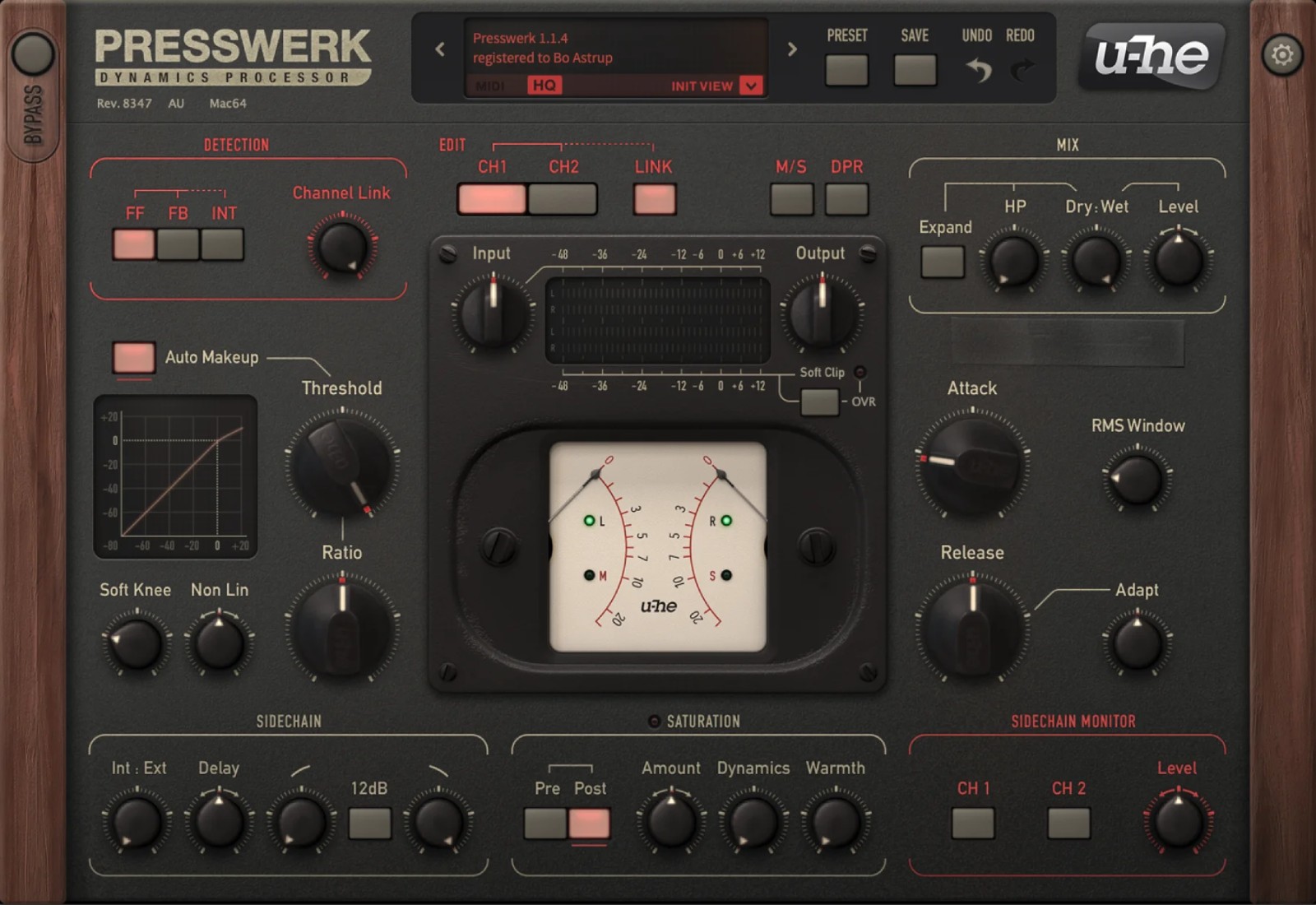
u-he Presswerk is a dynamic processing plugin designed to control, enhance, and stylize the level of an audio signal within a DAW. It is used to stabilize a vocal, add impact to drums, glue an instrument bus, or achieve more pronounced pumping or ducking effects via sidechain. Its philosophy is not to emulate a single "legendary" compressor, but to offer a toolbox capable of ranging from transparent compression to more colored compression, while maintaining a natural and musical sound.
Presswerk offers all the expected controls of a modern compressor: extended ratio, knee (transition softness), attack and release with adaptive behavior, as well as an auto-makeup option to facilitate gain staging. You can adjust the curve and response to preserve transients, thicken sustain, or conversely "lock" a signal to make it more present in the mix.
Sidechaining allows compression to be triggered by an external source, ideal for creating space between kick and bass, calming a pad when a vocal passes, or generating rhythmic pumping effects. Presswerk is also well suited for fine bus work, adding cohesion without crushing dynamics.
Thanks to the Dry/Wet control (internal parallel mix of the "New York" style), you can dose compression without losing the original energy. A high-pass filter associated with the mix helps prevent bass frequencies from triggering excessive compression, improving low-end stability. A downward expander mode is also available to refine signal breathing and subtly clean up.
The Saturation section is one of Presswerk's highlights: used sparingly, it adds warmth and softens attacks; pushed further, it can produce a more "overdrive" tape-like texture. The soft clip helps round off peaks to increase perceived loudness while avoiding overly aggressive output clipping.
With M/S mode, you process the center (Mid) and sides (Side) separately, useful for solidifying a vocal in the center without hardening the stereo ambiance, or conversely animating the sides of a musical bus. The Dual Phase Rotator (DPR) is inspired by a broadcast technique: it modifies phase relationships to reduce certain asymmetries, slightly increase headroom before saturation, and add a sense of "weight" in the low spectrum.
Presswerk offers several detection topologies (feed-forward, feed-back, or interactive) to vary compression behavior: more modern and reactive, softer and "sticky," or more hybrid depending on the context. The interface is resizable and skinnable, with global preferences and a MIDI learn page for quick parameter assignment to a controller.