30-day satisfaction guarantee or your money back
Call us : +33 257 880 074
 en
en 










Complete software

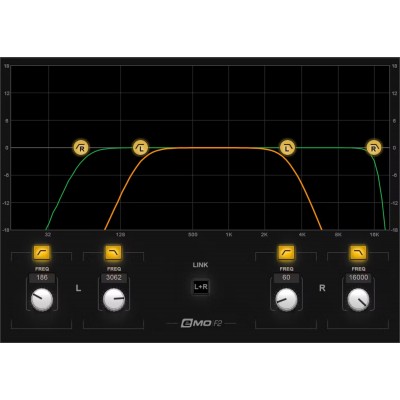
Waves eMo F2 Filter is a filtering utility designed to get straight to the point: applying a clean high-pass and/or low-pass filter without stacking parametric EQ stages. It's the perfect tool to clean a source, stabilize a mix, and avoid unnecessary energy buildup at the spectrum extremes.
In practice, it helps prevent bass buildup, reduce hiss and harsh highs, eliminate plosives on vocals (p-pops), or avoid low-end cluttering a reverb. It's also very useful for softening overly aggressive saturation on amp simulations or quickly correcting acoustic and capture issues during a live performance.
The core of eMo F2 Filter relies on two complementary filters: a high-pass and a low-pass, each with a slope of 18 dB per octave. This choice provides clean filtering without complicating the interface or slowing decision-making. Result: you correct faster, listen more, and maintain control over what matters.
Designed for mixing in real conditions, eMo F2 Filter offers zero latency and minimal CPU consumption. This is a direct advantage on stage, where stability and responsiveness are paramount, but also in the studio when using multiple instances to cleanly filter dozens of tracks (vocals, drums, guitars, synths, effects returns).
Its touch-friendly interface naturally adapts to modern environments: you can turn controls, drag the curve directly in the graphical display, or enter values precisely. This triple control mode speeds up work, whether you're front-of-house needing immediate intervention or in a mix session where repeatability of settings is important.
eMo F2 Filter allows you to filter left and right sides independently or link them for consistent behavior. This flexibility is valuable for managing uneven stereo takes, room ambiance, or a stereo bus that requires uniform cleaning. The plugin supports mono, dual mono, or linked stereo operation according to your needs.
Optimized for live mixing, the plugin can be used as a separate instance or integrated within the eMotion LV1 console channel strip. This approach keeps a channel clean, intelligible, and controlled from the input, with a filter that's quick to adjust during soundchecks or live shows.