30-day satisfaction guarantee or your money back
Call us : +33 257 880 074
 en
en 









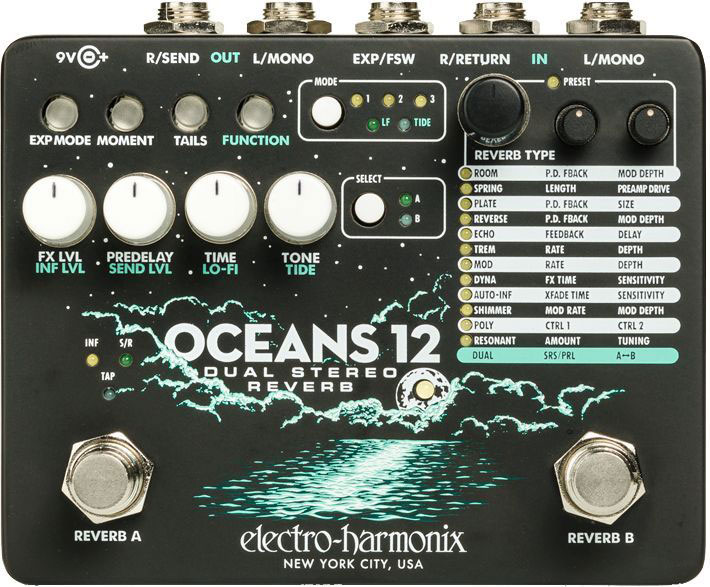


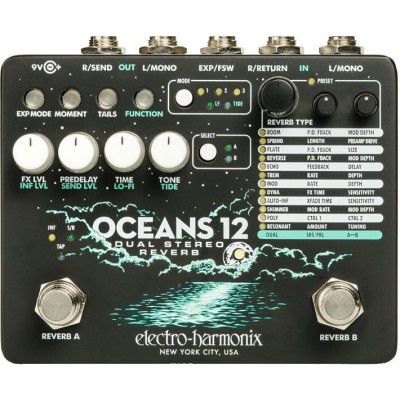
The Oceans 12 positions itself as the "big brother" of the Oceans 11, with a simple philosophy: keep direct access to musical reverbs while adding the power of a dual engine. Where many reverbs excel with a single character, the Oceans 12 aims for layering: a first reverb for depth (room, plate, spring), and a second for signature (shimmer, reverse, mod, resonances), all in stereo. The result: a pedal that covers both the spirit of vintage reverbs and ambient and experimental approaches, while remaining designed for guitar.
The Electro-Harmonix Oceans 12 targets guitarists of intermediate to advanced level who want a versatile reverb, as well as stage musicians who need reliable presets. In blues and rock, it adds depth without drowning the attack; in pop and indie, it helps build a wide and elegant stereo space; in post-rock, shoegaze, and ambient, it becomes a pad creation tool thanks to infinite modes and series combinations. In the studio, its routing and stereo facilitate integration into complex chains; live, the tap tempo and presets secure transitions.
At the heart of the Oceans 12 are two stereo reverb engines that can operate simultaneously and independently. You can chain them (series) to get a reverb that "enters" another, or layer them (parallel) to blend two distinct spaces. The pedal offers 12 reverb families with several variations per type: room, spring (including classic inspirations), plate, reverse, echo, trem, mod, dyna, auto-inf, shimmer, polyphonic, and resonant. Each family is designed to cover a clear use: from realistic room to pitch and resonator reverbs for experimental purposes.
Regarding control, the Oceans 12 emphasizes sound movement: the Tide setting modifies the stereo image of the reverb (from a tighter field to a more immersive width), while the Lo-fi control adds a more granular and organic texture, ideal for dirtying up an overly perfect tail. An infinite decay mode allows freezing an ambience and playing over it, then "launching" another reverb to create layers. The tap tempo is used to set the pre-delay, echo times, and other tempo-dependent parameters, handy as soon as your reverb becomes rhythmic.
Finally, the dedicated input accepts an expression pedal (to control one or more parameters in real time) or a 3-button footswitch for extended control. The Tails switch lets you choose a more "studio" bypass (the reverb naturally decays) or a hard cut, useful for precise stops live. The effects loop and pre/post reverb options complete the package to integrate the Oceans 12 as a central piece of the pedalboard.
The signature of the Oceans 12 is a rich and defined reverb, capable of being subtle and realistic but also shifting to very crafted textures. In room, spring, and plate modes, you get a convincing sense of space, with an attack that can remain clear if you balance the mix. The mod, shimmer, polyphonic, and resonant modes bring a more modern color: rich tails, stereo movement, harmonization, and resonances that transform the guitar into a pad source. The dynamics remain responsive to playing, and the infinite mode opens an ideal field for ambient and sound design. In terms of known uses, the Oceans 12 appears notably in setups oriented towards rock and modern textures, with at least one publicly referenced artist: Yarik (Satoruu).