30-day satisfaction guarantee or your money back
Call us : +33 257 880 074
 en
en 









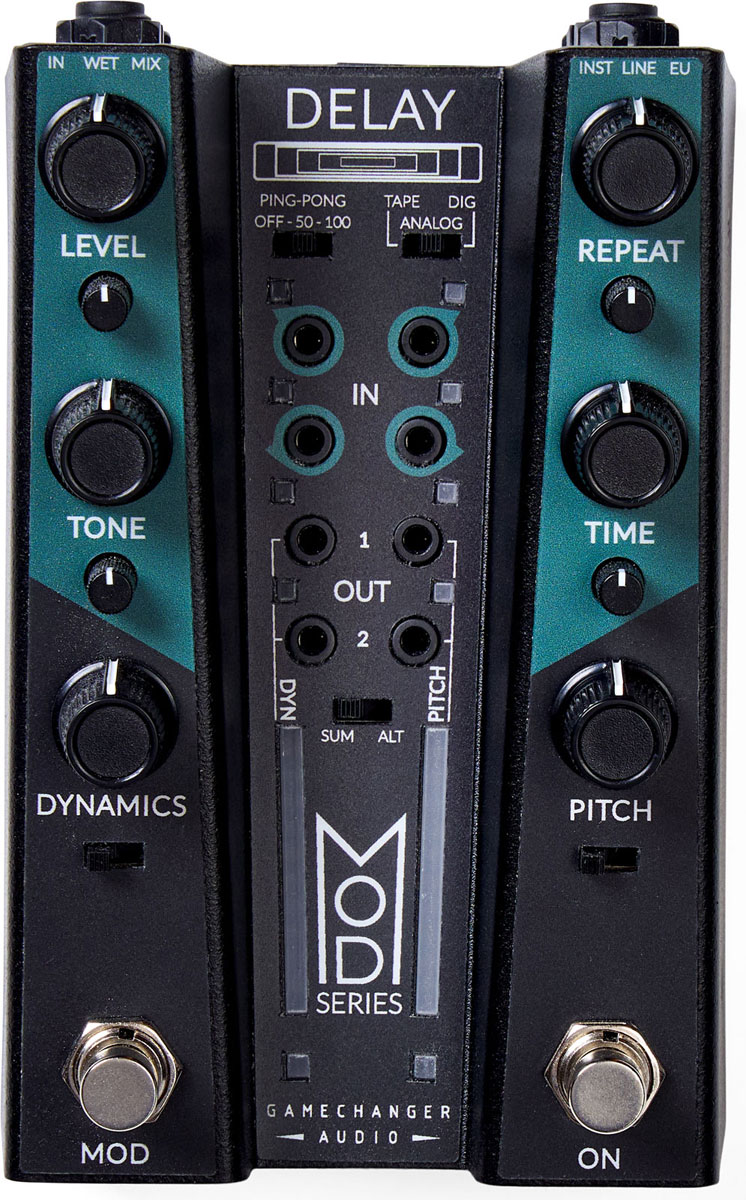


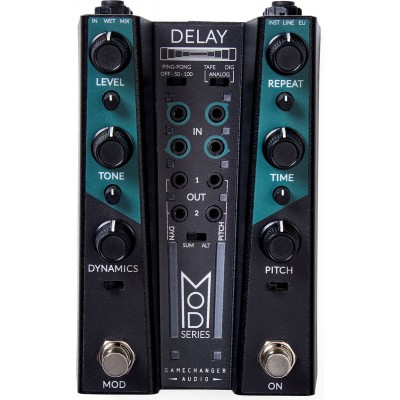
The MOD Delay fits within Gamechanger Audio's approach: transforming a classic effect into a performance tool, responsive to playing and capable of evolving without letting go of the neck. Here, the delay doesn't just add repeats: it becomes a field of expression, where your right-hand nuances and melodic intention can move the timing, amount, color, or intensity of the feedback.
With its three engines Tape, Analog, and Digital, the MOD Delay covers a wide palette of references: warm and rounded echoes with a tape vibe, darker and more compact repeats in an analog style, up to a clean and articulated digital delay. All this with a modern architecture that favors immediacy on the front panel and depth through modulation.
The MOD Delay is aimed at guitarists, bassists, and sound creators who want an expressive delay, equally comfortable on a traditional pedalboard as in a studio or hybrid setup. Thanks to the switchable input level (Instrument, Line, Eurorack), it can be placed after a guitar, behind a preamp, on an effects bus, or at the heart of a modular system.
In playing, it excels both for rock and blues (slapback, thickening, solos), as well as for ambient, post-rock, and electronic (evolving textures, stereo ping-pong, controlled feedback). Live, clock sync and tap tempo secure tempos, while Dynamics/Pitch modulation allows "musical" variations without a dedicated expression pedal.
The front panel goes straight to the point with Level, Time, Feedback, and Tone, but each control can become a modulation destination. You have 2 playable sources: Dynamics analyzes the intensity and volumes of your playing, while Pitch tracks notes, bends, and vibratos. The idea is simple: you play, the pedal reacts, and the delay transforms organically.
For fine-tuning, the MOD Delay offers modulation customization parameters: adjust the release time of Dynamics for faster or more gradual ducking, introduce a glissando on Pitch for smooth transitions, and adapt the response curves to your touch. Each large potentiometer is accompanied by a dedicated attenuverter to precisely dose the amount of modulation and its direction (increasing or decreasing the parameter depending on playing), independently for Level, Time, Feedback, and Tone.
The pedal goes further with threshold and center note functions: you can play a note to set it as the center note by holding both footswitches, so that Pitch modulation only activates above (or according to the setting) this pitch. Meanwhile, Dynamics offers an adjustable volume threshold: modulation only intervenes above a given intensity, ideal for achieving an "intelligent" delay that backs off when you play loud and opens up when you let the notes breathe.
Regarding tempo, the Tap Tempo is accessible via a long press on the ON footswitch, and synchronization can be done via MIDI clock or analog clock. Finally, the MOD Delay includes a three-position Ping Pong panorama (0 percent, 50 percent, 100 percent) to widen the stereo image and create more or less pronounced left/right bounces.
The MOD Delay stands out with an immediately musical character, with three well-defined personalities. The Tape mode emphasizes roundness, a slight softness in attacks, and repeats that stack naturally. The Analog mode offers darker and more compact echoes, perfect for thickening without crowding the mix. The Digital mode provides a crisper definition, ideal for rhythmic parts, clean stereo delays, and precise repeats.
The great strength of this pedal is its dynamics: it responds finely to playing, and its Dynamics/Pitch modulation allows lively effects (ducking, time following the melody, feedback that "breathes") without falling into gimmickry. Whether you're looking for a subtle studio delay or controlled self-oscillating textures, the MOD Delay maintains an instrument-like feel rather than a simple processor.