30-day satisfaction guarantee or your money back
Call us : +33 257 880 074
 en
en 









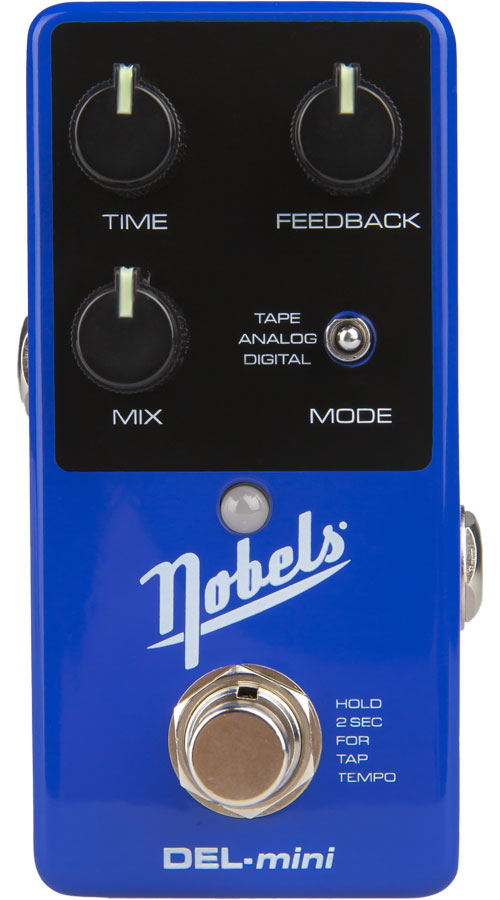


With the DEL-mini, Nobels condenses the spirit of echoes that have shaped decades of productions: the organic and slightly "alive" feel of a tape echo, the warm darkened tone of an analog delay, and the clean, defined precision of a digital delay. The idea is not to overwhelm the user with menus but to offer immediately musical sounds that are easy to dial in, all within a minimal footprint.
This "essentials without compromise" approach is also reflected in its place within the Nobels lineup: a compact, robust pedal focused on performance, prioritizing playability and stage efficiency (visibility of controls, pedalboard mounting, bypass choice), while maintaining a genuine sonic ambition.
The Nobels DEL-mini targets guitarists (and musicians more broadly) who want to add a compact stereo delay to their rig without sacrificing space. It suits all levels from beginner to advanced: the controls remain familiar and "plug and play," but the three modes cover a wide range, from slapback to long delays for ambient layers.
In blues and rock, the Analog mode offers smoother repeats that sit behind the playing. In pop and indie, the Digital mode helps lock in tight rhythmic patterns. In ambient or post-rock, the Tape mode with its more textured repeats adds depth, especially in stereo. In the studio, it serves both to thicken a take and to create quickly adjustable depth; live, its stereo and tap tempo make it very practical when the set changes tempo from one song to another.
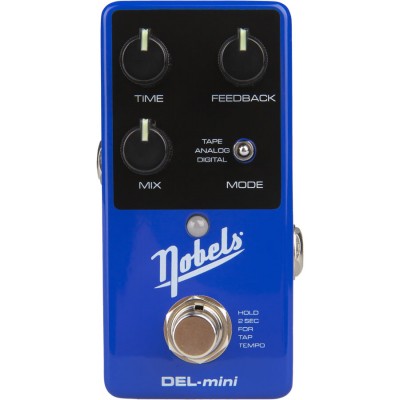
The DEL-mini adopts a straightforward ergonomics: three potentiometers to shape the essentials of a delay. Time controls the delay duration, Feedback the amount of repeats, and Mix the effect level relative to the dry signal. A mode selector allows instant switching between Tape, Analog, and Digital depending on the desired texture.
Tap Tempo is integrated despite the single footswitch design: a long press (about 2 seconds) activates Tap mode, then simply tap the tempo with your foot. This is especially useful on a mini pedalboard, where every centimeter counts, without giving up on "by ear" adjustment in real situations.
For integration, the pedal offers dedicated selectors to choose mono or stereo operation via TRS, and a bypass choice between true bypass or buffered with trails (repeats naturally continue after bypass). Phosphorescent markers facilitate adjustments on stage, and integrated Mounty-P mounting plates secure installation on the pedalboard.
The Nobels DEL-mini offers a deliberately "classic" but highly usable palette. The Tape mode provides rounder, slightly moving repeats, ideal for thickening a lead or adding vintage depth. The Analog mode favors a darker decay that blends with the signal without highlighting it, perfect for blues-rock rhythms and solos. The Digital mode aims for cleaner, more articulated repeats, useful for precise lines and longer delays (up to 1000 ms).
The dynamics remain musical: the pedal responds well to attack variations, and the Mix control allows going from a subtle "space" to a more present delay. In stereo, the image gains width and a sense of depth, very effective in a two-amp setup or a stereo chain to a console/interface.
Note: documented artist use for this specific model is still limited, which is common for a recent pedal; nevertheless, it is designed as a reliable working tool, meant to integrate quickly into any rig.