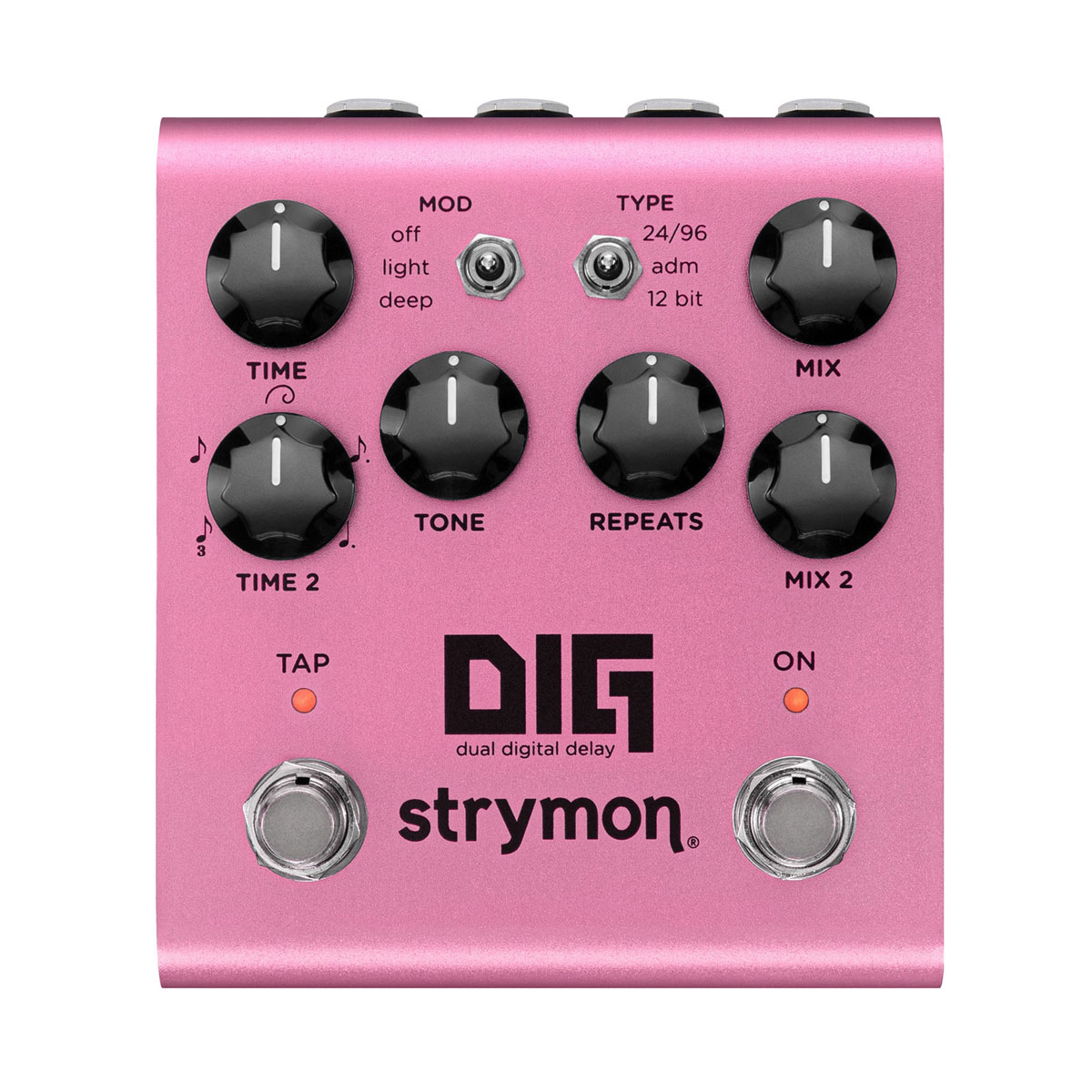
The Essentials to Know About the Strymon "DIG" Pedal
- Stereo double delay inspired by the great digital racks of the 1980s, with three distinct "voicings" (ADM, 12-bit, modern 24/96).
- Total control: five rhythmic subdivisions, three routings (series, parallel, ping-pong), and dedicated Tap Tempo.
- Advanced integration: full MIDI via TRS/USB-C, 300 presets, and MIDI clock synchronization.
- Studio quality: Class A JFET input, 24-bit/96 kHz converters, 32-bit processing, and selectable true or buffered bypass.
From 80's rack to modern pedalboard: the DNA of double delay
The DIG captures the spirit of early rack digital delays, known for their clarity and musicality, while adding the flexibility of a pedal format. The three voicings cover the adaptive delta modulation of the early 80s, the 12-bit grain of the mid-decade, and a modern high-resolution playback. The result: repetitions with exemplary precision or deliberately textured, according to your needs.
For whom and for which styles?
Ideal for guitarists, keyboardists, and producers seeking synchronized and creative echoes. The DIG excels in pop, indie, post-rock, ambient, worship, funk, or classic rock. Its stereo and presets make it a perfect ally for live performance, while its transparency and tempo stability are appreciated in the studio and on demanding pedalboards.
Controls and connectivity designed for the stage
Each delay has its own time and level, with an intelligent Tone control that combines high-cut (left) and low-cut (right), flat at noon. Five subdivisions and three routings allow synchronized patterns, enveloping ping-pong textures, or dense parallel layers. Stereo input/output, Tap Tempo, and expression/MIDI compatibility ensure smooth integration into any modern setup.
The sound
The DIG offers clear, articulated, and dynamic repeats, capable of remaining crystalline in a mix or blending into silky trails close to reverb. The 12-bit voicing brings slight granulation and musical compression, while the modern mode maintains hi-fi definition. The JFET response preserves attack and nuance of playing, from shimmering arpeggios to expansive pads.
Technical Specifications
Audio processing and architecture
- Class A JFET analog front end, ultra low noise
- 24-bit, 96 kHz A/D and D/A converters
- 520 MHz superscalar ARM processor
- 32-bit floating point processing
- Frequency response: 20 Hz - 20 kHz
- Audio input impedance: 1 M Ohm
- Audio output impedance: 100 Ohm
Modes, voicings, and routings
- Three delay voicings: ADM (early 80's), 12-bit PCM (mid-80's), modern 24/96
- Five rhythmic subdivisions
- Three routings: series, parallel, ping-pong
- Foot Tap Tempo
Inputs, outputs, and switches
- High-impedance JFET stereo TRS input
- Independent low-impedance stereo TS outputs
- Input for expression pedal TRS, MiniSwitch, MultiSwitch Plus, or TRS MIDI
- USB-C port for MIDI control and firmware updates
- Dedicated footswitches: On/Off and Tap Tempo
MIDI and presets
- Full MIDI implementation via TRS EXP/MIDI or USB-C
- Delay times synchronized to MIDI clock
- 300 MIDI preset slots
Bypass and dynamics
- Relay true bypass (default) or high-quality buffered bypass
- Discrete Class A high-impedance JFET preamplifier
Levels and stereo
- Selectable mono or stereo input via rear switch
- Line level mode offering approximately +10 dB headroom
- Stereo processing and output
Dimensions and build
- Rose-colored aluminum chassis, sturdy and lightweight
- Dimensions: 11.4 cm D x 10.2 cm W x 4.4 cm H (4.5" x 4" x 1.75")
- Designed and manufactured in the USA
Included accessories
- 9V DC power supply included
- Original documentation
Power consumption
- Required power: 9 V DC center negative
- Consumption: minimum 300 mA
 en
en