Essential Information About the Strymon Lex Pedal
- Complete rotary speaker simulation (bass rotor + treble horn) with modeled tube preamp and adjustable mic placement.
- Next-generation version: Class A JFET input, powerful ARM DSP, full stereo, USB-C, and TRS MIDI.
- Instant controls for speed, acceleration, dry level, and mic distance/position to sculpt the perfect "swirl."
- 300 presets via MIDI, selectable bypass (true or buffered), and line-level mode for keyboards, synths, and effects loops.
From Vintage Leslie to Modern Pedalboard
Born from a love for legendary rotary speakers, the Strymon Lex recreates the mechanical behavior of the bass rotor and treble horn, as well as the slight saturation of the internal preamp. It condenses the soul of a Leslie stack into a compact format designed for modern rigs, while adding the precision and reliability of high-end digital processing.
Who Is It For, and For What?
Guitarists, keyboardists, bassists, or producers seeking organic textures will find immediate inspiration in the Lex. From warm blues to psychedelic rock, neo-soul to post-rock and cinematic atmospheres, it shines both in the studio and on stage. The stereo widens the space, while MIDI synchronization facilitates integration into a modern pedalboard or DAW setup.
Realistic Controls, Modernized
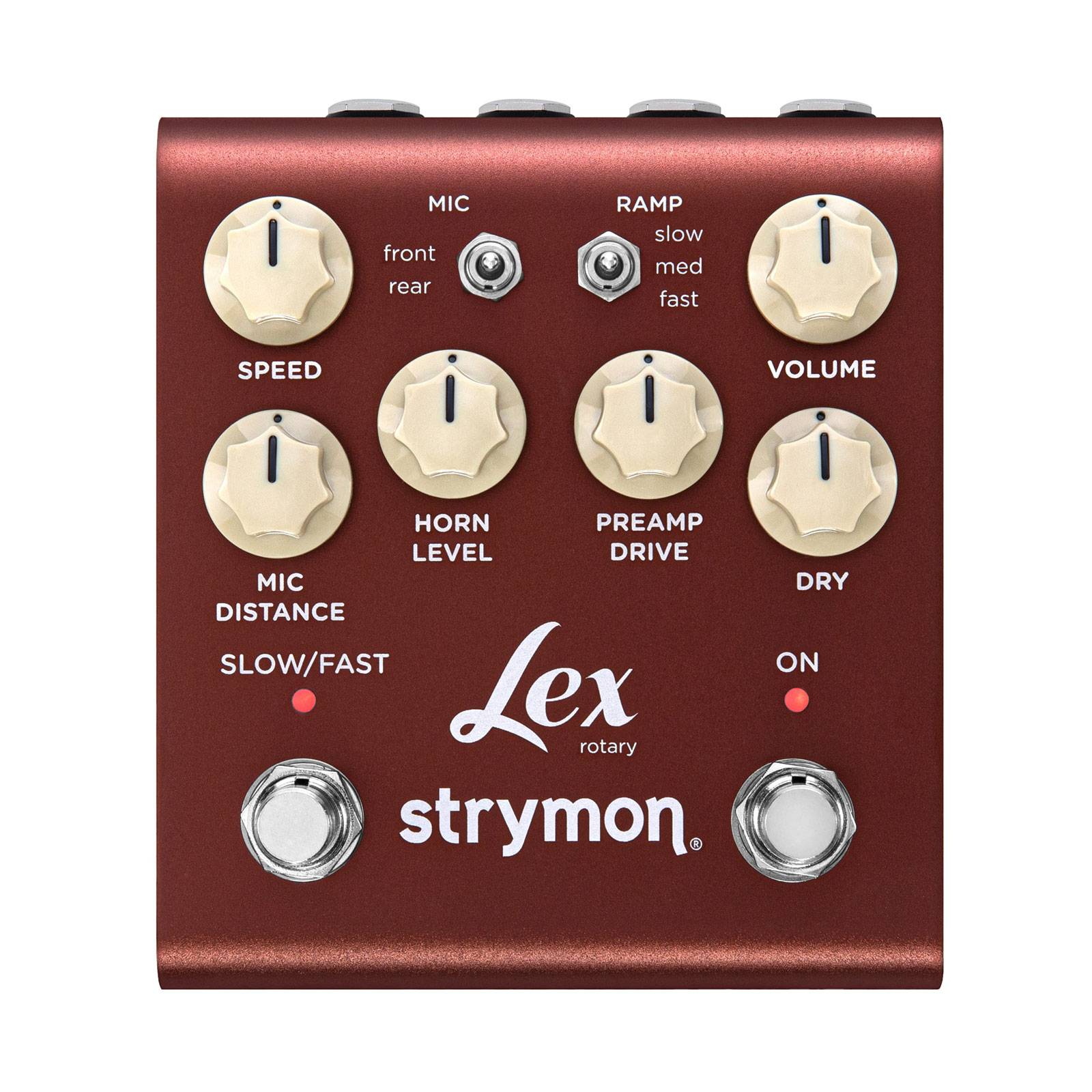
The Lex offers direct access to key rotary speaker parameters: slow/fast speed, acceleration time, "Preamp Drive" for texture, "Horn Level" for treble/bass balance, plus mic distance/position to adjust proximity and width. Advanced functions allow setting the dry level, applying a slight global boost/cut, saving your favorite speeds, and controlling every parameter via MIDI (TRS or USB-C). Stereo input/output, instrument/line mode, and selectable bypass ensure uncompromising integration.
The Sound
Expressive and three-dimensional, the Lex ranges from subtle shimmer reminiscent of chorus/vibrato to a wide, enveloping swirl, with realistic acceleration and a sense of moving air. The modeled preamp adds that typical harmonic halo, responsive to touch and volume nuances. In stereo, the soundstage opens widely; in mono, the output remains dense, musical, and precise, without dulling the attack or compressing dynamics.
Technical Specifications
Audio and Processing
- Class A JFET analog input, high impedance, ultra-low noise.
- 24-bit / 96 kHz converters, 32-bit floating-point internal processing.
- 520 MHz superscalar ARM DSP.
- Frequency response: 20 Hz - 20 kHz.
- Input impedance: 1 M Ohm; output impedance: 100 Ohm.
Controls and Features
- Slow/fast speed with adjustable acceleration ramp.
- Dedicated parameters: Preamp Drive, Horn Level, Mic Distance/Position, Dry level, and Global volume.
- 300 preset slots via MIDI, MIDI clock synchronization.
- Selectable bypass: relay true bypass or high-quality buffered bypass.
- Instrument or line level mode (+10 dB additional headroom).
Connectivity and Control
- Stereo input on TRS jack (mono/stereo selector on the back).
- Two independent stereo outputs on TS jacks.
- EXP/MIDI port for TRS expression pedal, MiniSwitch, MultiSwitch Plus, or TRS MIDI.
- USB-C port for MIDI control and firmware updates.
- Two dedicated footswitches: On/Off and Slow/Fast.
Included Accessories
- 9 V DC power supply included.
- Original box and documentation.
Power Consumption
- Required power supply: 9 V DC, center negative.
- Recommended minimum current: 300 mA.
Chassis, Dimensions, and Manufacturing
- Brown anodized aluminum chassis, robust and lightweight.
- Dimensions: 11.4 cm (D) x 10.2 cm (W) x 4.4 cm (H) - 4.5" x 4" x 1.75".
- Designed and manufactured in the United States.
 en
en