30-day satisfaction guarantee or your money back
Call us : +33 257 880 074
 en
en 









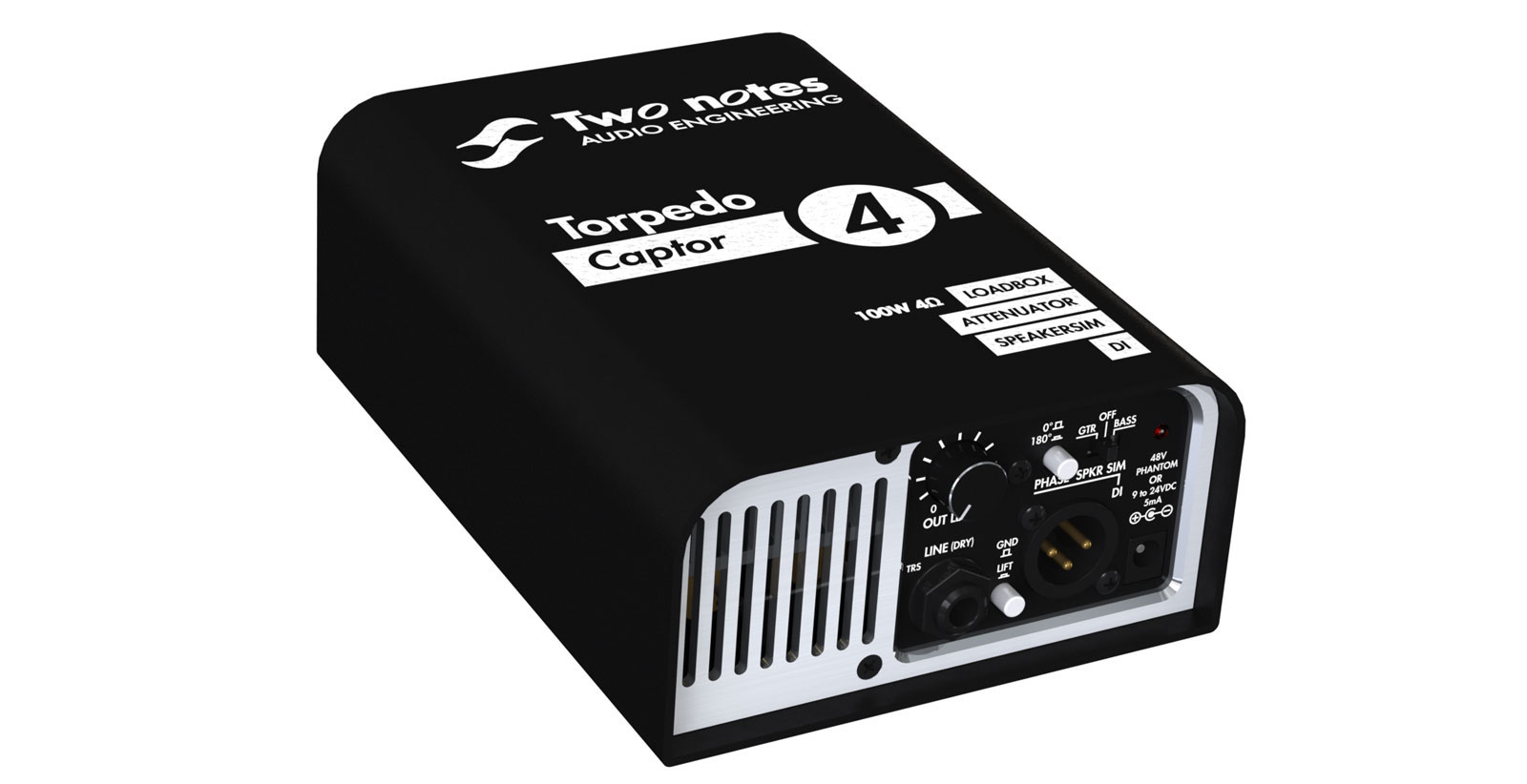


In the Two Notes universe, the Torpedo series is designed to solve a very real problem: enjoying the tone and dynamics of a cranked amp without relying on deafening volume or tricky mic placement. The Torpedo Captor 4 goes straight to the point with a "plug and play" approach: a reliable reactive load, immediately usable attenuation, and outputs ready for both stage and studio. It sits between the amp's speaker output and the cabinet and quickly becomes a staple on a studio pedalboard or in a compact rack.
This Captor is perfect if you play through a head amp and want to keep the "full amp" feel at volumes compatible with home, control rooms, small stages, or booths. In rock, blues, metal, country, or jazz, it allows you to capture a solid and reproducible foundation, then fine-tune during mixing without depending on the room or a microphone. Live, you gain consistency (identical sound from one gig to another) and reduced bulk : less weight, less stage volume, and a simpler front-of-house setup.
You can also use it in silent mode (without a cabinet) to record through headphones via your audio interface and cabinet simulation software, while retaining the playing feel and response of your amp.
The Torpedo Captor 4 is designed for speed: you plug the amp's speaker output into the Captor's input, then choose your output method. The speaker output offers a THRU (full volume to the cabinet) or ATT (cabinet at -20 dB ) option to keep air and dynamics on stage while controlling volume. On the direct side, the XLR DI output provides a musical analog emulation with switchable guitar or bass modes depending on your instrument. You also have a line output with adjustable level and a built-in phase inverter, very useful to avoid phase issues in multi-source setups (DI plus mic, stage monitors, reamping, etc.).
The strength of a reactive loadbox is preserving the amp's feel: more natural attack, more coherent low-mids, and dynamics that truly respond to pick attack and guitar volume. The Captor 4 respects the "punch" of the power stage, and the attenuation preserves the compression and harmonics typical of a pushed amp. The DI provides an immediately usable foundation, while the Captor combined with cabinet simulation (via software) delivers a sound closer to a mic'd recording, with great consistency from session to session.
Note: for optimal results, always respect the impedance : this 4-ohm version is intended for amp outputs set to 4 ohms, to preserve sound quality and electronic safety.

 Certified