30-day satisfaction guarantee or your money back
Call us : +33 257 880 074
 en
en 









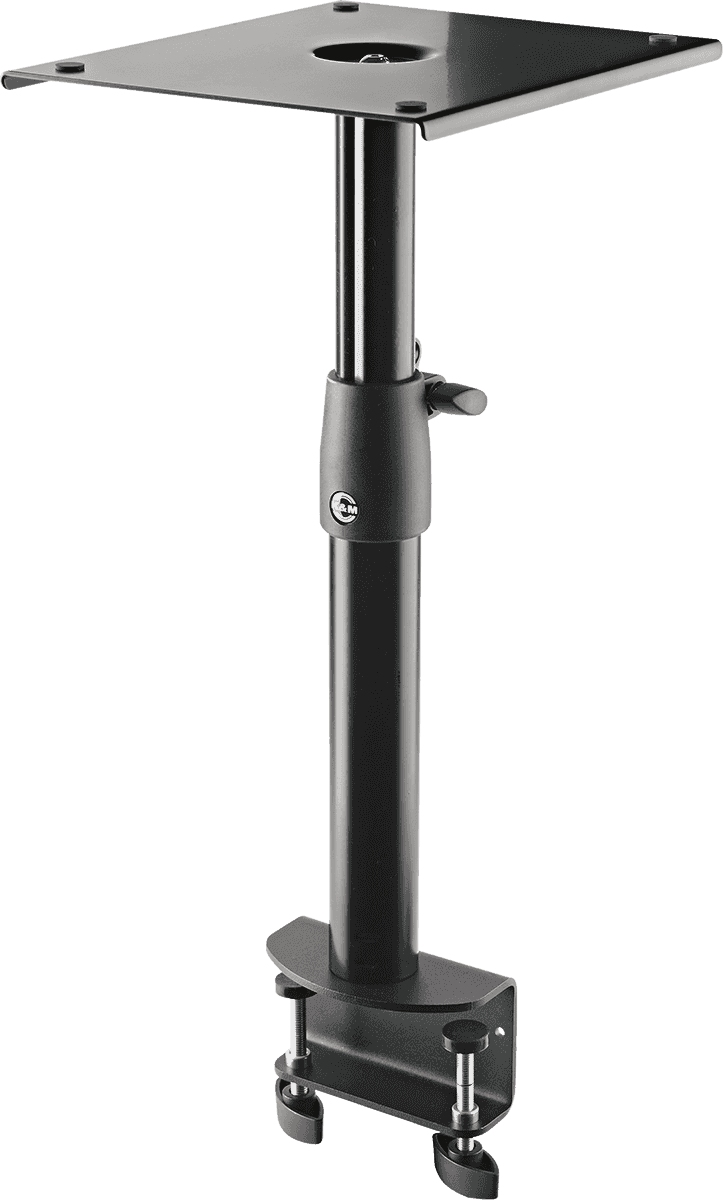


With the widespread use of desk setups (DAW, editing, streaming, mixing), the clamp monitor stand has become a simple solution to position monitoring speakers at the right height without adding multiple floor stands. This model focuses on a "studio-friendly" approach: a small footprint on the desk, a wide plate to accommodate various nearfield monitor sizes, and quick adjustment to adapt your setup to your posture, screen height, and room acoustics.
This stand is intended for musicians, beatmakers, sound engineers, and content creators who want to improve the positioning of their nearfield monitors on a desk. It is also suitable for spaces where every centimeter counts: small home studios, editing stations, classrooms, mobile studios, or multi-screen setups. Thanks to its desk clamp, it securely attaches to most tabletops and frees up the central area for the master keyboard, control surface, or audio interface.
Beyond speakers, the large support plate can hold other equipment of similar size, as long as the weight stays within the specified limit and the load is properly centered. The rubber pads contribute to a secure base while limiting vibrations that can color the sound and cause desk resonance.
The stepped height adjustment makes it easier to approach the recommended listening position by bringing the tweeters closer to ear level. In practice, better height reduces unnecessary mixing compensations (too much bass or treble corrected "blindly") and improves stereo imaging consistency, especially during long desk sessions.
The continuously rotatable support plate allows precise alignment of the monitors toward the listening point without moving the entire stand. This is particularly useful when the desk is not perfectly symmetrical or when you need to work around a screen, microphone arm, or desktop rack.
The 4 supplied rubber supports improve grip and help limit mechanical vibration transmission to the platform. The result: fewer unwanted hums, less furniture resonance, and a cleaner listening experience, especially at moderate to high volumes. Combined with the rigidity of the steel structure and the large plate, this setup provides a stable base for nearfield monitors of various sizes.