30-day satisfaction guarantee or your money back
Call us : +33 257 880 074
 en
en 









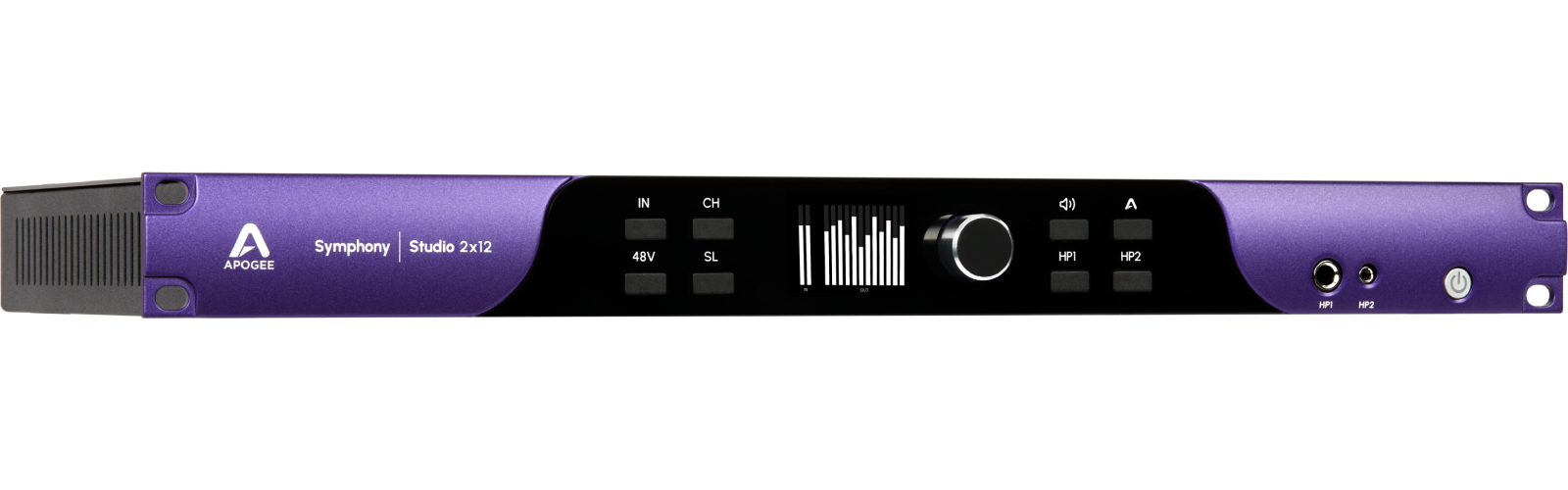


With the Symphony Studio 2x12, Apogee brings its historic expertise in conversion and studio integration into a decidedly contemporary approach: USB-C connectivity, production- and mixing-oriented workflow, and DSP tools directly at the core of the interface. Within the lineup, this model stands out for a particularly relevant balance between recording (2 mic/line inputs) and advanced monitoring control (12 line outputs), making it a solid foundation for both a production studio and a compact control room dedicated to immersive mixing.
This audio interface is aimed at producers, mixers, and composers who want reliable listening and precise control of their monitoring environment without multiplying external boxes. It is perfectly suited for studios that alternate between stereo, surround, and Atmos 7.1.4, while maintaining an efficient recording chain for one or two sources (vocals, guitar, synth, overdubs). The two independent headphone outputs are also very useful for booth recordings or working with two people, offering stable listening and controlled levels.
Each input features a DSP channel strip processing, ideal for securing a take and improving headphone comfort. You benefit from a high-pass filter to clean up low end, a 3-band EQ to quickly shape the source, and a compressor to smooth dynamics. The advantage is twofold: saving time in the production flow and preserving a "console" feel during recordings, all while keeping latency under control thanks to onboard processing.
The Symphony Studio 2x12 goes beyond just "outputting sound": it helps ensure your mixes translate reliably. The DSP speaker calibration includes equalization, delay (time alignment), and bass management, valuable features whenever working with multi-speaker setups, subwoofers, or in rooms requiring some correction. The result: more coherent monitoring, clearer imaging, and faster mixing decisions.
Direct monitoring facilitates recording work, and the two independent headphone outputs allow for two different listening mixes (artist / engineer, or two musicians). The headphone outputs are designed with zero Ohm output impedance for stable reproduction, good bass control, and better compatibility with a wide range of headphones. On the line outputs side, the +4 dBu / -10 dBV switching simplifies integration with professional monitor speakers, amplifiers, or more semi-pro oriented gear.
Finally, the Control 2 software fits into a studio logic: it allows saving up to 8 different monitor configurations. Convenient for switching from stereo to Atmos listening, changing speaker sets, or recalling setups according to projects without reconfiguring all routing each session.