30-day satisfaction guarantee or your money back
Call us : +33 257 880 074
 en
en 









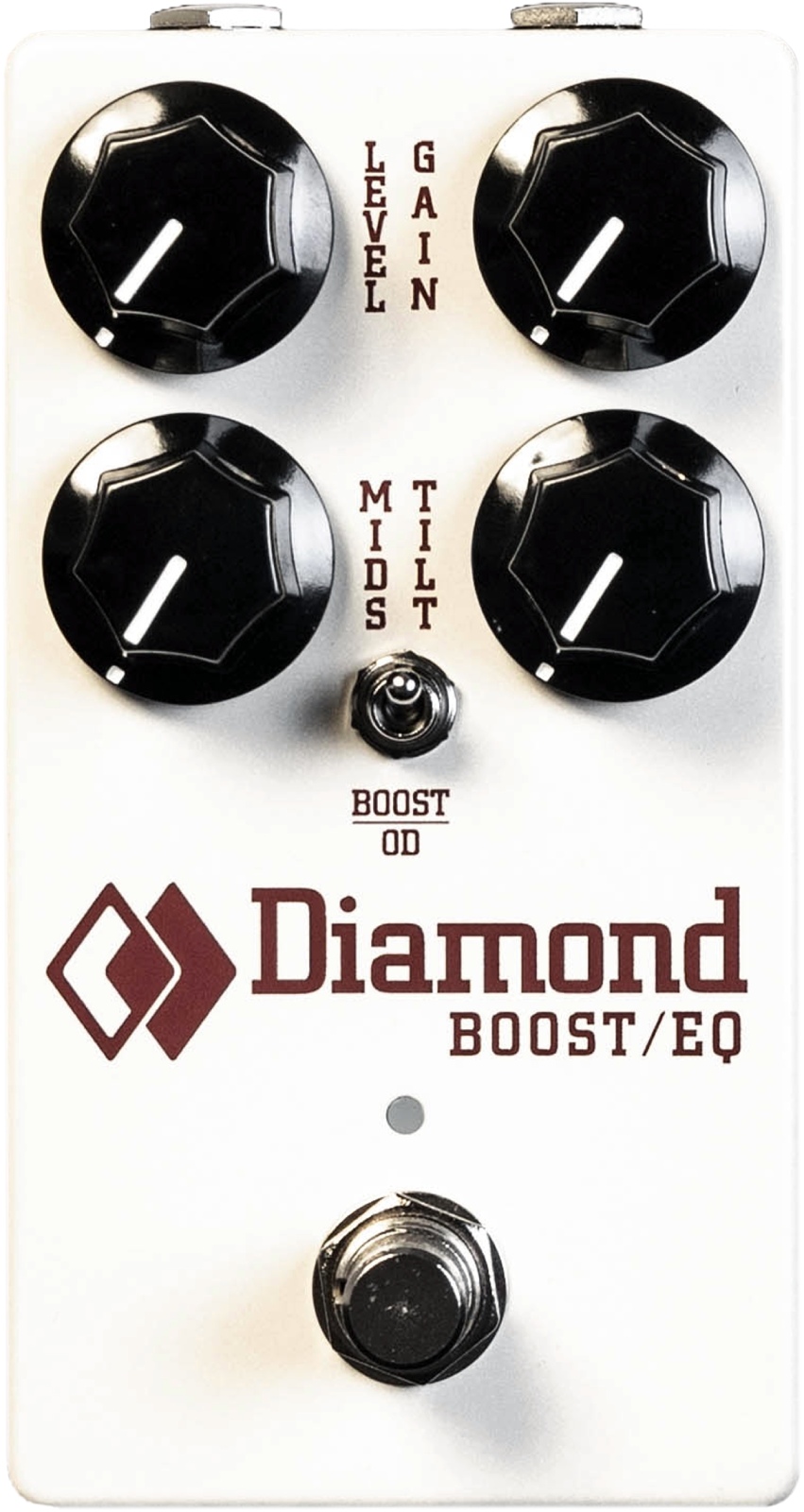


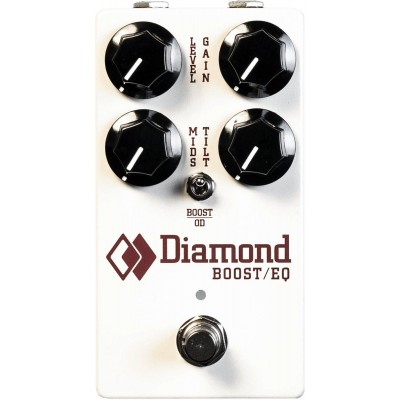
The Diamond Boost/EQ is rooted in the brand's DNA: a "hi-fi" approach to the guitar signal, with a great sense of dynamics and punch. Originally, the concept came from a very simple request: to recapture the spirit of the famous Diamond circuit, but without compression, while retaining the Tilt EQ. Nearly two decades after the first version, Diamond reinvents the format on the same platform as the Comp/EQ, with a gain stage that is clean, generous, and very usable on any pedalboard.
This pedal is aimed at guitarists (and bassists depending on configuration) who want to gain presence without losing their instrument's identity. In Boost mode, it is perfect for blues, rock, pop, funk, or country musicians seeking a reliable clean boost to thicken a clean tone, highlight an arpeggio passage, or give a "shoulder push" to a crunch amp.
In OD mode, the Boost/EQ becomes a low to moderate gain overdrive, ideal for punchy rhythms, singing leads, and "edge of breakup" tones. It also excels as a pre-saturation pedal in front of a fuzz or more pronounced overdrive, to refine the low end and better anchor the midrange in the mix. Live, it's a formidable ally to maintain a consistent and clear level, even when drums and bass fill the space.
The heart of the Diamond Boost/EQ is its ability to switch from a clean boost to a smooth overdrive without changing its philosophy: staying musical, precise, and easy to dial in. The Boost/OD selector changes the gain structure: in Boost position, the pedal acts as a clean boost capable of significantly raising the output level, perfect for pushing a preamp, another saturation pedal, or simply to lift a passage.
In OD position, soft clipping diodes come into play: the result is a transparent, smooth grain with harmonics naturally sitting on the attack. The outcome depends greatly on placement in the signal chain: placed before a saturation, the Boost/EQ adds more gain and sustain; placed at the end of the chain or in a series effects loop, it serves more as a clean volume boost, without upsetting the overall balance.
Regarding EQ, Diamond relies on two very effective controls. The Tilt EQ acts as a "bass/treble" switch around a pivot frequency, allowing you to warm up a too-bright tone or, conversely, open up a dark amp in a snap. The Mid control offers direct access to the core of the spectrum: perfect for making a guitar stand out in a dense mix, taming a mid hump depending on the amp, or adjusting the bite of a bridge pickup.
The Boost/EQ stands out with a feeling of clarity and responsiveness: fingerpicking, pick nuances, and guitar volume remain clear. In Boost mode, you get a stronger, "bigger" signal with headroom that helps push a tube amp toward natural crunch without excessive compression. In OD mode, the grain remains transparent and musical: the attack keeps its edge, chords retain definition, and leads gain density without falling into heavy distortion.
The Tilt EQ and Mid control greatly contribute to the character: you can go from a rounder, vintage sound (tilt toward bass, controlled mids) to a more modern, incisive presence (tilt toward treble, mids emphasized). This is typically the kind of pedal that allows you to "tune" a guitar to an amp, compensate for a room acoustic, or quickly adapt a pedalboard to a second guitar.