30-day satisfaction guarantee or your money back
Call us : +33 257 880 074
 en
en 









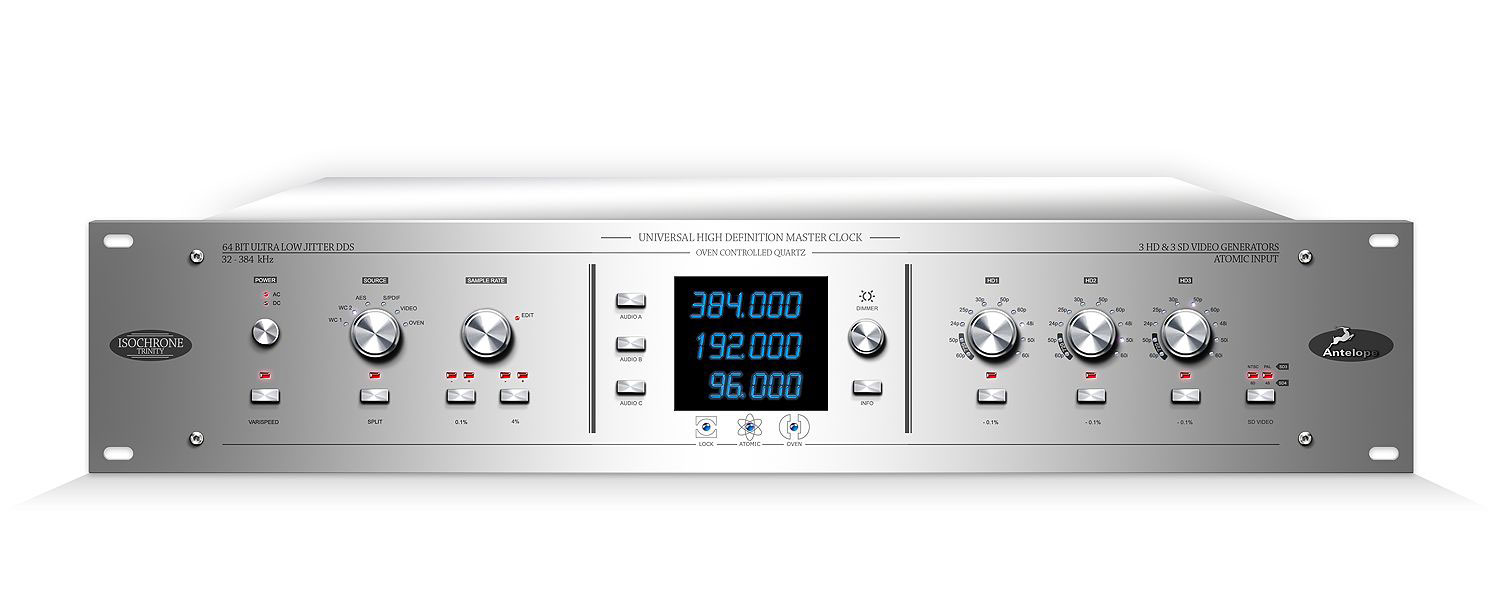


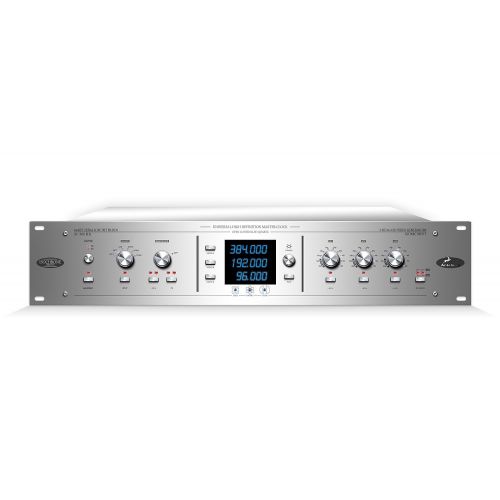
Balancing the demands of high-resolution audio and video constraints (SD, HD, frame rates, conversions), the Trinity stands as an all-in-one master clock aimed at studios and post-production. Antelope focuses its synchronization approach here: a highly stable clock base, multiple generators, and dedicated functions that avoid compromises when multiple devices need to share a common reference.
Its positioning is clear: to offer a central solution capable of evolving with formats and handling hybrid audio/video configurations. The integration of the 4th generation AFC with 64-bit DSP emphasizes clock precision while maintaining control designed for daily efficiency.
The Trinity targets recording studios, mixing rooms, post-production facilities, and control rooms that need to synchronize multiple converters, interfaces, recorders, routers, and video systems. Where simple word clock distribution is no longer sufficient, its nine independent generators provide valuable flexibility: you can feed multiple synchronization "worlds" in parallel without imposing a single format on the entire chain.
It is also suitable for environments requiring quick project changes (different frame rates, broadcast constraints, PAL/NTSC conversions) while maintaining a stable reference. The expected outcome is a more predictable system with better-controlled synchronization and overall smoother operation, even during long sessions.
The Trinity relies on Acoustically Focused Clocking (AFC) 4th generation and a 64-bit DSP to enhance perceived stability and reference accuracy. To minimize jitter, it can utilize a temperature-controlled oscillator or an atomic clock (via dedicated input), depending on the installation's requirements.
Each unit is factory calibrated with a declared precision better than +/- 0.001 PPM, a key factor when multiple systems must remain locked together over time.
The strength of the Trinity lies in its 9 fully independent generators. Specifically, you have three sections dedicated to audio, three to HD, and three to SD, all usable simultaneously. This setup allows distributing different references to multiple equipment groups or maintaining several active standards within the same control room without constant re-cabling.
The varispeed facilitates fine adjustments: the Trinity offers a +/- 200 cent setting to adapt the tempo and meet the needs of certain workflows (post, transfer, compatibility). The triple display enhances readability: you keep clear visual feedback on the generators and sync states, saving time during session changes.
For video chains, the Trinity includes European and American pull-up and pull-down functions, usable in both SD and HD. The SD generators can be used independently or simultaneously in PAL and NTSC, while the HD section offers 16 HD formats available. This enables building coherent synchronization even in multi-standard environments.
The Trinity features a USB connection for firmware updates or external control via PC, convenient for keeping the system up to date and tailored to studio needs. It also offers a redundant dual power supply (230V and 12V) with automatic switching, an important asset for installations that cannot afford interruptions.