30-day satisfaction guarantee or your money back
Call us : +33 257 880 074
 en
en 











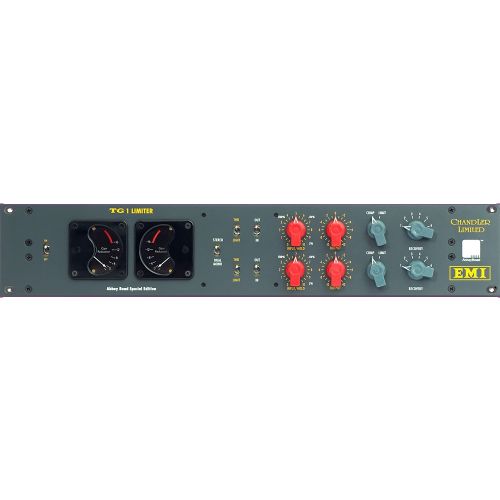
Born in the late 1960s within the EMI studio universe, the TG12413 marked a generation of recordings that became benchmarks. The TG1 follows this lineage by capturing the spirit of the limiter that equipped consoles used in mixing and mastering, notably at Abbey Road. Originally designed to approach the aesthetic of a Fairchild 660/670 highly appreciated by EMI engineers (including Geoff Emerick), the circuit ultimately established its own personality: sharper attack, incredibly flattering mids, and resolutely "record ready."
This reissue is reconstructed from period information and circuit drawings provided by Abbey Road and EMI, with a deliberate intent to stay as close as possible to the historical specifications. It also stands out by having official authorization to bear the EMI and Abbey Road logos on the unit, reinforcing its positioning as an authentic replica rather than a modern interpretation.
The TG1 targets producers, mix engineers, and mastering studios seeking a characterful compressor/limiter rather than an invisible tool. If your priority is absolute transparency, this is not the most neutral machine: its value lies elsewhere, in its ability to thicken, densify, and instantly provide an "analog finishing" feel.
It excels on buses (drums, mix bus, instruments), sources that demand weight (bass, guitars, piano), and vocals that benefit from being brought forward without becoming harsh. In mastering, it is especially appreciated when you want control and presence with a deliberate color rather than surgical compression.
At the heart of the TG1, the limiting element relies on a diode network, a much less common approach than VCA or opto designs. The result is compression that remains surprisingly smooth to the ear while generating flattering harmonic distortion when pushed. This behavior is precisely what gives the TG1 its "big," warm, and lively character, often compared in intent to a Fairchild 670 but with its own unique and immediately recognizable signature.
A now essential new feature: all TG1 units are delivered standard with the THD function. It allows you to bypass the threshold so no compression occurs, while letting the signal pass through the entire electronics. You then get a true harmonic distortion generator, capable of "boosting" up to 2% THD (a value stated to exceed what typical analog tape imparts).
The implementation is simple and very creative: adjust the input level to control the amount of THD, switch from "limit" to "THD" mode, then compensate with the output level. For further exploration, a routing trick is to run one channel in "limit" mode, then re-inject it into the other channel in "THD" mode to stack control and texture, achieving an impressive sense of "size" without losing impact.
The transformer-balanced inputs and outputs greatly contribute to the sensation of openness and warmth. This design enhances low-end solidity, adds body to the mids, and provides a very "console-like" coherence when stacking multiple processes, making it a natural choice for a hybrid mixing chain or an analog studio front-end.